


AI-Assisted Coding Tools for Inclusive Classrooms in 2026
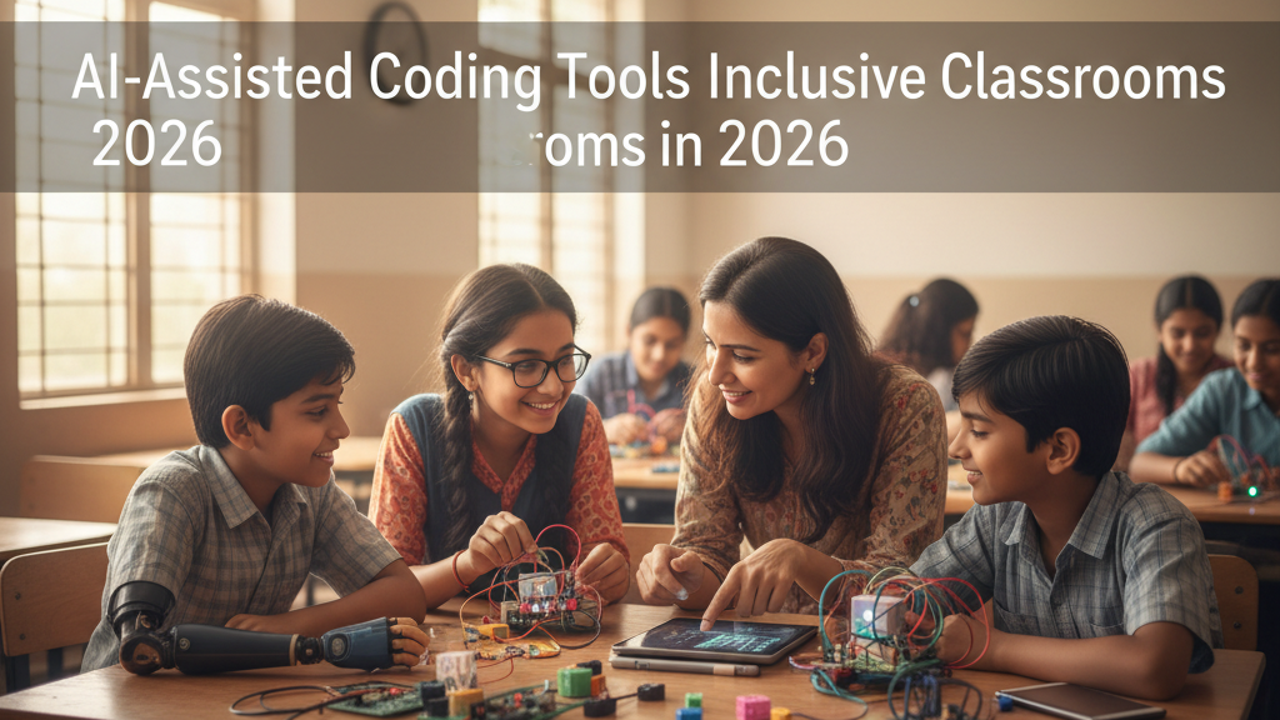
Every classroom in India holds learners at different paces, abilities, and access levels — yet most coding tools are designed for the average, connected, computer-equipped student. In 2026, with CBSE mandating 100 hours of Computational Thinking and AI for Classes 6–8, the pressure on schools to deliver inclusive, accessible coding education has never been greater. AI-assisted coding tools built for inclusive classrooms are no longer a future aspiration — they are a present necessity, and the right solution fits in a single box.
Why Inclusive Classrooms Need AI-Assisted Coding Tools Now
NEP 2020 placed computational thinking at the heart of school education from Class 6 onwards. Now, CBSE's 2026-27 mandate for 100 hours of Computational Thinking and AI annually for Classes 6–8 has made delivery urgent — not optional. Yet India's infrastructure reality makes this mandate deeply challenging. According to UDISE+ 2023-24 data, only 57% of India's schools have working computers and only 54% have internet connectivity. That means nearly half of all schools — serving millions of children — simply cannot access device-dependent coding programmes. Layer in the inclusion dimension and the gap widens further. Students with disabilities, students in low-resource settings, and learners who fall outside the pace of a standard classroom are routinely excluded from conventional coding curricula. Truly addressing this mandate requires AI-assisted coding tools that are accessible, self-paced, and not dependent on a tech-trained teacher to be present at every session.
What Makes a Coding Tool Truly 'Inclusive'?
In the EdTech context, inclusion is not simply about adding accessibility features as an afterthought. It means a tool works for students with varying abilities and learning needs, functions without a computer lab or internet connection for core activities, and does not require teacher availability at every moment for a learner to progress. Self-paced, AI-guided learning is central to this definition. When an AI chatbot mentor can answer queries in real time, provide hints, offer debugging support, and adapt its guidance to each learner's level, the dependence on a specialist IT teacher — or even a teacher at all — reduces significantly. Compare that with the conventional lab-based coding model: fixed schedules, one-size-fits-all instruction, and a single teacher managing 40 to 80 students. In that environment, slow learners fall behind, students with disabilities are frequently excluded, and schools in underserved geographies are left out entirely. Truly inclusive coding education demands a fundamentally different approach.
Introducing ProGame SmarToy: AI-Assisted Coding in One Self-Learning Box
ProGame SmarToy (Skills-in-a-Box) by Next Skills 360 is an all-in-one self-learning package designed precisely for the inclusive, self-paced context. Inside the box: the physical ProGame coding kit — built around patented cardboard command blocks that make coding tangible and hands-on — the AI Module covering data, patterns, face recognition, image recognition, and object detection, the Life Skills 360 component addressing 50+ social-emotional learning themes, and ProGame hAI, an AI-powered chatbot coding mentor. An important clarification on device use: the physical coding activities require no computer lab, no IT teacher, and no per-child device. The AI Module, Life Skills 360, and AI Chatbot are delivered through the ProGame Android app on a shared or personal device. This combination makes ProGame SmarToy genuinely portable and deployable — equally suited to a school library, a home learning environment, or a self-paced classroom corner — without the bottlenecks of lab scheduling or device procurement.
How the AI Chatbot Mentor Supports Every Kind of Learner
At the heart of the ProGame SmarToy experience is ProGame hAI — an AI-powered chatbot coding mentor that transforms how learners engage with coding concepts independently. It provides step-by-step guidance, answers real-time queries, offers targeted hints, supports debugging, and personalises its responses to each individual learner's level and pace. For inclusive classrooms, this is genuinely transformative. A student with a learning difference no longer has to wait for teacher attention in a class of 40. A child studying at home progresses through coding and AI concepts with structured AI support. A self-paced learner using the school library box works independently — building confidence and competence without needing a tech-trained teacher in the room. This approach reflects Next Skills 360's track record of impact at scale: 240,000+ students impacted across India since 2020, deployed in 1,200+ schools across 15 Indian states, with 10,000+ trainers and educators trained — demonstrating that this model works in real, diverse, resource-constrained school environments.
ProGame SmarToy in the School Library and Home Learning Context
For school librarians and principals, ProGame SmarToy opens a practical new model: library-based deployment. Students check out or use the SmarToy box independently, with no lab scheduling conflicts, no IT staff requirements, and no server infrastructure to procure or maintain. The ProGame Kit can be deployed to 10,000+ schools simultaneously with no server, lab, or device procurement bottleneck — and any classroom teacher can facilitate sessions after a one-day orientation, regardless of prior technical background. For parents supporting home-based skill development, ProGame SmarToy is a structured, curriculum-aligned, AI-assisted learning tool that builds coding, AI literacy, and life skills in one package — without the need for a computer lab for core activities. The kit carries genuine institutional credibility: it is backed by a Harvard Business Publishing case study ('Teaching Coding Without Computers', case W37092) and 14 international and national recognitions, including MIT Solver and the AI for Humanity Prize from the McGovern Foundation — making it a purposeful, future-skills investment families and schools can trust.
Choosing the Right AI-Assisted Coding Tool for Your School in 2026
When evaluating AI-assisted coding tools for inclusive classrooms, school decision-makers would do well to ask five practical questions: Does it function without a computer lab for core activities? Is it self-paced and AI-guided so learners are not blocked by teacher availability? Does it cover both coding and AI literacy in a single package? Is it curriculum-aligned with NEP 2020 and CBSE mandates? And critically — can it genuinely serve students with disabilities? ProGame SmarToy meets all five criteria. For schools seeking to extend inclusive skilling further, Next Skills 360's broader portfolio goes even deeper: ProGame Tactile supports students with visual impairments through an audio-first, screen-reader-friendly programme, while ProGame Signify teaches coding and STEM to students with speech and hearing impairments using Indian Sign Language throughout. Together, these solutions represent a comprehensive, India-built approach to inclusive STEM education. Explore the full portfolio and request a demo at nextskills360.in.
Ready to bring AI-assisted, inclusive coding to your school, library, or home? Explore the ProGame SmarToy (Skills-in-a-Box) at nextskills360.in and request a demo or free sample today.
Ready to bring AI-assisted, inclusive coding to your school, library, or home? Explore the ProGame SmarToy (Skills-in-a-Box) at nextskills360.in and request a demo or free sample today.