


AI-Integrated Coding Labs for Government Schools India 2026
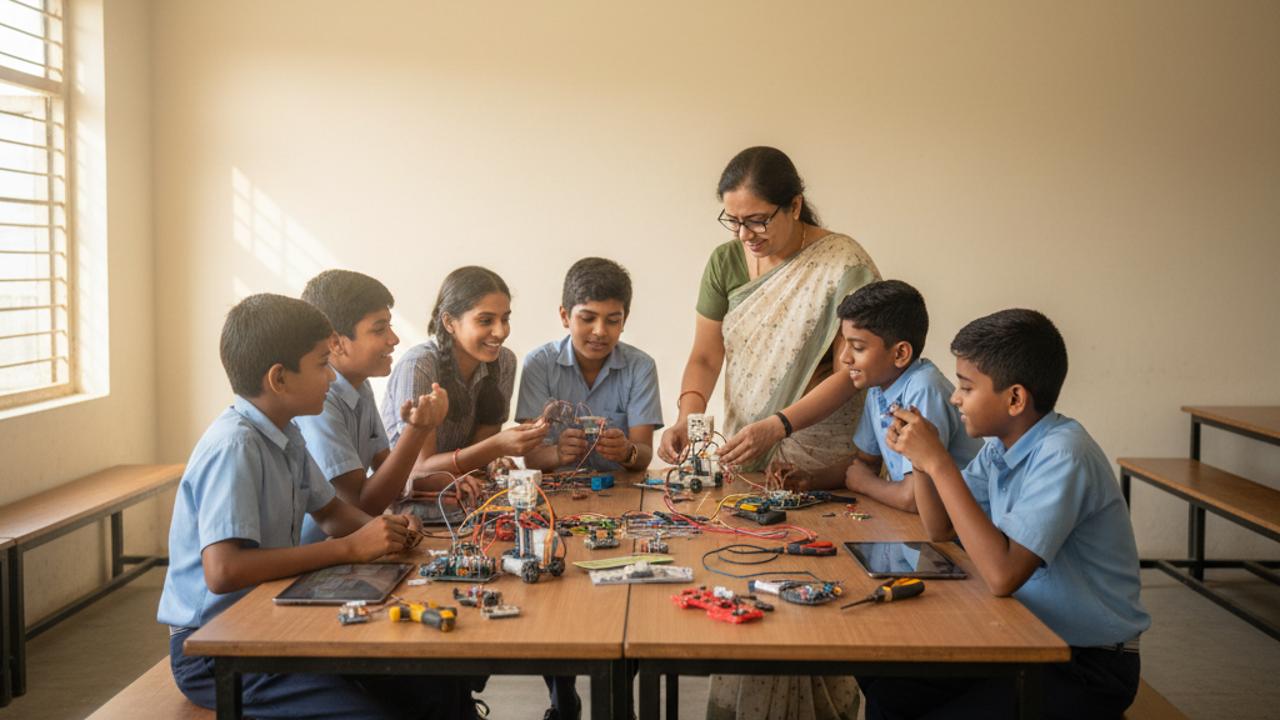
India has 14.7 lakh schools and 24.8 crore students, yet only 54% of schools have reliable internet connectivity — making most device-dependent coding platforms a non-starter for government institutions. As CBSE mandates 100 hours per year of Computational Thinking and AI for Classes 6–8 from academic year 2026-27, the pressure on district education departments to activate functional, AI-integrated coding labs has never been greater. The question is no longer whether government schools need coding infrastructure — it is how to build it practically, affordably, and at scale.
Why Government Schools Can't Wait on Coding and AI Education
The policy direction has been clear since NEP 2020 first mandated computational thinking and coding from Class 6 onwards. What has sharpened dramatically is the timeline. With CBSE's 100-hour annual Computational Thinking and AI requirement for Classes 6–8 taking effect from academic year 2026-27, state and district education departments are now operating under a firm compliance deadline — not a distant aspiration. The scale of the challenge reflects the scale of India's ambition. Serving 14.7 lakh schools and 24.8 crore students (UDISE+ 2024-25) means coding education cannot remain a privilege of well-resourced urban institutions. District-level procurement committees, state education technology cells, and school chain leadership are all facing the same urgent question: which coding infrastructure can actually be activated across hundreds — or thousands — of government schools before the 2026-27 academic year begins? The window for planning, procurement, and deployment is narrowing fast.
The Infrastructure Reality: Why Most Coding Platforms Fall Short
Before selecting any coding platform, decision-makers must confront an uncomfortable data point: according to UDISE+ 2023-24, only 57% of India's schools have working computers, and only 54% have internet connectivity. That means nearly half of all government schools cannot reliably run cloud-first or always-online coding programmes — regardless of how well-designed those platforms are. Most commercially available coding platforms are built for connected, device-rich environments. They assume stable broadband, dedicated computer labs, and ideally an IT-trained facilitator. In practice, government school settings frequently involve shared devices, intermittent power supply, limited bandwidth, and teachers who are generalists rather than technology specialists. Deploying a platform that requires server procurement, per-device licensing tied to online authentication, or a permanent internet connection creates an immediate bottleneck at scale. What government school coding infrastructure actually demands is a solution engineered for low-resource realities — one that functions fully offline, runs on existing Windows hardware, and does not collapse the moment connectivity drops.
What an AI-Integrated Coding Lab Actually Needs to Do
Defining the right solution starts with defining the right requirements. For a government school coding lab serving Classes 6–8 under the CBSE 2026-27 mandate, the functional checklist is non-negotiable: - Curriculum alignment with CBSE Computational Thinking and AI learning objectives - Age-appropriate engagement for K-8 learners who are encountering coding for the first time - Teacher-friendliness that does not assume a computer science background - Offline capability that ensures uninterrupted learning regardless of connectivity - Built-in AI mentoring that reduces instructional dependency on the classroom teacher That last requirement is particularly significant at scale. When a single teacher manages 40 or more students across varied learning levels, an AI coding mentor that provides real-time guidance, hints, and debugging support is not a premium feature — it is a practical necessity for functional classroom delivery. A platform meeting all five requirements can be deployed confidently; one that misses even one creates operational risk for district programmes.
How Skills Buddy Activates AI-Integrated Coding Labs Without Barriers
Skills Buddy, NS360's gamified coding and AI platform for K-8, is purpose-built to meet every requirement outlined above. Available on both web and Windows, it features Scratch-style drag-and-drop programming that makes coding accessible to first-time learners — and to teachers who are not coding specialists. Critically, Skills Buddy is fully functional offline, eliminating internet dependency as a deployment barrier for government schools. At the heart of the platform is an in-built AI Chatbot coding mentor that gives students step-by-step guidance, real-time answers, hints, and debugging support — individually, at scale. The gamified design sustains student engagement and enables self-paced progress, taking considerable instructional pressure off classroom teachers. Behind Skills Buddy is a team with proven ground-level experience. Next Skills 360 (NS360), founded in 2020 and headquartered in Hyderabad, has been deployed in 1,200+ schools across 15 Indian states and has impacted 240,000+ students since inception. That is not a pilot — it is a deployment track record built for the realities of Indian government school contexts.
Scaling Across Districts: Lessons from NS360's Deployment Track Record
For district education officials evaluating whether a vendor can truly deliver at scale, track record matters as much as product features. NS360's numbers speak directly to implementation capacity: 1,200+ schools across 15 states, 240,000+ students impacted, and 10,000+ trainers and educators trained across India since 2020. That last figure is especially relevant for government procurement. Large-scale coding lab activation lives or dies on teacher readiness. NS360's investment in educator training means Skills Buddy deployments come with structured onboarding support — not a manual and a helpline. Government-linked stakeholders will also find NS360's partnerships with Infosys Foundation and Bharat Electronics Limited (BEL) on skilling projects reassuring, alongside recognition from institutions with direct government relevance: the SKOCH Award for the Telangana Early Coders (TeC) Project and the ElevatED Award from Dell Technologies India and MeitY. These recognitions reflect a consistent ability to deliver coding and AI education programmes within government school ecosystems — at meaningful scale.
Getting Started: From Lab Activation to Student Impact in 2026
The practical activation path for a government school adopting Skills Buddy is deliberately straightforward. No server procurement is required. The Windows-compatible platform runs on existing computer lab hardware, and offline mode means schools do not need to upgrade their connectivity infrastructure before going live. Teacher onboarding is supported by NS360 directly, so even educators without prior coding experience can confidently facilitate Skills Buddy sessions. The gamified, AI-mentored design means that once students are seated and logged in, the platform carries a significant share of the instructional workload. For state and district education departments planning for the 2026-27 CBSE Computational Thinking and AI mandate, the strategic advantage of early adoption is clear: schools that activate coding labs in 2026 enter the new academic year with trained teachers, engaged students, and a functioning programme — rather than scrambling to achieve compliance after the mandate is already in force. The time to act is now, not after the deadline arrives.
Ready to activate AI-integrated coding labs across your government schools before the 2026-27 CBSE mandate kicks in? Request a free Skills Buddy demo for your district or school chain at nextskills360.in and see how offline-ready, gamified coding education can reach every student — with or without internet.
Ready to activate AI-integrated coding labs across your government schools before the 2026-27 CBSE mandate kicks in? Request a free Skills Buddy demo for your district or school chain at nextskills360.in and see how offline-ready, gamified coding education can reach every student — with or without internet.