


CBSE Revised Curriculum 2026: Python for Students with Visual Impairments
Quick answer
CBSE's April 2026 circular (Acad-15/2026) makes Computational Thinking and AI compulsory from Classes 3 to 10 from the 2026-27 session. For students with visual impairments in Classes 8 and above, ProGame Tactile Pro offers a three-level, audio-first Python programme aligned to this vocational and career-readiness direction.
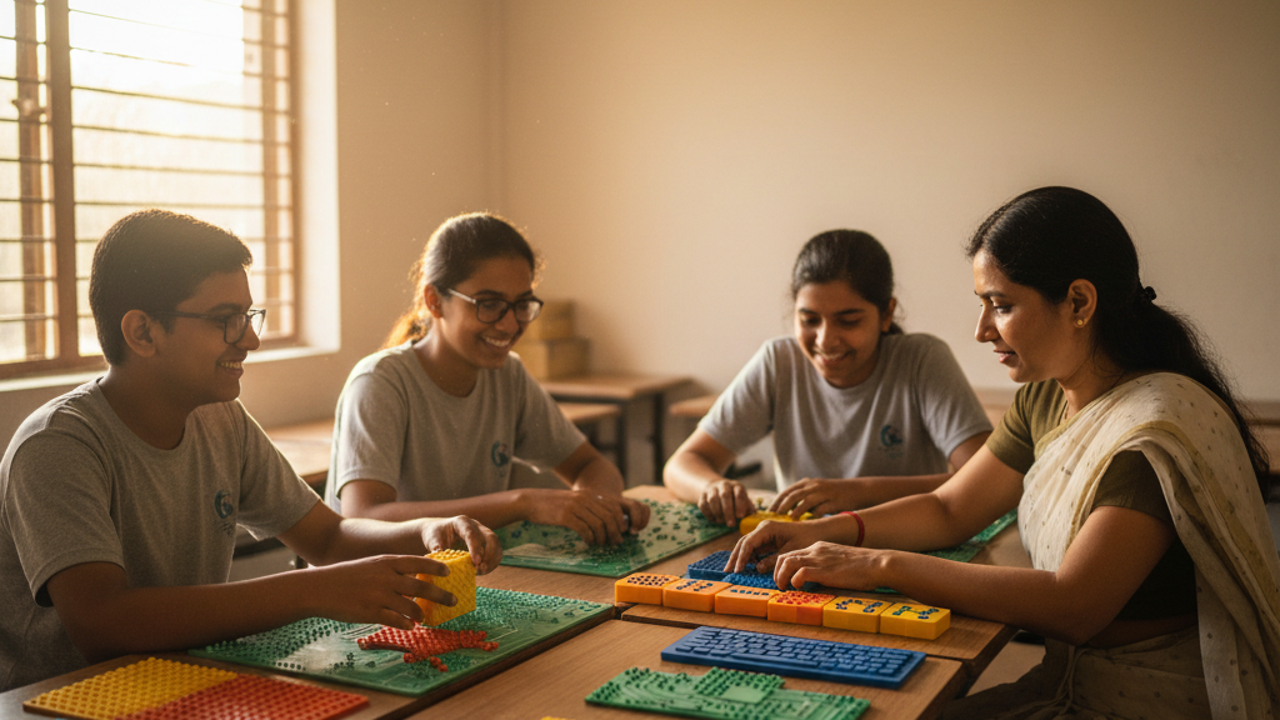
CBSE 2026 Makes Coding Compulsory — Here's the Accessible Pathway for Students with Visual Impairments
CBSE's April 2026 circular (Acad-15/2026) makes Computational Thinking and AI compulsory from Classes 3 to 10 from the 2026-27 session. For students with visual impairments in Classes 8 and above, ProGame Tactile Pro offers a three-level, audio-first Python programme aligned to this vocational and career-readiness direction.
When CBSE released its revised curriculum in April 2026, it sent one clear signal to every school in India: Computational Thinking and AI are no longer optional. But for the thousands of students with visual impairments enrolled in special schools and vocational training centres, the bigger question is not whether this change happened — it is whether an accessible, career-ready pathway now exists to meet it. That pathway is closer than most coordinators realise.
What CBSE's April 2026 Curriculum Revision Actually Changed
CBSE Circular Acad-15/2026, dated 1 April 2026, formally brings a Computational Thinking and Artificial Intelligence curriculum to Classes 3 to 10 across all CBSE-affiliated schools, with CT and AI now compulsory in Classes 9 and 10 from the 2026-27 session. This follows earlier NCF-aligned changes that had already begun reshaping curriculum scope for Classes 3 and 6. The revision is not a distant policy horizon — the 2026-27 session begins imminently, and schools are expected to demonstrate delivery now.
For most mainstream schools, the curriculum shift is a logistical challenge. For special schools serving students with visual impairments, and for the National Career Service Centres for Differently Abled and NSDC-affiliated vocational training programmes, it is something more pressing: a formal, time-bound mandate that arrives without a corresponding accessible tool already in most classrooms. Coordinators and principals need solutions that work today, not promises scheduled for a future release cycle.
Why the Revised Curriculum Creates an Urgent Gap for Special Schools
The mainstream coding ecosystem was largely built around visual interfaces — mouse-driven block editors, screen-centric IDEs, GUI-based drag-and-drop platforms. These tools were not designed with learners with visual impairments in mind, and most remain inaccessible to screen-reader users without significant adaptation, if at all.
Special schools for students with visual impairments at the secondary and vocational level, Government Vocational Rehabilitation Centres — now formally designated as National Career Service Centres for Differently Abled under the Directorate General of Employment — and NSDC or State Skill Development Mission programmes all face the same structural challenge: CBSE's 2026 revision creates a compliance need and a career-pathway imperative simultaneously, while the available toolkit has not kept pace.
This is not a problem unique to any one institution. It is a sector-wide gap — well-documented, structural, and now made sharper by the April 2026 circular. The question for every programme coordinator is no longer whether to act, but which pathway is genuinely ready.
ProGame Tactile Pro: Audio-First Python for Career Readiness
ProGame Tactile Pro is our direct response to this gap. Part of Next Skills 360's Inclusive Skilling suite, it is a desktop Python programming programme built from the ground up for students with visual impairments — audio-first and fully compatible with screen readers, with all navigation, coding prompts, and feedback accessible without any reliance on sight.
The programme offers three progressive levels — foundational, advanced, and career-ready — designed for students in Class 8 and above, as well as adults in colleges and vocational training centres. ProGame Tactile Pro has been live with learners since 2025 and is currently used in special schools and NGO training centres in South India. As an early-stage programme, it is building a track record deliberately and carefully. Learners receive a Next Skills 360 certificate at each of the three levels, providing a recognised credential at every stage of the journey.
How Three Progressive Levels Map to CBSE and Vocational Outcomes
ProGame Tactile Pro's three-level architecture is designed to do two things at once: meet the CBSE Computational Thinking and AI requirement at the secondary level, and carry learners meaningfully beyond it toward genuine employability in technology roles.
The foundational level builds core Python literacy — variables, sequences, conditionals, loops — giving students with visual impairments the same conceptual grounding that CBSE's Classes 9 and 10 CT mandate now requires. The advanced level deepens programming fluency. The career-ready level targets practical, job-relevant Python skills that vocational training centres and NSDC skill missions can directly map to employment outcomes.
ProGame Tactile Pro sits at the top of a broader journey. As we describe it, ProGame Tactile is an audio-first skilling super app covering computational thinking, coding, AI literacy, social-emotional skills, financial literacy, and career guidance — with Tactile Pro as the vocational-level destination of that pathway. This makes Tactile Pro a natural adoption for VRCs and State Skill Development Missions, either alongside or following the foundational ProGame Tactile programme.
What Implementation Looks Like for a Special School or VRC
ProGame Tactile Pro is specifically designed for special schools for students with visual impairments, vocational rehabilitation centres, colleges, and skill-training centres preparing learners for technology careers. It works on desktop, is audio-first, and requires no reliance on sight at any stage of the learning journey.
Our broader inclusive skilling programmes for students with visual impairments are built around a structured delivery model: train-the-trainer workshops, a teacher LMS, an analytics dashboard, and ongoing programme support — all evidenced through our ProGame Tactile implementation across schools for the blind in Pune and new projects commencing in Tamil Nadu and Karnataka.
Since 2020, Next Skills 360 has trained 10,000+ educators across India, according to our own records, and has received 14 national and international recognitions — including the MIT Solver award, the AI for Humanity Prize from the McGovern Foundation, and the ElevatED Award from Dell Technologies India and MeitY. That track record matters when a special school or VRC is evaluating whether an implementation partner can deliver at institutional scale.
Next Steps: Aligning Your School or Centre with CBSE 2026 Requirements
CBSE's April 2026 curriculum revision has created both a compliance need and a genuine career-pathway moment for students with visual impairments in India. For the first time, Computational Thinking and AI carry the full weight of mandatory CBSE expectation at the secondary level — and the students most likely to be left behind by a poor implementation choice are those whose access depends entirely on audio-first design.
ProGame Tactile Pro is a structured, certificate-awarding, audio-first Python programme that is available now, already in use in South India, and purpose-built for the institutions this mandate most directly affects: special schools, vocational rehabilitation centres, and NSDC or State Skill Development Mission programmes.
For principals, VRC programme coordinators, and NSDC officers reading this: the pathway exists, and the team at Next Skills 360 is ready to walk through what deployment at your institution would look like. Explore the full ProGame Tactile journey to understand how Tactile Pro fits within a broader, multi-year skilling continuum for students with visual impairments.
Frequently Asked Questions
Is ProGame Tactile Pro aligned to the CBSE 2026 Computational Thinking and AI curriculum?
ProGame Tactile Pro teaches Python programming across three progressive levels — foundational, advanced, and career-ready — designed for Class 8 and above. It directly addresses the Computational Thinking and AI mandate introduced by CBSE Circular Acad-15/2026 for Classes 9 and 10, while extending learning to a genuine vocational and employment-readiness level suited to special schools and National Career Service Centres for Differently Abled.
Does ProGame Tactile Pro require Braille or any specialist hardware?
No. ProGame Tactile Pro does not use Braille. It is an audio-first, screen-reader-compatible desktop Python programme. All navigation, coding prompts, and feedback are delivered through audio, requiring no reliance on sight and no specialist hardware beyond a standard desktop computer with screen-reader software.
Who is the intended learner for ProGame Tactile Pro?
ProGame Tactile Pro is designed for students with visual impairments in Class 8 and above, as well as adults in colleges, vocational training centres, and National Career Service Centres for Differently Abled. It is used in special schools and NGO training centres in South India, and is suited to any institution preparing learners with visual impairments for technology-sector careers.
What certification do learners receive on completing a level?
Learners receive a Next Skills 360 certificate at each of the three levels — foundational, advanced, and career-ready — providing a recognised credential at every stage of the Python learning journey, not just at programme completion.
How does ProGame Tactile Pro connect to the broader ProGame Tactile ecosystem?
ProGame Tactile Pro is the vocational-level top of the ProGame Tactile journey. The broader ProGame Tactile programme is an audio-first super app covering computational thinking, coding, AI literacy, social-emotional skills, financial literacy, and career guidance for students with visual impairments from Class 5. Tactile Pro extends that journey into career-ready Python, making it a natural continuation for learners completing the foundational programme.
Is your school or centre ready to meet CBSE's 2026 Computational Thinking mandate inclusively? Write to the Next Skills 360 team to explore how ProGame Tactile Pro can bring audio-first, career-ready Python programming to your students with visual impairments — and request a demonstration today.
Is your school or centre ready to meet CBSE's 2026 Computational Thinking mandate inclusively? Write to the Next Skills 360 team to explore how ProGame Tactile Pro can bring audio-first, career-ready Python programming to your students with visual impairments — and request a demonstration today.