


Fundraising for Education in India: A 2026 Guide for Schools
Quick answer
Fundraising for education in India is increasingly viable in 2026 because CSR mandates, government schemes such as PM eVIDYA and Samagra Shiksha Abhiyan, and international foundations are all directing money toward the digital skilling gap that CBSE's 100-hour Computational Thinking and AI mandate for Classes 6–8 from 2026-27 has made impossible for school leaders to ignore.
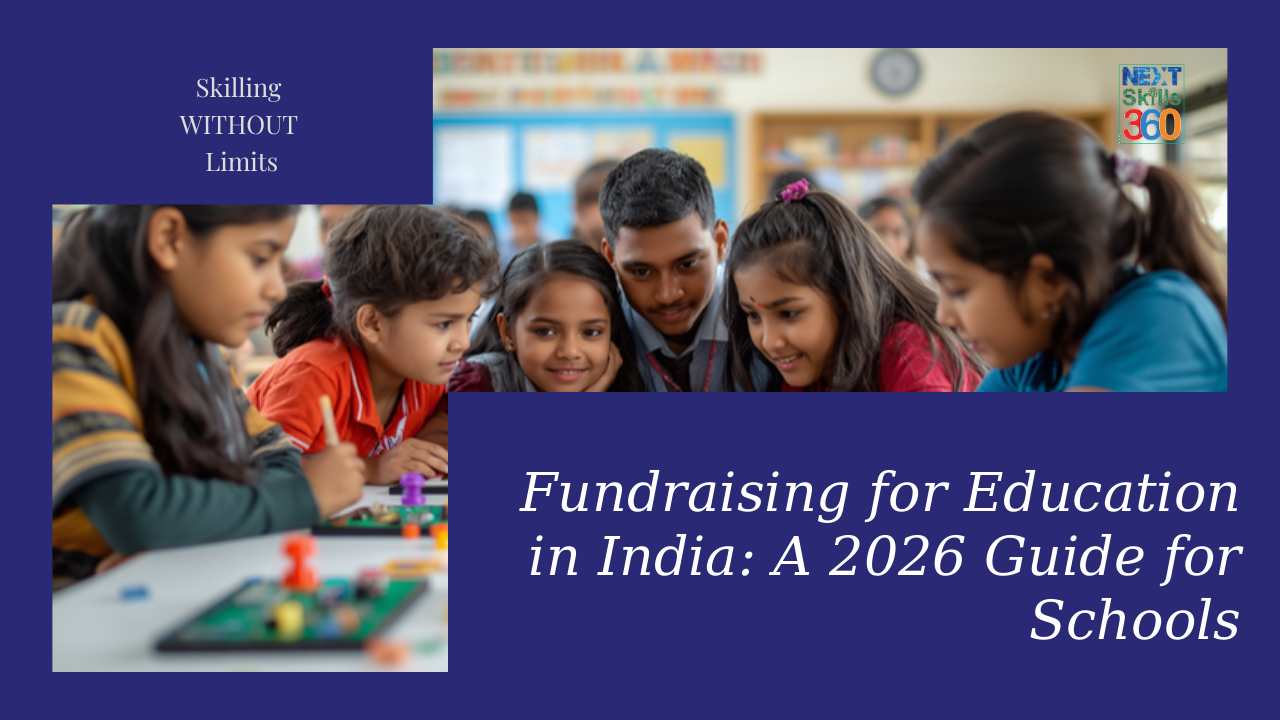
With CBSE mandating 100 hours of Computational Thinking and AI for Classes 6–8 from 2026-27, Indian school leaders are under real pressure to upgrade their digital skilling infrastructure — but budgets rarely move as fast as policy. Fundraising for education in India has never been more urgent, or more possible, with CSR mandates, central government schemes, and international foundations all channelling money toward exactly this gap. This guide breaks down where the money is, how to access it, and how a solution like Skills Buddy can make your funding proposal both credible and compelling.
Why Fundraising for Education in India Is at an Inflection Point in 2026
India's school education system is one of the largest in the world — 14.7 lakh schools serving 24.8 crore students (UDISE+ 2024-25). Yet the infrastructure reality is sobering: only 57% of schools have working computers and just 54% have internet connectivity, meaning nearly half of all schools cannot run device-dependent coding programmes even if the will and the curriculum mandate exist.
This is precisely what makes 2026 a pivotal moment. NEP 2020 established coding and computational thinking as non-negotiable from Class 6 onwards. CBSE's incoming mandate for 100 hours per year of Computational Thinking and AI for Classes 6–8 from 2026-27 transforms that intent into an institutional deadline — one that school leaders simply cannot defer.
For anyone approaching a CSR committee, a government scheme officer, or an international foundation, this convergence of policy pressure and infrastructure gap practically writes the funding argument for you. The need is documented, the mandate is dated, and the urgency is real.
The Main Funding Channels: CSR, Government Schemes, and Global Grants
There are three primary routes available to Indian school leaders seeking CSR funding for schools in India and beyond.
Corporate CSR remains the most accessible channel. Under India's Companies Act, qualifying companies must direct 2% of net profit toward CSR activities — and coding, AI literacy, and STEM skilling sit squarely within approved education and digital literacy themes. IT companies, BFSI institutions, and manufacturing conglomerates are among the most active funders in this space.
Government schemes — including PM eVIDYA, Samagra Shiksha Abhiyan, and various state-level digital mission grants — are specifically designed to close the infrastructure gap. Solutions like Skills Buddy, with its web, Windows, and offline capability, align naturally with procurement norms for government-funded lab activation programmes.
International foundations and global prizes represent a third, often underutilised channel. Next Skills 360's own recognitions — including MIT Solver, the AI for Humanity Prize from the McGovern Foundation, and the Innovation for Women Prize from the Vodafone Americas Foundation — demonstrate clearly that Indian EdTech impact stories attract serious global attention. Schools that co-present proposals with established EdTech partners significantly strengthen their international funding prospects.
How to Build a Fundable Proposal: What Donors Actually Want to See
Regardless of the funding channel, successful proposals for education grants for Indian schools share a common anatomy. Donors — whether corporate CSR heads or foundation programme officers — consistently look for four things: measurable outcomes, curriculum alignment, scalability, and sustainability.
Your proposal checklist should include verified student impact numbers, explicit alignment to NEP 2020 and the CBSE 2026-27 mandate, a clear teacher training plan, and evidence of prior deployment at scale.
This is where partnering with Next Skills 360 gives your bid immediate credibility. NS360 has impacted 240,000+ students across 1,200+ schools in 15 Indian states since 2020 and has trained 10,000+ educators — benchmarks that anchor any co-branded proposal in proven, auditable reality.
NS360 is also formally documented through a Harvard Business Publishing case study (case W37092, "Teaching Coding Without Computers"). Citing a published HBP case in a funding proposal signals institutional rigour and gives evaluators the third-party validation they need to say yes.
Skills Buddy: The Coding Platform That Makes Your Funding Go Further
When it comes to school technology funding in India, funders are increasingly asking not just what will be purchased, but how far each rupee will stretch. Skills Buddy is designed to answer that question convincingly.
Skills Buddy is a gamified skilling platform (web and Windows) for Class 4 and above students, featuring coding, AI, and social-emotional skills modules, online and offline capability, and an in-built AI chatbot coding mentor. From a fundraising perspective, its strengths are tangible:
- Offline functionality makes it deployable in low-connectivity schools — dramatically widening the eligible student population for any CSR or government proposal.
- Direct curriculum alignment to CBSE's 100-hour Computational Thinking mandate means every funded hour maps to a policy deliverable.
- The AI chatbot mentor delivers personalised guidance to each student without requiring a specialist coding teacher — stretching every funded rupee further while ensuring learning outcomes remain strong.
- The gamified format generates engagement data — completion rates, progress milestones, student interaction metrics — that funders can cite confidently in impact assessments and annual reports.
Skills Buddy doesn't just deliver learning. It delivers the evidence of learning that modern funders require.
Partnering With an EdTech Company to Strengthen Your Funding Bid
School-EdTech co-proposals consistently outperform school-only applications, and the reason is straightforward. An established EdTech partner brings implementation credibility, existing impact data, and a validated deployment model that a single school or district simply cannot demonstrate independently.
Partnering with Next Skills 360 gives your proposal access to:
- 14 national and international recognitions, including MIT Solver, the AI for Humanity Prize, and the ElevatED Award from Dell Technologies India and MeitY
- Documented partnerships with Infosys Foundation and Bharat Electronics Limited (BEL) on Skilling WITHOUT Computers projects
- Deployment across 1,200+ schools in 15 states, with a proven train-the-trainer model that has prepared 10,000+ educators
- A DPIIT-recognised startup status and incubation history that includes MIT SOLVE, T-Hub, and AIC-IIITH
NS360 is headquartered in Hyderabad and operates at national scale — making it a credible partner for state education departments, large corporate CSR programmes, and district-level government initiatives alike. For funders evaluating risk, a partner with this track record significantly de-risks approval.
Next Steps: How to Start Your Fundraising Journey for School Coding in 2026
Turning intent into a funded programme requires a clear sequence of actions. Here is where to begin:
Step 1: Audit your current infrastructure. Map your school's lab status and connectivity against UDISE benchmarks to understand which funding windows — urban digital access, rural skilling, inclusive education — you are best positioned to target.
Step 2: Match your demographics to the right funder. A school serving predominantly rural students aligns with different CSR themes than an urban chain pursuing STEM excellence. Precision in targeting matters enormously.
Step 3: Request a Skills Buddy demo and impact data pack from NS360. Concrete platform data and NS360's verified impact metrics — 240,000+ students, 1,200+ schools, 15 states — will anchor your concept note in evidence.
Step 4: Draft a focused two-page concept note aligned to one specific CSR or government scheme deadline in the coming quarter. One strong, targeted application consistently outperforms multiple generic ones.
India's 24.8 crore school students deserve future-ready skills — and the funding infrastructure to make it possible already exists for schools that know where to look. The policy window is open. The funders are ready. The only remaining step is yours.
Ready to make your school's coding programme fundable? Request a free Skills Buddy demo and a customised impact data sheet from Next Skills 360 — visit nextskills360.in or write to us today to build a proposal that donors say yes to.
Ready to make your school's coding programme fundable? Request a free Skills Buddy demo and a customised impact data sheet from Next Skills 360 — visit nextskills360.in or write to us today to build a proposal that donors say yes to.