


Inclusive STEM Access for Students with Disabilities in 2026
Quick answer
Inclusive STEM access for students with disabilities is now achievable across Indian schools through activity-based programmes that require no continuous computer access. Next Skills 360 has impacted 500+ students with disabilities since 2020, offering tools like the ProGame AI Module that cover AI fundamentals from Classes 3 to 10 without device dependency.
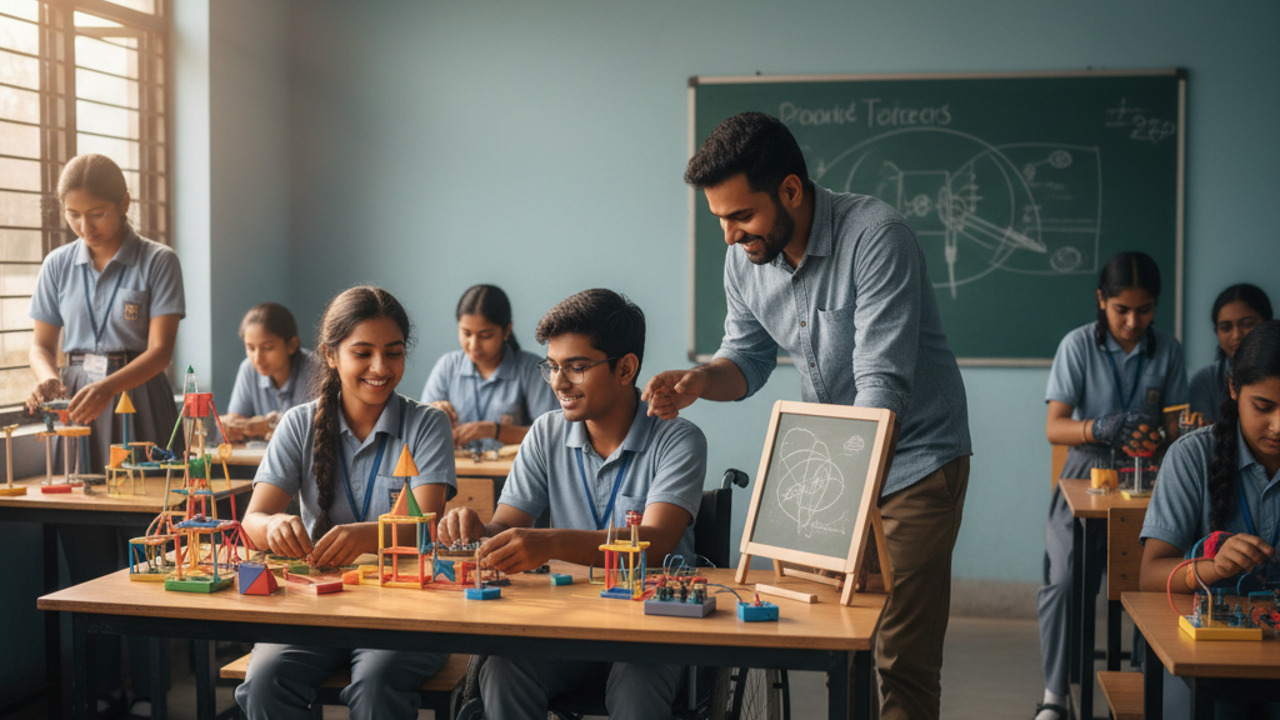
Inclusive STEM access for students with disabilities is now achievable across Indian schools through activity-based programmes that require no continuous computer access. Next Skills 360 has impacted 500+ students with disabilities since 2020, offering tools like the ProGame AI Module that cover AI fundamentals from Classes 3 to 10 without device dependency.
More than half of India's schools still lack reliable computers or internet, yet NEP 2020 demands that every learner — including students with disabilities — gains access to computational thinking and AI skills. The question is no longer whether inclusive STEM education is possible; it is whether schools have the right tools to make it happen today. In 2026, the answer is closer than ever.
Why Inclusive STEM Access Remains a Challenge in Indian Schools
India runs one of the world's largest school education systems — 14.7 lakh schools and 24.8 crore students, according to UDISE+ 2024-25. Yet UDISE+ 2023-24 tells us that only 57% of schools have working computers and only 54% have internet connectivity, which means nearly half of all schools simply cannot run device-dependent coding or AI programmes. That infrastructure gap falls hardest on students with disabilities, who already navigate physical, sensory and attitudinal barriers to classroom participation every single day.
The policy framework is unambiguous. NEP 2020 mandates computational thinking and coding from Class 6 onwards, and CBSE's Computational Thinking and AI curriculum now spans Class 3 to Class 10. Samagra Shiksha — the Government of India's integrated school education scheme — includes a dedicated inclusive-education component covering children with disabilities from pre-primary to Class XII under the Rights of Persons with Disabilities Act, 2016. For school leaders in 2026, the gap between that policy ambition and everyday classroom reality remains the central challenge to solve.
What Inclusive STEM Education Should Look Like in 2026
Genuine inclusive STEM access for students with disabilities means far more than ramp access or modified seating. It requires curricula that function without device dependency, multimodal learning pathways — audio, tactile, visual and gesture-based — alignment to national standards, and real support for teachers who may not be disability specialists.
Too many EdTech programmes are accessible by accident rather than by design: a screen-reader workaround here, a font-size setting there. What schools and district education departments actually need in 2026 are solutions built from the ground up for diverse learners.
At Next Skills 360 EdTech Private Limited, our entire portfolio is organised around exactly this principle. Our mission is to ensure no learner is excluded from future-ready education because of socio-economic background, physical ability or access to technology. Our Inclusive Skilling suite — alongside our broader Skilling WITHOUT Computers and Skilling WITH Computers offerings — reflects that commitment across every product line.
ProGame AI Module: Making AI Fundamentals Accessible Without Devices
The ProGame AI Module is an add-on kit that introduces AI fundamentals through games and analogies, covering data, pattern recognition, face recognition, image recognition, object detection and decision-making — all through activity-based, self-guided experiences. According to our own records, the module requires no device dependency for students; only the teacher's phone is needed in the classroom.
Built for Classes 3 to 10, the ProGame AI Module is mapped to the CBSE Computational Thinking and AI curriculum and delivers 30 to 50 hours of structured activities per year per class. It works equally well in low-resource classrooms and well-equipped school labs, and its activities extend into guided learning at home. Teachers are prepared through a focused two-day training we provide directly.
For students with disabilities, this model is genuinely transformative: by removing the requirement for individual devices, it eliminates the technology barrier that most often shuts these learners out of AI education entirely. Explore how the AI Module fits the 2026 CBSE and NEP 2020 curriculum.
Complementary Inclusive Skilling Solutions from Next Skills 360
The ProGame AI Module sits within a wider inclusive skilling ecosystem. ProGame Tactile is India's first audio-first skilling super app for students with visual impairments — fully screen-reader friendly, with no reliance on sight. It covers computational thinking and coding, AI literacy, social-emotional skills, financial literacy and career guidance across a structured three-year programme, working offline on any Android device for students in Classes 5 and above. It teaches in six languages — Telugu, Hindi, English, Marathi, Kannada and Tamil — and includes a first-of-its-kind accessible code editor.
ProGame Signify, currently in development, is our dedicated solution for students with speech and hearing impairments. It integrates Indian Sign Language throughout to deliver coding, AI and social-emotional learning through visual, gesture-based experiences. Institutions such as the National Institute for the Empowerment of Persons with Visual Disabilities (NIEPVD) in Dehradun — a national institute under the Department of Empowerment of Persons with Disabilities — represent precisely the kind of institutional partners that benefit from programmes designed at this depth.
Recognition and Real-World Impact: Our Track Record
Our impact is grounded in verified numbers. Since 2020, we have reached 500+ students with disabilities and 240,000+ students overall across 1,200+ schools in 15 states, with most learners in government and low-income private schools.
That track record has drawn significant recognition. We have received 14 national and international awards, including selection as an MIT Solver, the AI for Humanity Prize from the McGovern Foundation, the Innovation for Women Prize from the Vodafone Americas Foundation, the ElevatED Award from Dell Technologies India and MeitY, and the Best Indian Social Enterprise Award in Education from the AFI Forum.
Our inclusive skilling programmes have also been covered by The Hindu Business Line, and a business school case study titled "Teaching Coding Without Computers" is published and distributed through Harvard Business Publishing — recognition that our model has earned attention well beyond India's borders.
How School Leaders Can Act Now to Bridge the Inclusive STEM Gap
For principals, STEM and innovation heads, and district NEP 2020 AI cell officers, the first practical step is an honest audit: does your current STEM provision reach every learner — including students with disabilities, students in classrooms without computers and students who learn through non-visual modalities?
The ProGame AI Module can be deployed immediately across Classes 3 to 10 with minimal infrastructure, supported by our two-day train-the-trainer model. It is already active across 15 states — proof that rapid, district-scale rollout is absolutely achievable.
CSR managers should consider inclusive skilling programmes as high-impact, policy-aligned funding opportunities that directly advance NEP 2020's equity mandate. For deeper reference, explore inclusive STEM coding approaches for special education learners and accessible STEM education models for students with disabilities in India.
NEP 2020's vision of equitable, future-ready education cannot be fulfilled through device-dependent, one-size-fits-all tools. 2026 is the year for purposeful, disability-inclusive STEM action.
Frequently Asked Questions
What is inclusive STEM access for students with disabilities?
Inclusive STEM access means designing science, technology, engineering and mathematics education so that students with disabilities — including those with visual impairments, speech and hearing impairments, or other needs — can participate fully, without adaptation being an afterthought. It encompasses multimodal delivery, device-light infrastructure and alignment to national curriculum standards such as NEP 2020 and the CBSE Computational Thinking and AI framework.
How does the ProGame AI Module support students with disabilities?
According to our own records, the ProGame AI Module requires no individual device for students — only the teacher's phone is needed. This device-light design removes the primary infrastructure barrier that often excludes students with disabilities from AI education. Activity-based and self-guided, it covers data, pattern recognition, object detection and decision-making in ways that any learner in Classes 3 to 10 can access regardless of ability or school infrastructure.
What is ProGame Tactile and who is it designed for?
ProGame Tactile is India's first audio-first skilling super app for students with visual impairments. It is fully screen-reader friendly, works offline on any Android device and is designed for students in Classes 5 and above. It covers computational thinking, coding through to career-ready Python, AI literacy, social-emotional skills, financial literacy and career guidance across a structured three-year programme delivered in six languages.
How does NEP 2020 relate to accessible coding education in India?
NEP 2020, approved by the Union Cabinet on 29 July 2020, mandates computational thinking and coding education from Class 6 onwards. CBSE's Computational Thinking and AI curriculum now spans Class 3 to Class 10. Together, these policies require schools to provide AI and coding education to all students — including students with disabilities — making accessible coding education in India a compliance and equity priority for school leaders in 2026.
Can a government school or CSR programme implement the ProGame AI Module at scale?
Yes. The ProGame AI Module is already deployed across 1,200+ schools in 15 states and needs only a teacher's phone, making it scalable without server, lab or per-child device procurement. We prepare teachers through a two-day training, and CSR partners can fund programmes directly for schools that cannot self-fund — making it a practical, high-impact option for both government institutions and corporate social responsibility initiatives.
Ready to bring inclusive STEM access to every learner in your school? Book a free demo of the ProGame AI Module and discover how Next Skills 360 can help your school meet NEP 2020's AI and computational thinking goals — for all students, regardless of ability or infrastructure.
Ready to bring inclusive STEM access to every learner in your school? Book a free demo of the ProGame AI Module and discover how Next Skills 360 can help your school meet NEP 2020's AI and computational thinking goals — for all students, regardless of ability or infrastructure.