


Low-Cost STEM Kits for Government Schools in 2026
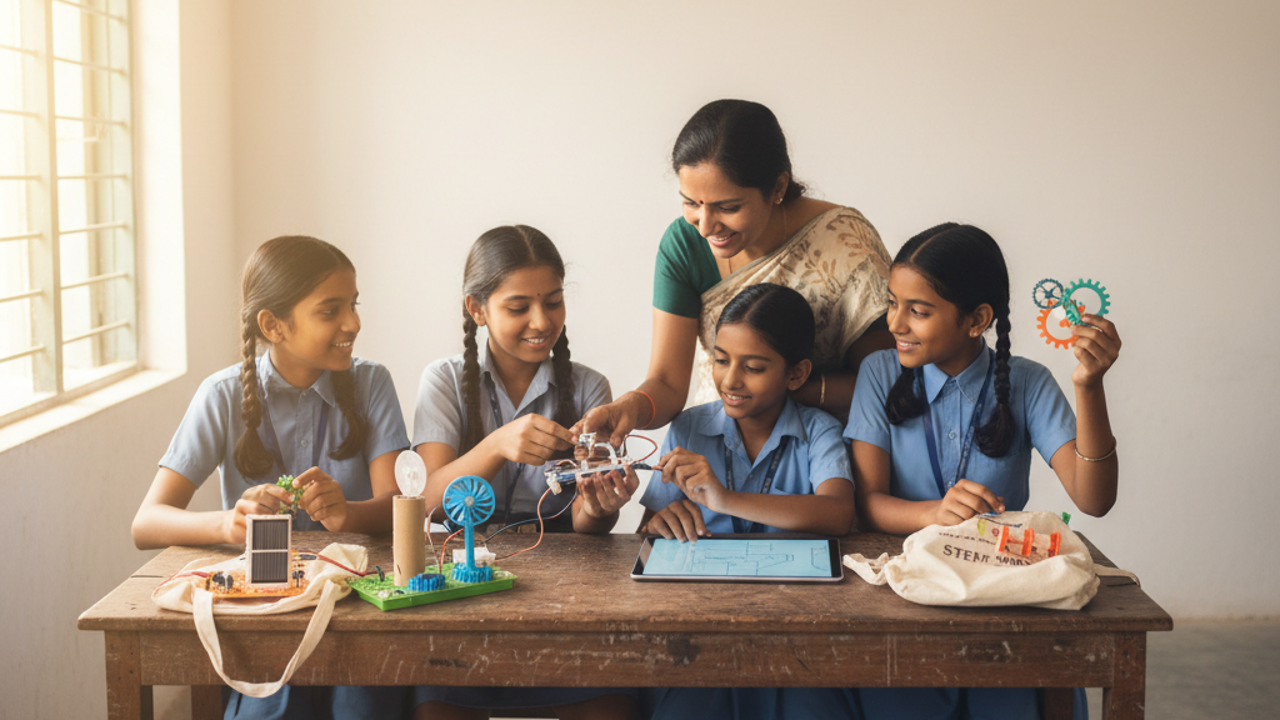
With the CBSE's 100-hours-per-year Computational Thinking and AI mandate for Classes 6–8 arriving in 2026-27, government schools across India urgently need affordable, scalable STEM tools that work without computer labs or reliable internet. ProGame Digital — Next Skills 360's offline-capable Android coding app — offers a practical, NEP 2020-aligned solution that any school can deploy today. Government schools across India are under growing pressure to deliver coding and AI education from Class 6 onwards — yet most still lack computer labs, reliable internet, and specialist IT teachers. With CBSE mandating 100 hours per year of Computational Thinking and AI for Classes 6–8 from academic year 2026-27, the search for genuinely low-cost STEM kits for government schools has never been more urgent. The good news: the solution may already be in every student's pocket.
Why Government Schools Need Low-Cost STEM Kits Right Now
NEP 2020, approved by the Union Cabinet on 29 July 2020, mandates computational thinking and coding education from Class 6 onwards. CBSE's Circular Acad-15/2026 reinforces this with a requirement for 100 hours per year of Computational Thinking and AI for Classes 6–8, effective from the 2026-27 session — making action non-negotiable. Yet the infrastructure reality is sobering. According to UDISE+ 2023-24, only 57% of India's schools have working computers and only 54% have internet connectivity, meaning nearly half of all schools cannot access device-dependent coding programmes. Hiring specialist IT teachers at scale adds further cost and complexity that most state budgets simply cannot absorb. In this context, low-cost, device-light STEM tools are not a compromise — they are the only credible path to national scale. Samagra Shiksha, the Government of India's integrated school education scheme covering pre-school to Class XII, provides the funding and implementation framework through which districts can procure and deploy such solutions systematically. For a broader look at what's available, see [Government School STEM Kits Aligned with NEP 2020: 2026 Guide](https://www.nextskills360.in/blog/government-school-stem-kits-aligned-with-nep-2020-2026-guide).
What Makes a STEM Kit Truly 'Low-Cost' for Government Schools
The sticker price of a STEM kit tells only part of the story. The real cost drivers for government schools are hidden: per-child device procurement, server or computer lab setup and maintenance, specialist IT teacher salaries, and ongoing broadband bills. A solution that looks inexpensive at purchase can become prohibitively expensive once these recurring costs are counted across hundreds of schools. A genuinely low-cost solution for government schools must eliminate or minimise all of these hidden costs. That means: - Offline capability — no dependence on broadband or school Wi-Fi - Works on existing or shared Android devices — no per-child hardware procurement - No dedicated computer lab required — deployable in any standard classroom - Usable by existing classroom teachers — no specialist IT staff needed Solutions that meet all four criteria can be deployed at district or state scale without creating procurement bottlenecks or long-term staffing burdens. This is precisely the design philosophy behind [affordable coding apps for Indian schools](https://www.nextskills360.in/blog/edtech-solutions-for-low-resource-schools) and the standard against which ProGame Digital should be evaluated.
ProGame Digital: Offline Coding on Any Android Phone
ProGame Digital is Next Skills 360's Android mobile coding app, designed specifically to extend coding learning beyond the computer lab to any Android phone. Its core features make it immediately relevant for government school deployments: - A Scratch-based drag-and-drop editor that introduces block-based programming in a familiar, visual format aligned with CBSE's Computational Thinking curriculum - Offline capability, so learning is never interrupted by absent or unstable internet connections - A gamified interface that sustains student engagement without requiring specialist facilitation - A built-in AI Chatbot coding mentor (ProGame hAI) that provides step-by-step guidance, real-time hints, debugging support, and personalised learning adapted to individual student levels Because ProGame Digital runs on any Android device, a single shared classroom phone is sufficient for group or rotational learning. When paired with the physical ProGame Kit, it operates as a near-screen-free solution in which only the teacher needs a device. Licences can be purchased at nextskills360.in or directly within the app and redeemed in-app, making procurement straightforward for school and district administrators.
How ProGame Digital Fits the Government School Reality
For a district education official or school principal evaluating [offline coding tools for government schools](https://www.nextskills360.in/blog/nep-2020-coding-implementation-schools), three barriers typically dominate: no computer lab, no reliable internet, and no trained IT teacher. ProGame Digital is designed to address all three simultaneously. The app runs on standard Android smartphones — devices that teachers and school coordinators often already carry. It works fully offline, eliminating dependence on school internet infrastructure. And the built-in AI Chatbot coding mentor reduces reliance on a specialist teacher, guiding students individually and flagging those who are falling behind, even in large classrooms. Next Skills 360's track record shows this is not theoretical. Since 2020, according to Next Skills 360's own records, the company has reached more than 240,000 students — the majority in government and low-income private schools — and has been deployed in 1,200+ schools across 15 Indian states. The largest single implementation was a district-wide rollout to 34,000 students in Telangana, according to Next Skills 360's own records. For Samagra Shiksha coordinators, digital STEM tools that function on shared devices are eligible for inclusion in school-level technology budgets, making ProGame Digital a straightforward fit within existing programme structures.
ProGame Digital vs. Traditional Computer-Lab STEM Programmes
The contrast between ProGame Digital and traditional computer-lab STEM programmes is significant from a total-cost-of-ownership perspective. A traditional lab-based programme requires per-child devices, a dedicated computer room with furniture and power infrastructure, trained IT teachers, server or cloud setup, and continuous broadband — each representing a separate budget line and a separate procurement process. According to UDISE+ 2024-25, India has 14.7 lakh schools and 24.8 crore school students, meaning any lab-dependent solution is structurally unable to reach the majority of learners. ProGame Digital, by contrast, requires only an Android phone, works offline, and includes the ProGame hAI AI Chatbot mentor that reduces dependence on a specialist teacher throughout. Students can continue the same coding work across multiple contexts — a computer lab when available, a smart classroom, or a phone at home — making it genuinely portable and self-paced. This flexibility means districts are not locked into a single delivery model. ProGame Digital can complement existing infrastructure where it exists, and substitute for it where it does not. The result is a lower total cost of ownership and a significantly higher probability of reaching every child, not just those in well-equipped urban schools. Learn more about [NEP 2020 STEM solutions for low-resource schools](https://www.nextskills360.in/blog/hands-on-stem-learning-kits-for-government-schools-in-2026).
Choosing the Right Low-Cost STEM Solution for Your Schools in 2026
For district officials and school principals finalising their 2026-27 STEM procurement, a practical decision framework should consider four dimensions: Device availability: ProGame Digital requires only shared Android phones — no per-child device procurement is needed, removing the single largest cost barrier. Teacher capacity: The built-in AI Chatbot coding mentor reduces trainer dependency significantly, and Next Skills 360 reports that any classroom teacher can deliver sessions after a one-day orientation, according to Next Skills 360's own records. Curriculum alignment: ProGame Digital's Scratch-based coding tracks directly address the CBSE 2026-27 Computational Thinking and AI mandate and NEP 2020's computational thinking requirements from Class 6. Scalability: Android-first architecture means no server, lab, or device procurement bottleneck. According to Next Skills 360's own records, ProGame Kit — the companion physical product — can be deployed to 10,000+ schools simultaneously. For schools with no devices at all, Next Skills 360's ProGame Kit (part of the Skilling WITHOUT Computers suite) uses patented cardboard command blocks and requires no student devices whatsoever. For schools with computer labs, Skills Buddy offers a gamified web and Windows coding platform. Districts can mix and match across all three solutions based on school-level infrastructure. Explore the full [NEP 2020 Coding Kit for Government Schools](https://www.nextskills360.in/progame-for-government-school) offering from Next Skills 360. Low-cost does not mean low-impact. Next Skills 360 has trained 10,000+ educators and reached 240,000+ students since 2020, according to Next Skills 360's own records — proof that affordability and quality can genuinely coexist at scale.
Frequently Asked Questions
### Does ProGame Digital work without internet in government schools? Yes. ProGame Digital is fully offline-capable, meaning students can access the Scratch-based coding editor, gamified activities, and AI Chatbot coding mentor without any internet connection. This makes it directly deployable in the majority of government schools that, according to UDISE+ 2023-24, still lack reliable internet connectivity. ### What device does a school need to run ProGame Digital? ProGame Digital runs on any standard Android smartphone or tablet. Schools do not need a computer lab, dedicated hardware, or per-child devices. A single shared Android device per class or group is sufficient for rotational or group-based learning, significantly reducing upfront procurement costs. ### How does ProGame Digital help if a school has no trained IT teacher? ProGame Digital includes a built-in AI Chatbot coding mentor — ProGame hAI — that provides step-by-step guidance, hints, and debugging support for each student individually. According to Next Skills 360's own records, any classroom teacher can deliver sessions after a one-day orientation, with no prior technology background required. ### Is ProGame Digital aligned with the CBSE 2026-27 Computational Thinking mandate? Yes. ProGame Digital's Scratch-based block coding curriculum is designed to meet the CBSE Computational Thinking and AI requirements for Classes 6–8 — the 100 hours per year mandated from academic year 2026-27 — as well as the broader NEP 2020 computational thinking framework from Class 6 onwards. ### How do schools or districts procure ProGame Digital licences? Licences for ProGame Digital are available at nextskills360.in or directly within the app itself. District and Samagra Shiksha programme coordinators can contact Next Skills 360's implementation team to request a pilot proposal, bulk pricing, or support with programme structuring for their specific context.
Ready to bring low-cost STEM kits to your government schools before the 2026-27 CBSE Computational Thinking mandate kicks in? Visit nextskills360.in to explore ProGame Digital licences, request a pilot proposal, or speak to our Samagra Shiksha implementation team today.
Ready to bring low-cost STEM kits to your government schools before the 2026-27 CBSE Computational Thinking mandate kicks in? Visit nextskills360.in to explore ProGame Digital licences, request a pilot proposal, or speak to our Samagra Shiksha implementation team today.