


New NCERT Textbooks Grades 1–8: What Schools Must Know in 2026
The March 2026 NCERT Revision: What It Means for Your School — and Every Student in Your Classroom
The March 2026 NCERT textbook revision for Grades 1–8 marks a pivotal shift in Indian school education, introducing competency-based learning aligned to NEP 2020. For school leaders managing large classrooms, the challenge is not just acquiring new textbooks — it is ensuring every student actually learns the revised content. ProGame hAI by Next Skills 360 offers a curriculum-aligned, AI-powered solution built for Indian classroom realities. In March 2026, NCERT released revised textbooks for Grades 1 through 8 in both print and digital formats — the most significant curriculum overhaul Indian schools have seen in years. For school leaders, this is not just a resource update; it is a signal that the pace of learning must keep up with the pace of change. The question every principal, academic head, and education department now faces is the same: how do you ensure every student — especially in a classroom of 40 to 80 — actually absorbs the revised content, at their own level, without stretching your teachers beyond capacity?
What the 2026 NCERT Textbook Revision Actually Changes
The 2026 NCERT revision is not a cosmetic update. New textbooks for Grades 1 through 8 have been released simultaneously in print and digital formats, with Grade 9 currently in progress, according to ncert.nic.in. This is a foundational curriculum shift designed to deliver on NEP 2020's core goals: competency-based learning, holistic development, and the integration of computational thinking from Class 6 onwards. The policy backdrop reinforces the urgency. CBSE has mandated 100 hours per year of Computational Thinking and AI for Classes 6–8, effective from academic year 2026-27, per CBSE curriculum guidelines. These revised textbooks are not arriving in isolation — they come bundled with new subject requirements that demand structured delivery, skilled facilitation, and measurable outcomes. For school principals and academic heads, the implication is direct: teaching methods, skilling tools, and classroom technology must now align to a significantly updated framework. Schools that delay this audit risk falling behind before the next academic term begins.
Why Curriculum Alignment Is Now a School Procurement Priority
Every EdTech tool, skilling kit, and digital platform currently deployed in your school must now be evaluated against one question: does it align to the revised NCERT 2026 framework? Solutions designed for the previous curriculum may introduce inconsistencies in learning progression, confuse students with mismatched content, or simply fail compliance checks during school inspections and government audits. For school chains and state education departments managing hundreds of institutions simultaneously, this is a governance risk, not merely a pedagogical one. Inconsistent content across a network of schools undermines the very purpose of a national curriculum revision. We should also remember the scale we are working with. India operates one of the largest school education systems in the world — 14.7 lakh schools and 24.8 crore school students, according to UDISE+ 2024-25. At this scale, a misaligned tool does not affect one classroom; it affects millions of learners. Procurement decisions made in the next few months will determine whether your schools enter the 2026-27 academic year equipped — or scrambling to catch up.
The Personalisation Problem in Large Indian Classrooms
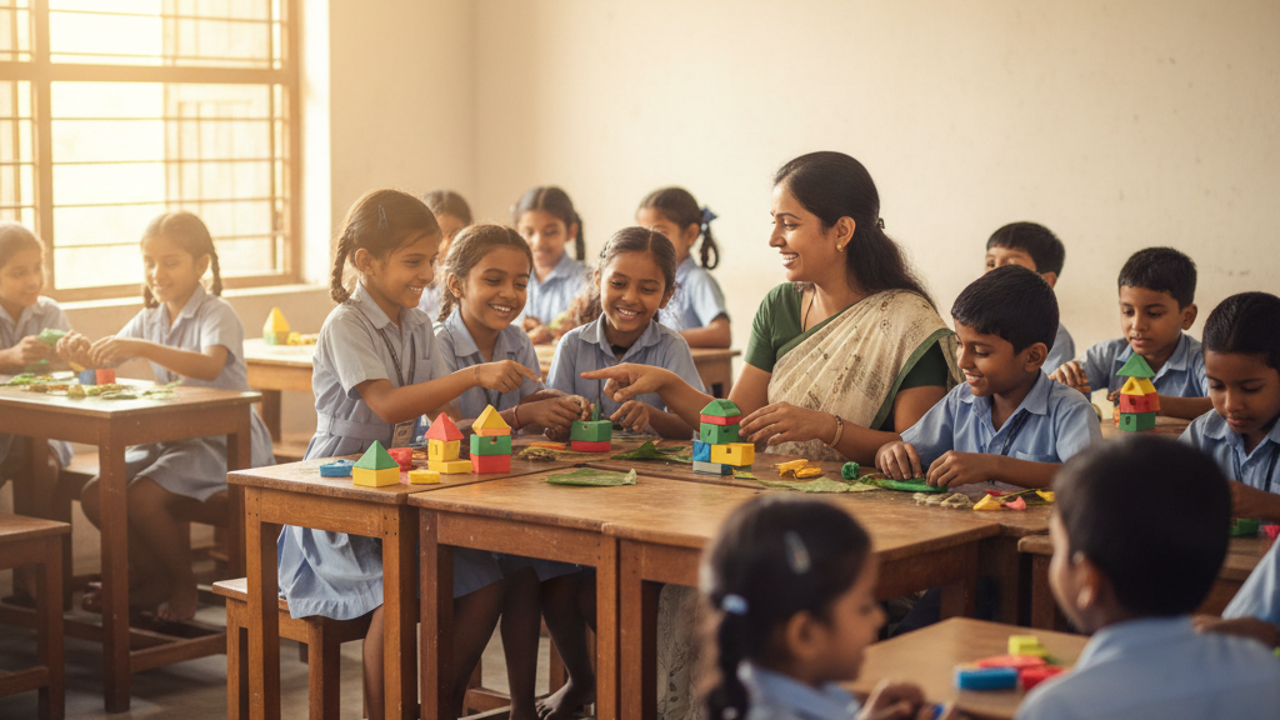
Revised textbooks bring new concepts, new learning progressions, and new expectations for student competency. But the delivery context in most Indian classrooms has not changed: one teacher, 40 to 80 students, and a curriculum that now demands more individual engagement than ever before. Even the most skilled teacher cannot simultaneously monitor whether every student in a class of 60 has understood a new concept introduced in a revised Grade 5 textbook. Students who fall behind on foundational ideas do not always raise their hands. In many cases, their gaps go undetected until a term exam reveals the damage — by which point, catching up requires significant remediation. This gap between curriculum ambition and classroom reality is the defining challenge for government school administrators and private school academic heads alike. The revised NCERT framework is thoughtfully designed, but design alone does not reach every student. Delivery infrastructure must do that work — and right now, for most schools, that infrastructure simply does not exist.
How ProGame hAI Bridges Revised Curriculum and Every Individual Learner
[ProGame hAI](https://www.nextskills360.in/blog/category/progame-hai) is Next Skills 360's AI-powered chatbot learning companion and coding mentor, designed specifically to address the personalisation gap in large Indian classrooms. Deployed as a shared-device classroom AI companion, it is built for environments of 40 to 80 students — precisely the scale at which individual attention breaks down. Its core capabilities are practical and immediate: step-by-step guidance, real-time query answering, hints, debugging support, and personalised learning adapted to each student's individual level. Crucially, ProGame hAI identifies students who are struggling and flags them — without requiring additional staff or a separate support teacher. As schools introduce revised NCERT content across Grades 1–8, ProGame hAI ensures that the gap between what is taught and what is understood does not silently widen. A student encountering a new computational thinking concept for the first time gets guided support in the moment, not a week later. To understand more about how [AI is reshaping learning in Indian schools in 2026](https://www.nextskills360.in/blog/pro-game-learning-teaching-ai-in-indian-schools-2026), this approach represents a genuine shift in how classroom support can be delivered at scale.
Consistent Personalised Learning Across Government and Private Schools at Scale
For government education departments and school chains overseeing dozens or hundreds of institutions, the challenge is not just quality — it is consistency at scale. When the NCERT revision reaches every classroom simultaneously, the quality of learning support must also be consistent, whether a student sits in a private school in Delhi or a government school in rural Telangana. Next Skills 360 has the deployment track record to back this ambition. Since its founding in 2020, NS360 has reached 1,200+ schools across India, built a presence in 15 Indian states, impacted 240,000+ students, and trained 10,000+ trainers and educators — all according to Next Skills 360's own records. ProGame hAI is built on the same infrastructure philosophy: a shared-device solution that delivers uniform, personalised learning support without per-student device procurement or additional staffing. A district-level rollout does not require a different product configuration for each school — it requires one well-designed AI companion deployed consistently. That is exactly what ProGame hAI is built to be. For further context on large-scale implementation, see how [AI-powered coding curricula are being deployed in government schools in 2026](https://www.nextskills360.in/blog/ai-powered-coding-curriculum-for-government-schools-in-2026).
Getting Curriculum-Ready Before the Next Academic Term
The window before the 2026-27 academic year is the right moment for school decision-makers to act — not react. The steps are practical. First, audit your current EdTech and skilling tools against the revised NCERT 2026 framework. Identify which solutions remain aligned and which have become obsolete. Second, map your personalisation gaps: in classrooms of 40 to 80 students, where does individual learning support currently break down? Third, evaluate AI-powered companions that work within your existing infrastructure — no per-student device procurement, no server installations, no IT overhaul required. ProGame hAI operates as a shared-device solution, making it accessible even where device availability is constrained. And because Grade 9 textbooks are still in progress, schools that build adaptive, AI-supported learning infrastructure now will be positioned to absorb each new release without disruption. The revised NCERT curriculum is a significant opportunity for Indian schools. The schools that pair it with intelligent, scalable delivery infrastructure will turn that opportunity into genuine learning outcomes — for every student, not just those at the front of the room. For a broader view of how [experiential and SEL-integrated learning is evolving in Indian schools](https://www.nextskills360.in/blog/experiential-learning-kits-india-schools-need-for-sel-in-2026), the 2026 curriculum shift opens important new conversations.
Frequently Asked Questions
### What has actually changed in the NCERT 2026 textbook revision? NCERT released revised textbooks for Grades 1–8 in both print and digital formats in March 2026, with Grade 9 currently in progress, according to ncert.nic.in. The revision is aligned to NEP 2020 goals, emphasising competency-based learning, holistic development, and computational thinking from Class 6. It represents the most significant curriculum overhaul Indian schools have seen in recent years. ### Is there a CBSE mandate connected to this curriculum revision? Yes. CBSE has mandated 100 hours per year of Computational Thinking and AI for Classes 6–8, effective from academic year 2026-27, per CBSE curriculum guidelines. This sits directly alongside the NCERT revision and means schools must now deliver structured computational thinking content — not just introduce new textbooks. ### How does ProGame hAI work in a classroom without one device per student? ProGame hAI is designed as a shared-device classroom AI companion for large classrooms of 40 to 80 students, according to Next Skills 360's own records. It does not require individual device procurement. Students access it through a shared device, receiving personalised guidance, real-time query answering, and hints adapted to their individual level — all without additional staff. ### Can ProGame hAI be deployed across a government school district or school chain? Yes. Next Skills 360 has deployed programmes across 1,200+ schools in 15 Indian states and trained 10,000+ educators, according to Next Skills 360's own records. ProGame hAI is designed for consistent, uniform rollout — delivering the same quality of personalised support across government and private schools simultaneously, without requiring different configurations per institution. ### What should school leaders do right now to prepare for the NCERT 2026 revision? School leaders should immediately audit all current skilling and EdTech tools for alignment with the revised NCERT 2026 framework, identify where personalisation gaps exist in large-classroom delivery, and evaluate AI-powered solutions that work within existing infrastructure. With Grade 9 textbooks still in progress, building adaptive learning infrastructure now ensures schools are ready for each subsequent release without disruption.
Is your school ready to deliver the revised NCERT curriculum to every student — not just the front row? See how ProGame hAI powers personalised learning across classrooms of 40 to 80 students with zero additional staffing. Request a free demo for your school or district at nextskills360.in.
Is your school ready to deliver the revised NCERT curriculum to every student — not just the front row? See how ProGame hAI powers personalised learning across classrooms of 40 to 80 students with zero additional staffing. Request a free demo for your school or district at nextskills360.in.