


Scaling Coding Education to Tier-2 Tier-3 Schools in 2026
Scaling Coding Education to Tier-2 and Tier-3 Schools: A 2026 Roadmap for Inclusive Access
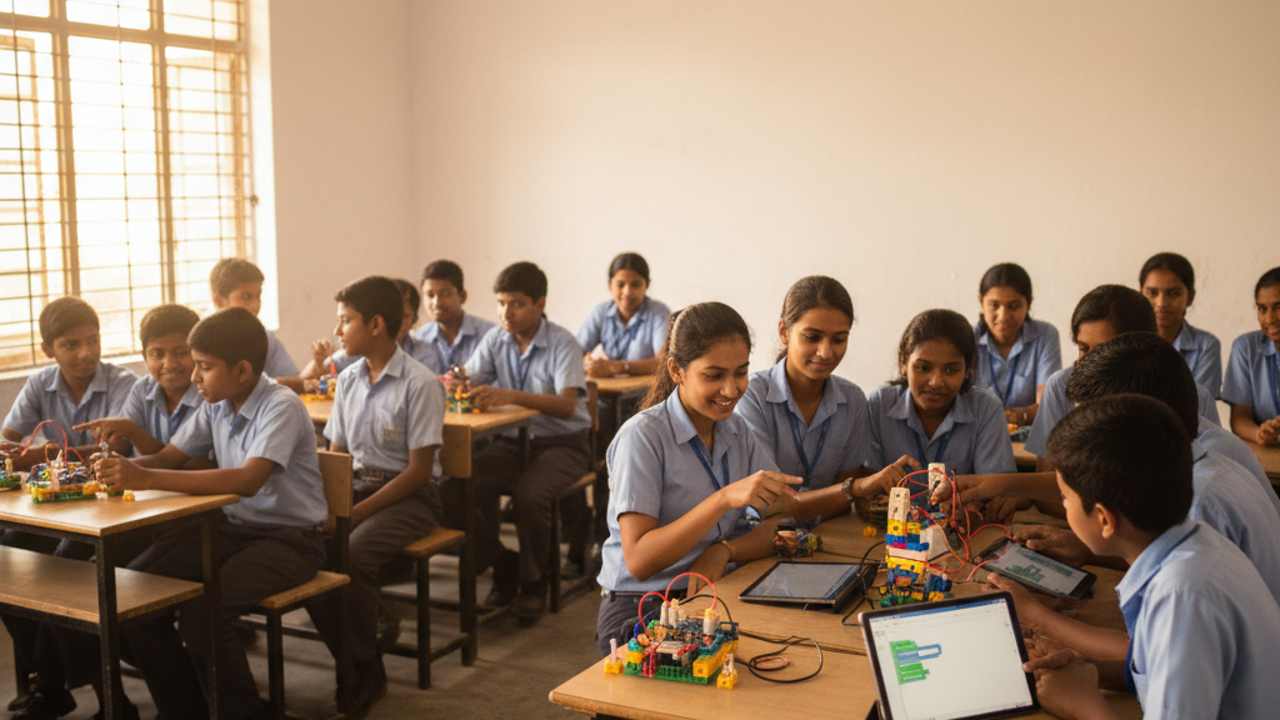
Scaling coding education to tier-2 and tier-3 schools in 2026 is no longer optional — it is a national imperative. For students with visual impairments in underserved districts, the challenge is compounded by inaccessible tools, absent labs, and undertrained teachers. Next Skills 360's ProGame Tactile Pro offers a structured, audio-first Python pathway that removes every one of those barriers. According to UDISE+ 2024-25, India has 14.7 lakh schools and 24.8 crore students — yet nearly half of all schools lack working computers or internet connectivity. For students with visual impairments in tier-2 and tier-3 towns, that gap is even wider and the stakes far higher. Next Skills 360's ProGame Tactile Pro is rewriting the rules of who gets to learn Python and who gets a shot at a tech career.
Why Tier-2 and Tier-3 Schools Are the Hardest to Reach
The numbers tell a stark story. According to UDISE+ 2023-24, only 57% of India's schools have working computers and only 54% have internet connectivity. Device-dependent coding programmes, then, automatically exclude nearly half the country's schools before a single lesson is taught. For students with visual impairments, the exclusion cuts even deeper. Even within the minority of schools that do have devices, almost no mainstream EdTech product is built for screen-reader compatibility. Coding platforms routinely rely on visual drag-and-drop interfaces, colour-coded blocks, or sighted navigation menus — tools that are functionally inaccessible to a student who is blind or has low vision. The result is a double barrier: infrastructure poverty on one side, inaccessible design on the other. Any credible strategy for [inclusive coding education in underserved rural schools](https://www.nextskills360.in/blog/inclusive-coding-education-for-underserved-rural-schools-2026) must address both simultaneously — not one at the expense of the other.
The NEP 2020 and CBSE Mandate: A Ticking Clock for Schools
The policy window is open — and closing fast. NEP 2020, as published by the Ministry of Education, mandates computational thinking and coding education from Class 6 onwards. More urgently, CBSE curriculum guidelines for 2026-27 have now mandated 100 hours per year of Computational Thinking and AI for Classes 6–8, beginning the next academic year. For mainstream schools, this is a curriculum compliance challenge. For special schools serving students with visual impairments and for Government Vocational Rehabilitation Centres, it carries a more significant weight: a formal national signal that their students deserve equivalent coding education, not a watered-down afterthought. Schools and VRCs that act now can align their 2026-27 programme planning with this mandate, access relevant CSR and government funding streams, and demonstrate credible skilling outcomes. Those that wait risk falling behind on national goals — and, more importantly, leaving their students without the career-ready skills the labour market will increasingly demand. For a deeper look at how policy intersects with accessible coding, see NS360's resource on [2026 education policy and inclusive coding for visually impaired students](https://www.nextskills360.in/blog/2026-education-policy-inclusive-coding-for-visually-impaired).
What Makes Scaling Coding Education to Tier-2 Tier-3 Schools So Difficult
Three structural barriers consistently block progress. First, infrastructure: most tier-2 and tier-3 special schools and VRCs have no computer lab, unreliable power supply, and no budget for device procurement. Programmes built around desktop labs or cloud platforms simply cannot land here. Second, accessibility: the overwhelming majority of coding tools — even well-funded ones — are sight-dependent. Screen-reader compatibility is an afterthought, if it exists at all. A student with visual impairment using a standard coding platform faces navigation barriers at every step. Third, teacher capacity: remote special schools rarely employ trained coding educators. Asking a vocational teacher with no technology background to deliver Python lessons without structured support is a recipe for abandoned programmes. These barriers are real — but they are not insurmountable. Next Skills 360 has trained 10,000+ trainers and educators across India since 2020 and deployed programmes across 1,200+ schools in 15 Indian states, according to its own records. The evidence is clear: with the right design, scale is achievable.
ProGame Tactile Pro: Audio-First Python for Every Learner
[ProGame Tactile Pro](https://www.nextskills360.in/progame-tactile) is Next Skills 360's purpose-built answer to the accessibility and infrastructure challenge. Designed specifically for students with visual impairments, it teaches desktop Python programming at a vocational and career-ready level — structured across three progressive levels: foundational, advanced, and career-ready. The programme is built for Classes 8 and above and adults in vocational training centres, making it directly relevant for the cohorts most VRCs and secondary special schools serve. Critically, it is audio-first and fully screen-reader compatible: all navigation, coding prompts, feedback, and the accessible code editor operate entirely through audio, with zero reliance on sight. This design eliminates the need for specialist sighted support at every step. Students write, run, and share their own Python programmes independently. According to Next Skills 360's own records, 70%+ of ProGame Tactile students independently create and share their own programmes — a figure that reflects genuine skill acquisition, not passive consumption. No expensive lab infrastructure. No specialist hardware. No barriers to entry.
Real Impact: NS360's Track Record in Underserved India
Impact claims in EdTech are easy to make and difficult to verify. Next Skills 360's track record is documented. According to the company's own records, 240,000+ students have been impacted across India since 2020, with a presence spanning 15 Indian states and deployment across 1,200+ schools. Inclusive skilling programmes have directly reached 500+ students with disabilities. External validators strengthen the picture further. NS360 has been recognised by MIT Solver, received the AI for Humanity Prize from the McGovern Foundation, and earned the Innovation for Women Prize from the Vodafone Americas Foundation — among 14 national and international recognitions. Perhaps most tellingly, a business school case study titled "Teaching Coding Without Computers" (case W37092) is published and distributed through Harvard Business Publishing — an indicator of academic credibility that few EdTech companies anywhere in the world can point to. For schools and VRCs evaluating partners, this combination of grassroots reach and international recognition matters. Explore [real stories from ProGame Tactile students](https://www.nextskills360.in/blog/progame-tactile-success-stories-coding-without-sight) to see what this looks like in practice.
A Practical Roadmap for Schools and VRCs Ready to Act in 2026
Acting on this opportunity does not require a lengthy procurement cycle. Here is a clear pathway for special school principals, VRC programme heads, and NSDC or State Skill Development Mission coordinators. Step one: Assess your current student cohort. ProGame Tactile Pro is designed for Class 8 and above and adult vocational learners — the exact population most VRCs and secondary special schools serve. Step two: Confirm that no computer lab or internet dependency is required for ProGame Tactile Pro deployment. According to Next Skills 360's own records, the programme runs on any Android device and works offline. Step three: Align your implementation timeline with CBSE's 2026-27 mandate for Computational Thinking and AI. Starting planning now means your school or VRC is ready when the academic year opens. Step four: Connect with the NS360 team at nextskills360.in for a deployment consultation, including programme structure, funding pathway guidance, and a live demo. You can also explore the full [ProGame Tactile accessible coding programme](https://www.nextskills360.in/coding-for-visually-impaired) to understand the complete learning journey before your first conversation.
Frequently Asked Questions
### Does ProGame Tactile Pro require a computer lab or internet connection? No. According to Next Skills 360's own records, ProGame Tactile Pro works offline on any Android device. There is no computer lab requirement, no server infrastructure, and no per-student device procurement needed. This makes it viable for schools and VRCs in tier-2 and tier-3 locations where reliable internet and lab facilities are absent. ### Is ProGame Tactile Pro suitable for adult learners in Vocational Rehabilitation Centres? Yes. The programme is designed for Classes 8 and above and adults, making it directly relevant for Government VRC cohorts undertaking vocational skilling. The three progressive levels — foundational, advanced, and career-ready — allow adult learners to progress at an appropriate pace toward employment-ready Python skills. ### How are teachers prepared to deliver ProGame Tactile Pro in special schools? NS360 delivers structured train-the-trainer workshops as part of every programme. The broader ProGame Kit teacher preparation model demonstrates that any classroom teacher can be deployment-ready after a one-day orientation, according to Next Skills 360's own records. Ongoing teacher support through a dedicated LMS and weekly engagement is also included. ### How does ProGame Tactile Pro align with the CBSE 2026-27 Computational Thinking mandate? CBSE curriculum guidelines for 2026-27 mandate 100 hours per year of Computational Thinking and AI for Classes 6–8. ProGame Tactile Pro's structured Python curriculum, designed for Class 8 and above, maps directly to this requirement and gives special schools a credible, accessible programme for demonstrating compliance with national coding education mandates. ### What Python skilling outcomes can students realistically achieve? According to Next Skills 360's own records, 70%+ of ProGame Tactile students independently create and share their own programmes using the accessible code editor. The career-ready level of ProGame Tactile Pro is designed to equip students with vocational Python skills relevant to entry-level technology roles — a meaningful and measurable outcome for students who previously had no accessible pathway into coding.
Ready to bring career-ready Python coding to your students with visual impairments — no lab, no barriers? Visit nextskills360.in to request a free ProGame Tactile Pro demo for your school or VRC today.
Ready to bring career-ready Python coding to your students with visual impairments — no lab, no barriers? Visit nextskills360.in to request a free ProGame Tactile Pro demo for your school or VRC today.