


Smart India Hackathon 2026: How Schools Can Prep Students
Quick answer
Smart India Hackathon 2026 is a government initiative connecting students across colleges to solve real-world challenges through innovation. Schools that build AI literacy and problem-solving skills early give students the strongest foundation. ProGame hAI supports this by providing personalised AI-powered learning in large government and private school classrooms across India.
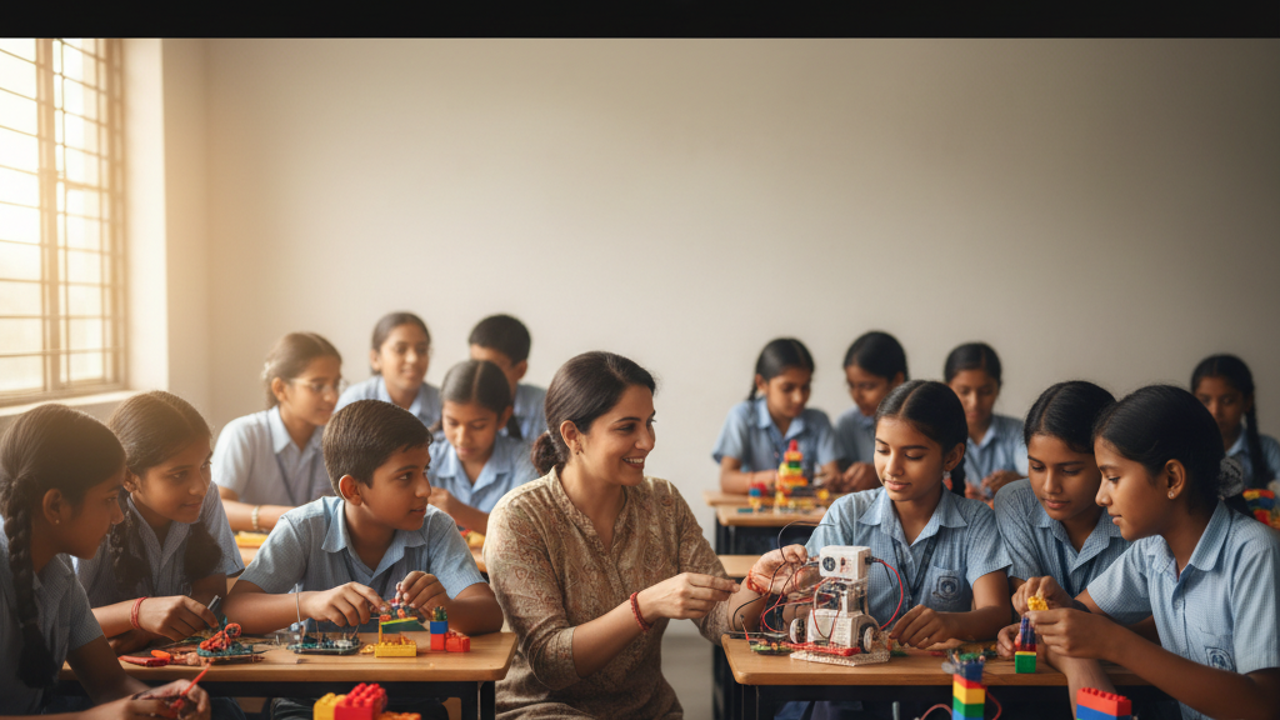
Smart India Hackathon 2026 is a government initiative connecting students across colleges to solve real-world challenges through innovation. Schools that build AI literacy and problem-solving skills early give students the strongest foundation. ProGame hAI supports this by providing personalised AI-powered learning in large government and private school classrooms across India. Smart India Hackathon 2026 is drawing thousands of college students into government-backed innovation challenges — but the students who arrive best prepared are the ones whose schools started building computational thinking and AI skills years earlier. With CBSE now mandating CT and AI from Classes 3 to 10 (Circular Acad-15/2026), the pipeline from school to national hackathon has never mattered more. How do schools — especially those with 40 to 80 students per classroom — actually deliver the personalised learning that produces confident innovators?
What Is Smart India Hackathon 2026 and Why Schools Should Care
Smart India Hackathon 2026 is a government initiative connecting students across colleges to tackle real national problems through structured, team-based innovation challenges. While participation is at the college level, the skills that determine success — computational thinking, AI literacy, and problem-solving — are built years earlier, in school. The policy signal is now unambiguous. CBSE Circular Acad-15/2026 makes Computational Thinking and AI compulsory for Classes 3 to 10 from the 2026-27 session, meaning every affiliated school must embed these skills into its curriculum. According to UDISE+ 2024-25 data published by India's Ministry of Education, India has 14.7 lakh schools serving 24.8 crore school students — one of the largest school education systems in the world. Preparing this pipeline for innovation is no longer optional; it is a national priority, and schools that act now will produce the confident, capable students who represent India at hackathons and beyond.
The School-to-Hackathon Pipeline: Building Future Innovators Early
The skills that power hackathon performance — coding, computational thinking, AI literacy, logical reasoning, and collaborative problem-solving — are not learned overnight. They are built steadily across Classes 5 to 10, in classrooms where students get regular, meaningful practice. Next Skills 360, a Hyderabad-based Indian EdTech company founded in 2020, has spent five years building exactly this pipeline. According to Next Skills 360's own records, the company has impacted 240,000+ students across India, deployed its programmes in 1,200+ schools, and trained 10,000+ educators — with the majority of students coming from government and low-income private schools. This matters enormously. Government schools are where most of India's future innovators study. A child in a Telangana government school or a municipal school in Tamil Nadu deserves the same quality of AI-powered, personalised learning as a student in a well-resourced private institution. Closing that gap is how India builds a truly national innovation pipeline, not just an elite one. Explore how [AI-powered coding curriculum is reaching government schools in 2026](https://www.nextskills360.in/blog/ai-powered-coding-curriculum-for-government-schools-in-2026) for a deeper look at what is possible at scale.
The Large-Classroom Problem: Personalised Learning at Scale
Here is the challenge every government school principal and academic head knows intimately: one teacher, forty to eighty students, and a curriculum that expects every child to keep up. In these conditions, personalised learning — the kind that identifies where each student is struggling and adapts support in real time — is nearly impossible to deliver manually. The consequences compound over time. Students who fall behind in foundational coding or AI concepts in Class 6 arrive at Class 9 without the confidence or skills to engage meaningfully with innovation challenges. By the time Smart India Hackathon becomes relevant at the college level, the gap has grown too wide to close quickly. According to UDISE+ 2023-24 data, only 57% of India's schools have working computers and only 54% have internet connectivity, meaning nearly half of all schools cannot access device-dependent solutions. Any approach to personalised learning must work within these real constraints — not assume an infrastructure that does not exist for millions of students.
How ProGame hAI Delivers Personalised Learning in Every Classroom
[ProGame hAI](https://www.nextskills360.in/progame-hai) is Next Skills 360's answer to the large-classroom challenge. It is a shared-device classroom AI companion built specifically for Indian classrooms of 40 to 80 students — requiring no per-child device, no dedicated lab, and no specialist IT teacher. As an AI-powered chatbot learning companion and coding mentor, ProGame hAI provides step-by-step guidance, real-time doubt-solving, hints, and debugging support, with responses personalised to each student's individual level. It answers questions across school subjects in English, Hindi, Telugu, Kannada, Tamil, and Marathi, keeping all interactions learning-focused and age-appropriate, with the teacher in control of the shared classroom device. Critically, ProGame hAI tells the teacher which students are falling behind — enabling timely intervention without requiring additional staffing. For schools seeking a computer-lab-based option, [Skills Buddy](https://www.nextskills360.in/blog/best-ai-module-for-school-students-in-india-2026) also includes an in-built AI chatbot for coding and social-emotional skills mentoring for students in Class 4 and above. Together, these tools bring AI-powered personalised learning for schools into classrooms that have long been underserved. ProGame hAI is currently being piloted in government schools in Telangana and in schools in cities where major IT companies operate, according to Next Skills 360's own records.
NS360's Track Record With Government Schools and Innovation Agendas
When schools evaluate partners for government-aligned skilling initiatives, credibility matters. Next Skills 360's track record across government school deployments is substantiated by verified data from the company's own records: 240,000+ students impacted, 10,000+ educators trained, and 1,200+ schools deployed across 15 Indian states since 2020 — with the majority of students in government and low-income private schools. The company's work has earned 14 national and international recognitions, including the MIT Solve selection, the AI for Humanity Prize from the McGovern Foundation, the ElevatED Award from Dell Technologies India and MeitY, and the SKOCH Award for the Telangana Early Coders project — a programme that demonstrated government innovation alignment at scale. Next Skills 360 is also a DPIIT-recognised startup under Startup India, and its work has been featured in a Harvard Business Publishing case study titled "Teaching Coding Without Computers" (case W37092). For schools seeking a partner that genuinely understands both government school realities and national skilling agendas, Next Skills 360 brings classroom-tested solutions alongside that credibility. Learn more about [ProGame solutions designed for government schools](https://www.nextskills360.in/progame-for-government-school).
What Schools Can Do Now to Align With SIH 2026 and Future Innovation Goals
The 2026-27 academic session brings the CBSE CT and AI mandate into force for Classes 3 to 10. For school principals, academic heads, and education department buyers, the time to act is now — not after the session begins. Three practical steps will make the difference: First, adopt curriculum tools — such as the ProGame AI Module, mapped to the CBSE CT and AI curriculum — that deliver 30 to 50 hours of activity-based learning per class, per year, without requiring a computer lab for every student. Second, deploy a shared AI companion like ProGame hAI to close the personalisation gap in large classrooms. Real-time doubt-solving and progress flagging mean no student is left behind because the teacher could not reach them in time. Third, track student progress with analytics so intervention is proactive, not reactive. Smart India Hackathon 2026 rewards students who have been building skills for years. The investment schools make in 2026-27 will shape the innovators who represent India in 2030 and beyond. Explore further insights on [AI-powered personalised learning for government primary schools in India](https://www.nextskills360.in/blog/ai-personalised-learning-for-government-primary-schools-india).
Frequently Asked Questions
### What is Smart India Hackathon 2026 and how does it connect to school education? Smart India Hackathon 2026 is a government initiative connecting students across colleges to solve real-world national challenges through innovation. Its relevance to schools lies in the pipeline: the computational thinking, coding, and AI skills that determine hackathon success are built during school years, not in college. CBSE's Circular Acad-15/2026 now mandates CT and AI for Classes 3 to 10, making early school-level preparation a policy requirement. ### What is ProGame hAI and how does it work in a large classroom? ProGame hAI is an AI-powered chatbot learning companion and coding mentor from Next Skills 360, designed for Indian classrooms of 40 to 80 students. Deployed on a single shared device, it provides each student with step-by-step guidance, real-time doubt-solving, hints, and debugging support at their individual level — while alerting the teacher to students who are falling behind, all without additional staffing or per-child devices. ### How does ProGame hAI support the CBSE Computational Thinking and AI curriculum? ProGame hAI works alongside Next Skills 360's ProGame AI Module, which is built for Classes 3 to 10 and mapped directly to the CBSE Computational Thinking and AI curriculum. Together, they deliver up to 30 to 50 hours of structured, activity-based AI learning per class per year, covering data, patterns, decision-making, and applied AI concepts — accessible with only the teacher's device in the classroom. ### Is ProGame hAI suitable for government schools with limited infrastructure? Yes. ProGame hAI is a school AI assistant for India designed specifically for low-infrastructure environments. It operates on a shared classroom device, requires no computer lab, no internet for core activities, and no dedicated IT teacher. According to Next Skills 360's own records, the solution is currently being piloted in government schools in Telangana, and NS360's programmes have already reached 1,200+ schools, the majority in government and low-income private settings. ### How do I get started with ProGame hAI for my school? Schools begin with a free demo from Next Skills 360, followed by a paid pilot programme. Pricing is customised based on school size, deployment context, and programme scope. You can request a demo at [nextskills360.in](https://www.nextskills360.in/progame-hai) or reach the NS360 team on WhatsApp at +91 79955 60306 or by phone at +91 79892 37476.
Is your school ready to produce the innovators who will compete at Smart India Hackathon and beyond? See how ProGame hAI brings personalised AI-powered learning to every student in your classroom — even in a class of 80. Request a demo from Next Skills 360 today at nextskills360.in.
Is your school ready to produce the innovators who will compete at Smart India Hackathon and beyond? See how ProGame hAI brings personalised AI-powered learning to every student in your classroom — even in a class of 80. Request a demo from Next Skills 360 today at nextskills360.in.