


Audio lessons in Indian languages for students who are blind
Quick answer
ProGame Tactile from Next Skills 360 teaches students with visual impairments through audio in Telugu, Hindi, English, Marathi, Kannada and Tamil. Students who are blind or visually impaired in India have long been left out of digital skilling because most learning tools depend entirely on sight.
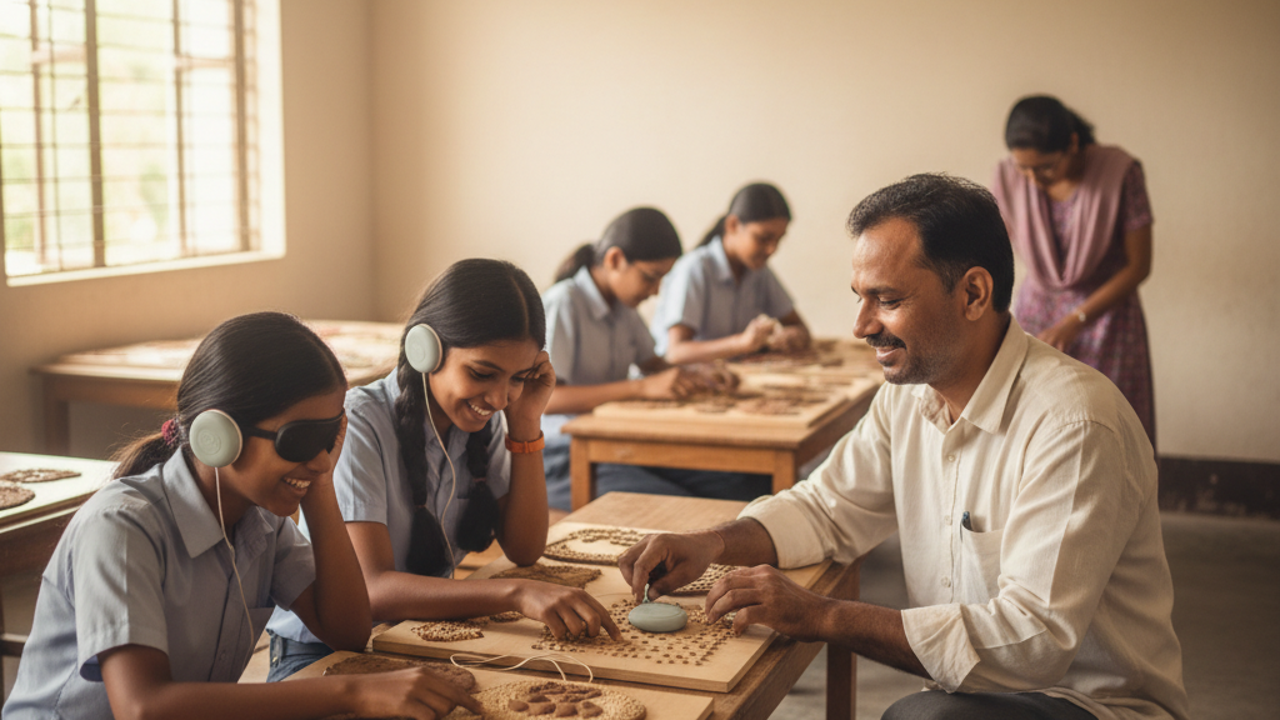
Students who are blind or visually impaired in India have long been left out of digital skilling because most learning tools depend entirely on sight. Audio lessons in Indian languages change that equation. When a student hears instructions in Hindi, Telugu, Tamil, Marathi, Kannada or English, comprehension rises and confidence follows. This article explains what to look for in an audio-first learning solution and how ProGame Tactile from Next Skills 360 meets that bar. ProGame Tactile from Next Skills 360 teaches students with visual impairments in six languages: Telugu, Hindi, English, Marathi, Kannada and Tamil. It is an audio-first app, fully screen-reader friendly, with 40+ audio lessons and 20+ guided activities in coding, AI literacy, social-emotional skills, financial literacy and career guidance, for Classes 5 and above.
Why the language of a lesson matters for audio learning
For a student who relies entirely on what they hear, language is not a preference — it is the whole learning environment. A lesson delivered in a student's mother tongue removes the double burden of decoding unfamiliar vocabulary while trying to absorb new concepts. For students seeking audio lessons for blind students in Hindi, or a learning app for blind students in Telugu or Marathi, the difference between hearing a lesson in their first language and struggling through it in English can mean the difference between mastering a concept and abandoning it altogether. India's school system spans 14.7 lakh schools and 24.8 crore students, according to UDISE+ 2024–25 data from the Ministry of Education, Government of India. Within that population, students with visual impairments are spread across every state and every language region. A solution that covers only English, or only one regional language, reaches only a fraction of the learners who need it most.
What to look for
Not every app that claims to support screen readers genuinely delivers an audio-first experience. When a school or CSR partner evaluates a solution, several questions matter: - Is every screen, button and output navigable without sight? A screen-reader-compatible label on a visual interface is not the same as a fully audio-first design. - Does the app teach in the student's mother tongue? Native-language audio tutorials — not just translated text on screen — make the difference for comprehension. - Can it work offline? Connectivity in special schools across India is unreliable. A solution that drops out mid-lesson is no solution at all. - Does it cover skills beyond one subject? Students with visual impairments need coding, AI literacy, life skills, financial literacy and career guidance — not just one module. - Does it store learning materials permanently? Study notes shared over WhatsApp are buried in threads, unfindable by screen reader, and lost when a phone is replaced. Any solution that falls short on these points will require workarounds that ultimately fall on the teacher or student.
The kinds of options
Schools in India currently manage a patchwork of resources for students with visual impairments: screen readers on shared computers, audio files sent over WhatsApp, Braille materials, and occasional visits from NGO volunteers. For coding for visually impaired students in Tamil or Hindi, the options narrow further. A handful of global assistive technology tools exist, but they are priced and designed for high-resource environments, rarely cover Indian languages, and teach only one skill domain. What the market has lacked is an integrated, affordable, audio-first solution built specifically for Indian classrooms and Indian languages — one that covers the full range of 21st-century skills, works offline on a budget Android device, and is structured as a proper multi-year programme rather than a one-off content drop. Next Skills 360 began building solutions for students with visual impairments in 2024, and ProGame Tactile is the result. You can read about [how schools are teaching coding to students with visual impairments](https://www.nextskills360.in/blog/coding-for-visually-impaired-students-india) for a fuller picture of where the field stands.
What ProGame Tactile offers
[ProGame Tactile](https://www.nextskills360.in/progame-tactile) is India's first audio-first skilling super app for students with visual impairments. According to Next Skills 360's own records, it includes 40+ audio lessons and 20+ guided activities across five domains — computational thinking and coding, AI literacy, social-emotional skills, financial literacy and career guidance — all fully navigable by screen reader with no reliance on sight whatsoever. Several features are genuinely first-of-their-kind. The accessible Code Editor lets students write, run and share their own programmes entirely through audio; Next Skills 360 reports that more than 70% of students independently create and share their own programmes. The Lifetime Document Repository gives teachers and students a permanent, screen-reader-navigable store for any subject material — replacing WhatsApp, where files are buried and unfindable. A Teacher LMS and a real-time analytics dashboard help educators track progress without guesswork. The app works offline on any Android device, includes native-language audio tutorials, and is available on Google Play. ProGame Tactile also includes technology podcasts and, through its optional low-vision interface, serves students with partial sight. For students ready to go further, [ProGame Tactile Pro](https://www.nextskills360.in/coding-for-visually-impaired) teaches Python at a vocational level across three progressive levels from Class 8 upward. And for students with speech and hearing impairments, [ProGame Signify](https://www.nextskills360.in/progame-signify) — which integrates Indian Sign Language throughout — is currently in development.
Where ProGame Tactile is in use
ProGame Tactile is delivered as a structured 3-year programme, not a licence drop. Year 1 covers coding Level 1 and social-emotional skills; Year 2 adds coding Level 2 and foundational AI; Year 3 completes coding Level 3 and introduces financial literacy and career guidance, with six months of structured learning each year. According to Next Skills 360's own records, a three-year programme is currently running in four schools for the blind in Pune, where 330 students were trained in 2025. New projects are commencing in Tamil Nadu and Karnataka. Every programme includes student licences, train-the-trainer workshops, Android smartphones placed in schools for shared access, career-guidance sessions with role models who are blind, a closing coding hackathon, and baseline and endline assessments. Next Skills 360 has impacted more than 500 students with disabilities across India since 2020, according to its own records. You can read [ProGame Tactile success stories](https://www.nextskills360.in/blog/progame-tactile-success-stories-coding-without-sight) to hear directly from students and teachers in the programme.
At a glance: what to check
Before a school, trust or CSR team commits to any audio learning solution for students with visual impairments, this checklist helps: | Check | Why it matters | |---|---| | Native-language audio | Comprehension in mother tongue vs. English | | Full screen-reader navigation | Not just compatible labels — every screen | | Offline capability | Reliable in schools with poor connectivity | | Multi-domain curriculum | Coding, AI, SEL, financial literacy, career guidance | | Permanent document storage | Replaces WhatsApp for study material | | Structured programme support | Trainer workshops, LMS, analytics, assessments | | Accessible code editor | Students write and run real programmes | ProGame Tactile meets every point on this list. For context on how national policy now supports accessible STEM, the [NEP 2020 and inclusive coding guidance](https://www.nextskills360.in/blog/2026-education-policy-inclusive-coding-for-visually-impaired) page is a useful reference.
Frequently Asked Questions
### Which Indian languages does ProGame Tactile support? ProGame Tactile teaches in six languages — Telugu, Hindi, English, Marathi, Kannada and Tamil — through native-language audio tutorials built into the app. All lessons, navigation prompts and feedback are delivered in the student's chosen language, with no requirement to read text on screen. ### Does ProGame Tactile use Braille? No. ProGame Tactile does not use Braille. It is designed entirely around audio and screen-reader navigation, so it is accessible to students who have not learned Braille and to schools that do not have Braille materials or specialist Braille teachers. ### Can the app work in schools with no internet connection? Yes. ProGame Tactile works offline on any Android device. According to Next Skills 360's own records, the programme places Android smartphones in schools for shared access, so connectivity gaps do not interrupt a student's learning journey. ### What is the Lifetime Document Repository? The Lifetime Document Repository is a permanent, screen-reader-navigable store built into ProGame Tactile. Teachers can upload study material for any subject, students can upload their own files, and everything stays accessible for the student's lifetime — replacing WhatsApp, where files are buried in scrolling threads and lost when a phone changes. ### How does a school get started with ProGame Tactile? A school begins with a free demo arranged through Next Skills 360, followed by a paid pilot. Every programme is priced by a quote tailored to the school's size and context. Schools can message Next Skills 360 on WhatsApp at +91 79955 60306 to book the demo.
Book a free demo
Hear ProGame Tactile in your students' own language. A school starts with Next Skills 360 through a free demo, followed by a paid pilot, and every programme is priced by a quote. Message Next Skills 360 on WhatsApp at +91 79955 60306 to book the demo.
Hear ProGame Tactile in your students' own language. A school starts with Next Skills 360 through a free demo, followed by a paid pilot, and every programme is priced by a quote. Message Next Skills 360 on WhatsApp at +91 79955 60306 to book the demo.