


CBSE Secondary School Curriculum 2026-27: Learning Standards Met
Quick answer
The CBSE Secondary School Curriculum 2026-27 anchors teaching to defined learning standards and measurable competency flows, requiring schools to demonstrate outcome alignment at every stage. Chitram, an AI-powered multilingual vocabulary platform for children aged 3–10, supports this pipeline by replacing rote drills with LLM-guided, draw-to-learn practice aligned to NIPUN Bharat vocabulary targets.
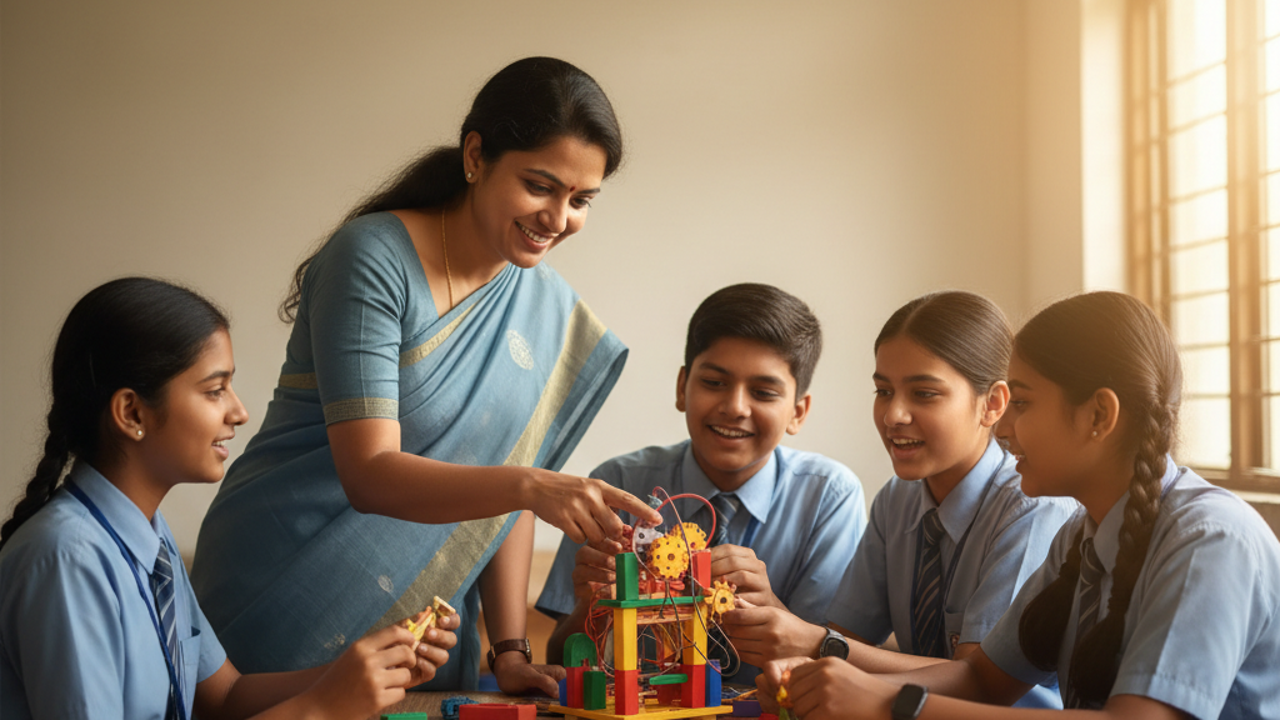
The CBSE Secondary School Curriculum 2026-27 anchors teaching to defined learning standards and measurable competency flows, requiring schools to demonstrate outcome alignment at every stage. Chitram, an AI-powered multilingual vocabulary platform for children aged 3–10, supports this pipeline by replacing rote drills with LLM-guided, draw-to-learn practice aligned to NIPUN Bharat vocabulary targets.
India's classrooms are entering a new era of accountability: the CBSE 2026-27 curriculum now demands that every learning activity map to a defined standard and a measurable outcome. For school leaders, Block Education Officers, and state SCERT teams, this shift raises an urgent question — how do you build that competency foundation before children even reach secondary school? The answer begins at the very start of a child's learning journey.
What the CBSE 2026-27 Curriculum Shift Actually Means for Schools
The CBSE 2026-27 secondary curriculum marks a decisive move away from content coverage toward defined learning standards and measurable competency flow. Schools and EdTech providers must now demonstrate that learners have actually acquired specific competencies — not merely completed activities. This changes procurement conversations significantly: government schools, CSR funders, and SCERT cells increasingly need evidence of competency gain, not programme delivery receipts.
The scope of this shift is wider than secondary alone. According to CBSE Circular Acad-15/2026, the Computational Thinking and Artificial Intelligence curriculum now runs from Class 3 to Class 10, establishing a long competency runway that begins well before secondary school. For Block Education Officers and state education departments, this means foundational years are no longer a separate concern — they are the upstream source of every measurable secondary outcome. Planning for CBSE 2026-27 alignment, therefore, must begin at the earliest grades.
Why Foundational Years Are the True Starting Point of Secondary Competency
Secondary-level measurable competencies cannot be retrofitted. They depend on strong foundational literacy and numeracy built during Classes 1–5 and even pre-school. This is precisely the logic behind NIPUN Bharat, the national mission launched by the Ministry of Education on 5 July 2021 under Samagra Shiksha, which sets a clear national target: every child reaches foundational literacy and numeracy by the end of Grade 3 by 2026-27.
Vocabulary acquisition is a core NIPUN Bharat target. Gaps at this stage do not stay contained — they create downstream competency deficits that surface visibly in secondary assessments, where reading comprehension, subject understanding, and analytical reasoning all depend on a robust word-level foundation. For SCERT FLN and NIPUN Cells, this makes early vocabulary investment a strategic lever for CBSE 2026-27 alignment, not an optional add-on. Building that foundation now is the most direct path to measurable secondary outcomes later. For a comprehensive view of the FLN landscape ahead, see our NEP FLN Targets 2026: EdTech Guide for Schools.
How Chitram Replaces Rote Drills with Measurable Vocabulary Growth
Chitram is Next Skills 360's AI-powered multilingual vocabulary platform for children aged 3–10 — covering Anganwadi through Class 5. The platform's core mechanic is distinctive: children learn new words by drawing doodles, after which a large language model provides personalised feedback for each child in both their mother tongue and English. Chitram is currently live in Telugu and English, with more Indian languages planned.
This is a meaningful departure from rote memorisation. Rather than delivering uniform drill responses to an entire class, Chitram generates individual feedback for every learner — making competency gain trackable at the child level, not just observable at the group level. Chitram is currently in pilot use in Anganwadis and primary schools in Telangana, and it supports continuity between school learning (offline) and home practice (online). That child-level measurability is precisely what CBSE 2026-27's competency-standards framework demands. For more on tools that support NIPUN 2026 vocabulary targets, explore Next Skills 360's dedicated resource.
Deployment Realities: Running Chitram in Government Schools and Anganwadis
Block Education Officers and government school procurement leads often ask a very practical question before any programme decision: what infrastructure does this actually require? With Chitram, the answer is reassuring. Chitram runs on any phone or tablet, is available on both Google Play and the Apple App Store, and offers free guest content with optional paid tiers. School and Anganwadi programmes are priced by quote — Next Skills 360 does not publish fixed prices, so every implementation is scoped to the specific context.
No computer lab or complex digital infrastructure is needed. A shared phone or tablet is sufficient to get a classroom or Anganwadi centre running. According to Next Skills 360's own records, Chitram helps government primary schools and Anganwadis meet NIPUN Bharat vocabulary targets using AI-guided draw-to-learn practice in place of rote drills. For CSR foundations and grant-funded programmes, the individual child-level feedback loop makes outcome reporting straightforward — every child's vocabulary progress is documented, not estimated.
Connecting the FLN–Secondary Competency Pipeline for SCERT and Policy Teams
For SCERT FLN and NIPUN Cells, the most useful way to think about Chitram is not as a standalone application but as the first rung of a competency ladder that runs continuously through CBSE's Class 3–10 Computational Thinking and AI curriculum. Vocabulary built in Anganwadi and primary school feeds directly into the reading comprehension and analytical thinking that secondary competency standards require.
Next Skills 360's credibility for state-level partnership is well established. According to Next Skills 360's own records, the company has received 14 national and international recognitions, including MIT Solver, the AI for Humanity Prize from the McGovern Foundation, the ElevatED Award from Dell Technologies India and MeitY, and the SKOCH Award for the Telangana Early Coders project. Headquartered in Hyderabad and present across 15 Indian states, Next Skills 360 is a natural partner for SCERT-aligned rollouts at scale. The company has reached over 240,000 students and trained more than 10,000 educators across India since its founding in 2020, according to its own records.
What Schools and Education Leaders Should Do Before the 2026-27 Session Closes
As the 2026-27 session progresses, education leaders can take four concrete steps to close the competency gap:
- Audit current FLN vocabulary assessment tools against NIPUN Bharat competency descriptors to identify where measurement is missing or approximate.
- Check whether child-level, personalised feedback exists — or whether programmes rely solely on group-level teacher observation, which cannot satisfy CBSE's outcome-alignment requirements.
- Evaluate school-to-home learning continuity: does your current FLN solution support children practising vocabulary at home, or does learning stop at the classroom door?
- Pilot Chitram in an Anganwadi or primary school cohort before the next academic review cycle, using the child-level data to inform programme decisions.
Schools that build measurable foundational competency now will be best positioned to demonstrate CBSE 2026-27 secondary standards as those cohorts progress. The NEP FLN Deadline 2026 readiness checklist from Next Skills 360 is a practical starting point for that audit.
Frequently Asked Questions
What is the CBSE Secondary School Curriculum 2026-27's approach to competency?
The CBSE 2026-27 curriculum requires schools to map every learning activity to a defined standard and demonstrate measurable competency gain — not just activity completion. According to cbseacademic.nic.in, this shift affects procurement decisions for government schools, CSR funders, and SCERT teams, all of whom now need child-level evidence of learning outcomes.
How does Chitram align to NIPUN Bharat vocabulary targets?
Chitram uses AI-guided draw-to-learn practice to build vocabulary in children aged 3–10, with an LLM providing personalised feedback in the child's mother tongue and in English. According to Next Skills 360's own records, Chitram is specifically designed to help government primary schools and Anganwadis meet NIPUN Bharat vocabulary targets with measurable, child-level outcomes rather than group-level observation.
Does Chitram require a computer lab or dedicated infrastructure?
No. Chitram runs on any phone or tablet and is available on Google Play and the Apple App Store. A shared device is sufficient. According to Next Skills 360's own records, Chitram is currently in pilot use in Anganwadis and primary schools in Telangana, demonstrating that deployment in low-resource government settings is entirely feasible.
Why does foundational vocabulary matter for CBSE secondary outcomes?
Vocabulary gaps in Classes 1–3 create downstream deficits that surface in secondary assessments through weak reading comprehension and limited subject understanding. NIPUN Bharat, launched on 5 July 2021 under Samagra Shiksha, sets the national target of foundational literacy and numeracy for every child by end of Grade 3 precisely because early vocabulary is a prerequisite for all later academic competency.
How does Chitram support CSR outcome reporting?
Because Chitram's LLM provides personalised, child-level feedback — not just aggregate class data — CSR foundations and grant funders can access granular evidence of vocabulary progress for each learner. This makes grant accountability reporting straightforward and auditable, aligning with the measurable-outcome expectations that most foundation and CSR programme teams now require.
Ready to see how Chitram can help your school or Anganwadi meet NIPUN Bharat vocabulary targets with measurable, child-level outcomes? Request a programme quote from Next Skills 360 at nextskills360.in — and build the competency foundation that CBSE 2026-27 demands.
Ready to see how Chitram can help your school or Anganwadi meet NIPUN Bharat vocabulary targets with measurable, child-level outcomes? Request a programme quote from Next Skills 360 at nextskills360.in — and build the competency foundation that CBSE 2026-27 demands.