


AI-Assisted Coding Without Expensive Infrastructure in 2026
Quick answer
AI-assisted coding without expensive infrastructure is possible in Indian schools today. Tools like NS360's Chitram use AI on any phone or tablet to deliver personalised, draw-to-learn vocabulary practice for children aged 3 to 10, helping government primary schools and Anganwadis meet NIPUN Bharat targets without a computer lab.
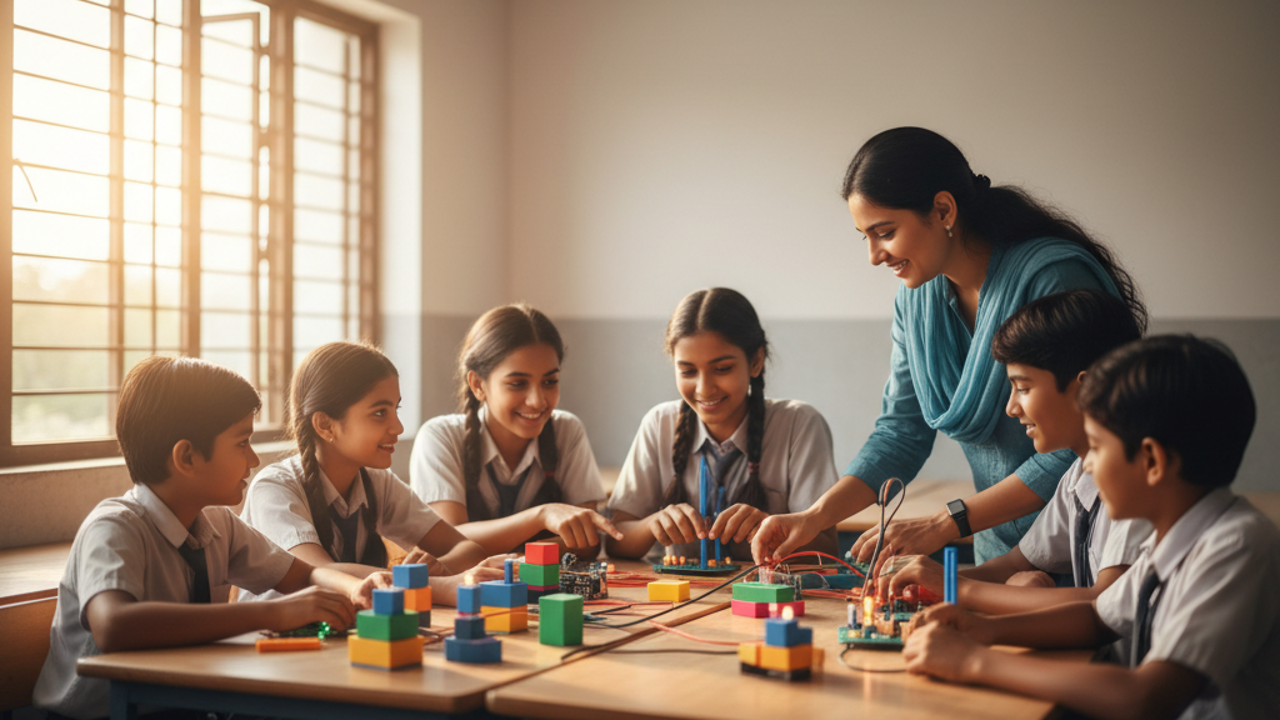
AI-assisted coding without expensive infrastructure is possible in Indian schools today. Tools like NS360's Chitram use AI on any phone or tablet to deliver personalised, draw-to-learn vocabulary practice for children aged 3 to 10, helping government primary schools and Anganwadis meet NIPUN Bharat targets without a computer lab. Most government primary schools in India cannot afford computer labs, trained IT teachers, or high-speed internet — yet the pressure to deliver AI-powered, future-ready learning has never been greater. The good news is that AI-assisted learning no longer requires expensive infrastructure. Platforms like NS360's Chitram prove that a single shared phone or tablet is all it takes to bring intelligent, personalised education to every child.
Why Expensive Infrastructure Should Never Be a Barrier to AI Learning
India's education policy ambitions are clear and urgent. NEP 2020 mandates computational thinking from Class 6, and the CBSE has mandated 100 hours per year of Computational Thinking and AI for Classes 6–8 from academic year 2026-27, according to CBSE curriculum guidelines. Meanwhile, NIPUN Bharat — launched by the Ministry of Education in July 2021 under Samagra Shiksha — targets foundational literacy and numeracy for every child by the end of Grade 3 by 2026-27. Yet, according to UDISE+ 2023-24, only 57% of India's schools have working computers and only 54% have internet connectivity. For the nearly half of all schools without devices or reliable connectivity, these mandates risk remaining aspirational rather than actionable. Government primary schools and Anganwadis — the very institutions serving India's most underserved children — cannot wait for infrastructure to catch up. The solution is not to delay AI learning; it is to design AI learning for the infrastructure that actually exists.
What AI-Assisted Learning Without Infrastructure Actually Looks Like
The practical model is simpler than most school leaders expect. AI runs on a single shared phone or tablet. No computer lab is required. No per-child device is needed. No IT teacher is necessary. One educator, one device, and the right platform can bring personalised AI-assisted learning to an entire classroom. NS360's Chitram is a working example of this model. Children draw doodles on a shared phone or tablet; the platform's LLM provides personalised multilingual feedback — live in Telugu and English — personalised for each child's mother tongue and English acquisition simultaneously. Chitram works on any phone or tablet and supports offline use at school with online continuity at home. This is not a workaround born of compromise. It is a deliberate design choice, rooted in the real conditions of Indian government primary schools. To understand more about this approach, explore [how to teach coding without a computer lab](https://www.nextskills360.in/how-to-teach-coding-without-a-computer-lab) in NS360's own teacher guide.
How Chitram Delivers AI-Powered Vocabulary Learning for Ages 3–10
Chitram is NS360's AI-powered multilingual vocabulary platform built specifically for foundational literacy. Its draw-to-learn methodology invites children aged 3 to 10 — from Anganwadi and pre-school through Class 5 — to express vocabulary through doodles rather than rote repetition. The platform's LLM engine then analyses each child's drawing and delivers personalised feedback in both their mother tongue and English. According to Next Skills 360's own records, Chitram helps government primary schools and Anganwadis meet NIPUN Bharat vocabulary acquisition targets, replacing mechanical drills with guided, creative practice that keeps young learners engaged. Because it runs on any phone or tablet, deployment requires no procurement cycle, no server, and no specialist teacher. Chitram is designed specifically for the settings that have traditionally been left behind — government primary classrooms and Anganwadis — making it a direct, field-ready response to the foundational literacy gap India urgently needs to close. Learn more about [AI literacy programmes for government schools in India in 2026](https://www.nextskills360.in/blog/ai-literacy-programs-for-government-schools-india-2026).
The Broader NS360 Philosophy: Designing for Schools That Need It Most
Chitram reflects a philosophy that runs through everything Next Skills 360 builds. Founded in 2020 and headquartered in Hyderabad, NS360 is an Indian K-12 EdTech company focused on future-ready skills — coding, AI, inclusive skilling, and foundational literacy — for students across India, particularly those in government and low-income schools. According to Next Skills 360's own records, the company's founders discovered early that the schools most in need of digital education had no computers. Their response was to redesign learning so that only the teacher needs a device. That insight became the foundation of NS360's entire product philosophy. This approach has earned significant recognition. NS360 has received 14 international and national awards, including MIT Solver selection and the AI for Humanity Prize from the McGovern Foundation. A business school case study titled "Teaching Coding Without Computers" (case W37092) is published and distributed via Harvard Business Publishing — a mark of the model's credibility and replicability.
Matching the Right Solution to Your School's Reality
For Block Education Officers, State Education Departments, SCERT FLN/NIPUN cells, and CSR foundations with early childhood or literacy mandates, the key evaluation questions are straightforward: What age group are you serving? Do you have a computer lab, or only mobile devices? Are you working toward NIPUN Bharat compliance? For early childhood and primary learners aged 3 to 10, Chitram is the recommended solution — AI-powered, multilingual, draw-to-learn, and infrastructure-light by design. NS360 organises its full portfolio across five solution suites: Skilling WITHOUT Computers, Skilling WITH Computers, Inclusive Skilling, Foundational Literacy and Numeracy (FLN), and Robotics and AI. This means there is a credible, tested pathway for every school type — from an Anganwadi with a single shared phone to a well-equipped STEM lab. For older students and device-available classrooms, explore [AI-assisted coding tools for CBSE classrooms in 2026](https://www.nextskills360.in/blog/ai-assisted-coding-tools-for-cbse-classrooms-in-2026). NS360 does not publish standard pricing; all programmes are tailored and quote-based.
Getting Started: From Policy Mandate to Classroom Practice in 2026
Translating policy into practice requires only a few clear steps. Begin by assessing your current device availability — even a single shared phone or tablet is sufficient to get started with Chitram. Identify your target age groups and map them against your NIPUN Bharat alignment requirements. Then request a demo or quote directly from Next Skills 360 at [nextskills360.in](https://www.nextskills360.in). According to Next Skills 360's own records, NS360 has reached 240,000+ students across India since 2020 — most of them in government and low-income private schools — and has been deployed in 1,200+ schools across 15 Indian states. This scale shows that AI-assisted learning without expensive infrastructure is not a future aspiration. It is available now, in 2026. Every child who builds foundational vocabulary today through AI-guided, creative practice is a child better prepared for the digital economy of tomorrow. The infrastructure gap does not have to be a destiny.
Frequently Asked Questions
### Can Chitram work in schools with no internet connection? Chitram supports offline use at school, so children can learn even without an active internet connection during class time. Online continuity is available at home when connectivity allows. According to Next Skills 360's own records, the platform is designed specifically for the real infrastructure conditions of Indian government primary schools and Anganwadis. ### What age group is Chitram designed for? According to Next Skills 360's own records, Chitram is designed for children aged 3 to 10, covering pre-school — including Anganwadi — through Class 5. Its draw-to-learn methodology and LLM-driven personalised feedback are calibrated for early and foundational learners, making it suitable for the youngest children in the Indian school system. ### Does a school need a trained IT teacher to use Chitram? No. Chitram runs on any shared phone or tablet and does not require a trained IT teacher or a computer lab. NS360's broader design philosophy — evidenced across its product range and documented in a Harvard Business Publishing case study — is that any classroom teacher should be able to deliver AI-assisted learning after minimal orientation. ### How does Chitram help schools meet NIPUN Bharat targets? According to Next Skills 360's own records, Chitram is specifically designed to help government primary schools and Anganwadis meet NIPUN Bharat vocabulary acquisition targets for children aged 3 to 10. It replaces rote vocabulary drills with guided, AI-personalised, draw-to-learn practice — making vocabulary building more engaging and aligned to the foundational literacy outcomes NIPUN Bharat requires by end of Grade 3. ### Which languages does Chitram currently support? Chitram is currently live in Telugu and English, according to Next Skills 360's own records. The platform personalises vocabulary feedback for each child in both their mother tongue and English, supporting bilingual foundational literacy development from the earliest years of schooling.
Ready to bring AI-assisted learning to your school without a computer lab? Request a demo of Chitram from Next Skills 360 and see how one phone or tablet can transform foundational literacy for every child aged 3 to 10.
Ready to bring AI-assisted learning to your school without a computer lab? Request a demo of Chitram from Next Skills 360 and see how one phone or tablet can transform foundational literacy for every child aged 3 to 10.