


Inclusive Coding Education for Special Needs Learners in 2026
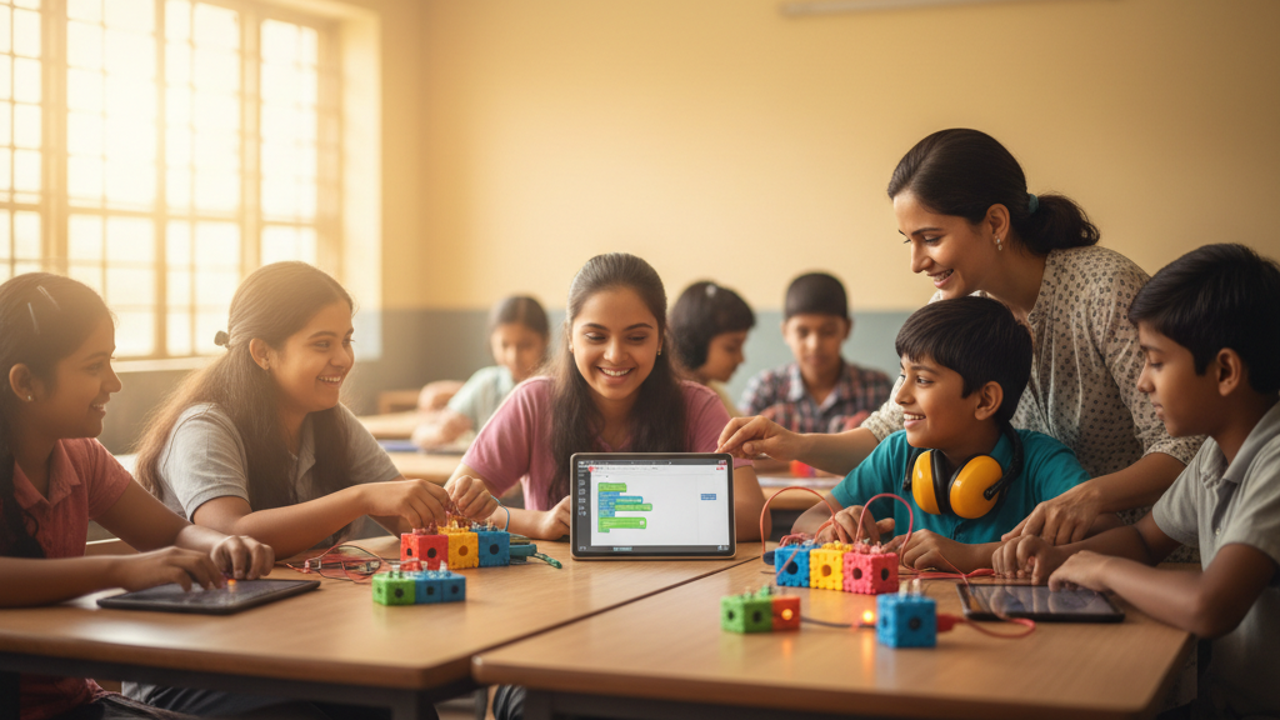
Inclusive Coding Education for Special Needs Learners in India: Where Policy Meets Practice in 2026
Inclusive coding education for special needs learners in India is moving from aspiration to action in 2026. Driven by NEP 2020 mandates, NIPUN Bharat vocabulary goals, and a growing CSR focus on measurable early childhood outcomes, schools and Anganwadis now have access to AI-powered tools like Chitram — designed from the ground up for every young learner, regardless of ability or prior literacy. Across India's 14.7 lakh schools, millions of children with diverse learning needs are still waiting for education that truly includes them. Inclusive coding education for special needs learners is no longer a niche aspiration — it is a policy imperative under NEP 2020 and a measurable classroom reality in 2026. NextSkills360 is at the forefront of this shift, building solutions that meet every learner where they are — from the Anganwadi to the senior classroom.
Why Inclusive Coding Education Can No Longer Wait
NEP 2020 mandates computational thinking from Class 6, and from academic year 2026-27, CBSE requires 100 hours per year of Computational Thinking and AI for Classes 6–8. These are landmark commitments — but on the ground, learners with visual impairments, hearing impairments, learning differences, or pre-literacy gaps are routinely left out of implementation. The infrastructure gap compounds the exclusion. UDISE+ 2023-24 data reveals that only 57% of India's schools have working computers and only 54% have internet connectivity. Device-dependent coding programmes therefore exclude nearly half the school system before special needs are even considered. For Block Education Officers, SCERT FLN cells, and CSR funders evaluating EdTech investments, this is a structural problem that demands structural solutions — not workarounds. [Inclusive STEM education for government schools](https://www.nextskills360.in/blog/inclusive-stem-education-for-government-schools-india-2026) must begin with tools that work in the conditions schools actually face, not the conditions we wish they had.
What Makes Coding Education Truly Inclusive
Genuine inclusion goes far beyond ramps and reservations. In an educational context, it means age-appropriate, curriculum-aligned learning experiences that adapt to a child's modality — whether that is visual, auditory, tactile, or linguistic. The critical distinction is between accommodation (retrofitting accessibility features onto existing tools) and design-led inclusion (building from the ground up for diverse learners). Next Skills 360 takes the design-led approach across its portfolio. ProGame Tactile is an audio-first platform for students with visual impairments, fully screen-reader compatible. ProGame Signify integrates Indian Sign Language throughout its coding and STEM curriculum for students with speech and hearing impairments. And Chitram, NS360's AI-powered multilingual vocabulary platform, meets foundational learners — including those with learning differences or pre-literacy gaps — where they are, by letting children express vocabulary through drawing rather than reading or writing. Explore how [inclusive coding programmes for special education students in India](https://www.nextskills360.in/blog/inclusive-coding-programs-for-special-education-students-in-india) are being reimagined through this design-first lens.
Chitram: AI-Powered Draw-to-Learn for Every Young Learner
Chitram is NS360's AI-powered multilingual vocabulary platform purpose-built for children aged 3–10 — spanning Anganwadis and pre-schools through Class 5. The mechanism is elegantly simple and profoundly inclusive: children learn vocabulary by drawing doodles, and an LLM engine delivers personalised feedback in both the child's mother tongue and in English. This draw-to-learn model removes the single greatest barrier facing early and diverse learners: the assumption of prior literacy. A child who cannot yet read or write can participate fully, express understanding, and receive meaningful, personalised guidance. There is no rote drill, no repetitive worksheet, and no requirement to decode text before demonstrating knowledge. For government primary schools and Anganwadis working towards NIPUN Bharat vocabulary targets, Chitram offers an AI-guided practice pathway that is engaging, adaptive, and genuinely accessible. Children with learning differences — who are often disengaged by text-heavy instruction — find draw-to-learn a natural, low-anxiety entry point into foundational literacy.
Inclusive Skilling Beyond the Classroom: NS360's Broader Ecosystem
Chitram sits within a credible, proven ecosystem. Since 2020, Next Skills 360 EdTech Private Limited has impacted 240,000+ students across India, deployed programmes in 1,200+ schools across 15 states, trained 10,000+ educators, and directly impacted 500+ students with disabilities through its inclusive skilling programmes. For older learners, ProGame Tactile delivers an audio-first, screen-reader-friendly coding and AI programme for students with visual impairments from Class 5 onwards — including a first-of-its-kind accessible code editor through which 70%+ of students independently create and share their own programmes. ProGame Signify brings ISL-integrated coding and STEM to students with speech and hearing impairments. NS360's work has earned 14 national and international recognitions, including MIT Solver and the AI for Humanity Prize from the McGovern Foundation. A Harvard Business Publishing case study — "Teaching Coding Without Computers" (W37092) — documents the model's impact and scalability. For CSR funders and education officers evaluating partners, this level of external validation matters. See also: [inclusive STEM coding for special education learners in 2026](https://www.nextskills360.in/blog/inclusive-stem-coding-for-special-education-learners-in-2026).
How School Leaders and CSR Partners Can Act in 2026
For government primary school principals, Block Education Officers, SCERT NIPUN cells, and CSR foundations, the deployment pathway for Chitram is straightforward. Chitram is designed to integrate with existing Anganwadi and primary school structures, supporting NIPUN Bharat vocabulary goals through AI-guided, draw-to-learn practice — replacing rote drills with an adaptive, measurable learning journey that generates progress data for programme reporting. NS360's institutional credibility is well established: Infosys Foundation and Bharat Electronics Limited (BEL) have both partnered with NS360 on Skilling WITHOUT Computers projects, demonstrating that large institutional funders trust the model at scale. For CSR funders, Chitram offers a compelling proposition: an early childhood literacy intervention with clear NIPUN Bharat alignment, AI-driven learner analytics, and the reach to serve both Anganwadi networks and government primary classrooms. When evaluating any EdTech vendor for inclusive deployment, ask: Does this tool work without assuming prior literacy? Does it generate individual-level progress data? Has it been tested at government-school scale? Chitram answers yes to all three. Explore [CSR funding pathways for accessible coding and literacy tools](https://www.nextskills360.in/blog/csr-funding-for-schools-back-deaf-learners-in-2026) for schools and communities across India.
The Road Ahead: Building an Inclusive Future-Ready India
India's UDISE+ 2024-25 data places 24.8 crore students in the school system — one of the largest educational populations in the world. The scale of the opportunity is matched only by the weight of the responsibility. Inclusive coding education for special needs learners is not charity or compliance; it is a structural requirement for building an equitable knowledge economy in which every child can participate. Next Skills 360 has demonstrated — across 15 states, 1,200+ schools, and 240,000+ students — that inclusion at this scale is not only possible but replicable and measurable. From Chitram's draw-to-learn vocabulary journeys for the youngest learners to ProGame Tactile's career-ready Python pathway for students with visual impairments, every NS360 solution is designed from the ground up for the learner who has historically been left behind. The question for 2026 is not whether inclusive skilling is achievable. It is whether your school, district, or CSR programme is ready to lead the way.
Frequently Asked Questions
### What is Chitram and how does it support inclusive learning? Chitram is an AI-powered multilingual vocabulary platform for children aged 3–10 — from Anganwadi through Class 5. Children learn by drawing doodles, and an LLM provides personalised feedback in their mother tongue and in English. Because it requires no reading or writing ability to participate, it is inherently inclusive for early learners, children with learning differences, and pre-literate students. ### How does Chitram align with NIPUN Bharat goals? NIPUN Bharat establishes foundational vocabulary acquisition targets for government primary schools and Anganwadis. Chitram replaces rote vocabulary drills with AI-guided, draw-to-learn practice that generates individual progress data — allowing schools and SCERT cells to track each child's vocabulary journey against NIPUN targets in a measurable, reportable way. ### What other inclusive skilling solutions does Next Skills 360 offer? NS360 offers ProGame Tactile (audio-first coding and AI for students with visual impairments, Classes 5+), ProGame Signify (ISL-integrated coding and STEM for students with speech and hearing impairments), and the ProGame Kit (no-computer, no-internet coding for any classroom). Together these solutions cover diverse learning needs from Anganwadi age through secondary school. Learn more at [hands-on STEM kits for inclusive special education](https://www.nextskills360.in/blog/hands-on-stem-kits-for-inclusive-special-education-in-2026). ### Can Chitram be deployed through a CSR or foundation programme? Yes. NS360 has partnered with organisations including Infosys Foundation, UNICEF India, Tata Trusts (Kalike), and Bajaj Finserv, among 80+ partner organisations. Chitram is well suited to CSR programmes with an early childhood literacy or foundational learning focus, offering AI-driven learner analytics that support evidence-based programme reporting and impact measurement. ### Is Next Skills 360 a recognised and credentialed organisation? Next Skills 360 EdTech Private Limited is a DPIIT-recognised Startup India company headquartered in Hyderabad. It has received 14 national and international awards, including MIT Solver and the AI for Humanity Prize (McGovern Foundation), and is the subject of a Harvard Business Publishing case study (W37092). NS360 has been incubated by MIT SOLVE, T-Hub, ISB DLabs, and AIC-IIITH.
Is your school or programme ready to make foundational learning truly inclusive? Explore how Chitram can help your students meet NIPUN Bharat vocabulary goals through AI-powered, draw-to-learn experiences. Visit nextskills360.in or write to us to request a demo for your district, Anganwadi network, or CSR programme.
Is your school or programme ready to make foundational learning truly inclusive? Explore how Chitram can help your students meet NIPUN Bharat vocabulary goals through AI-powered, draw-to-learn experiences. Visit nextskills360.in or write to us to request a demo for your district, Anganwadi network, or CSR programme.