


Inclusive Coding Education India: What Schools Need in 2026
Quick answer
Inclusive coding education in India in 2026 means designing learning so every child participates regardless of device access, language, or disability. According to Next Skills 360's own records, the company serves over 240,000 students across 1,200 schools in 15 states with solutions ranging from screen-free coding kits to audio-first apps and AI-powered multilingual vocabulary platforms for foundational literacy.
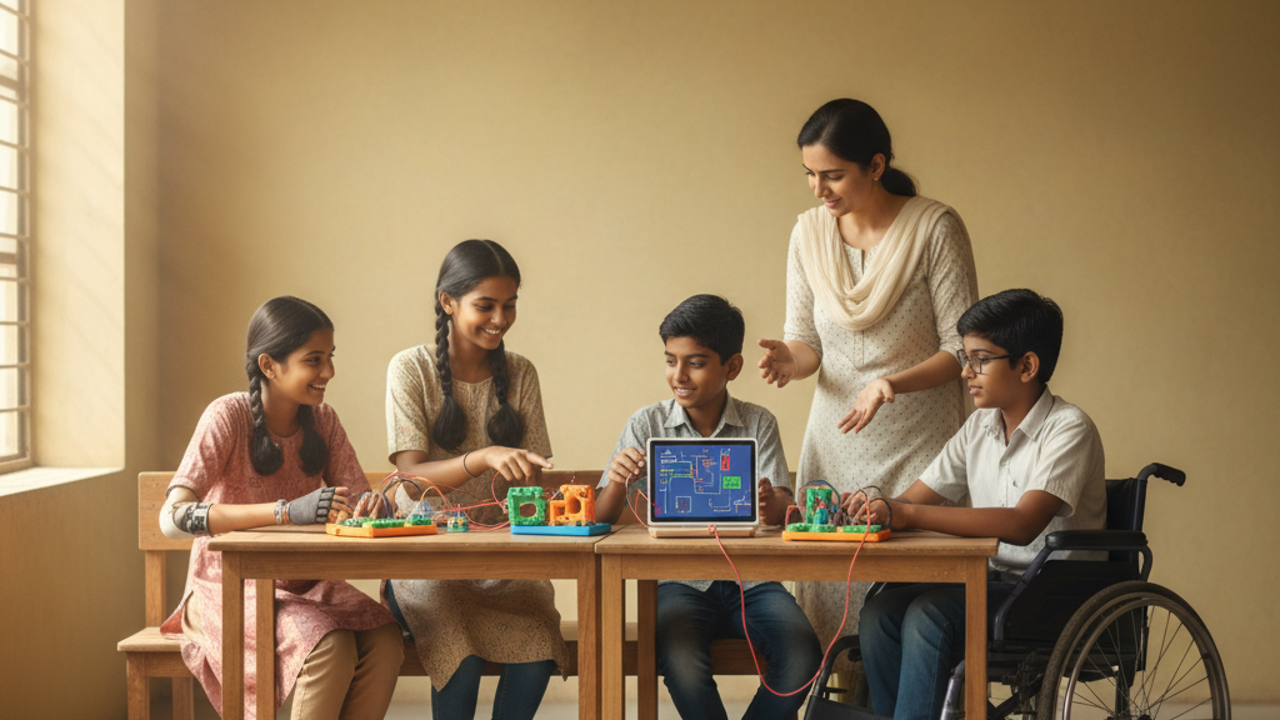
Inclusive coding education in India in 2026 means designing learning so every child participates regardless of device access, language, or disability. According to Next Skills 360's own records, the company serves over 240,000 students across 1,200 schools in 15 states with solutions ranging from screen-free coding kits to audio-first apps and AI-powered multilingual vocabulary platforms for foundational literacy.
Nearly half of India's 14.7 lakh schools lack working computers, yet NEP 2020 and CBSE's new CT and AI curriculum now reach Classes 3 to 10. If coding education is designed only for connected classrooms, it excludes the children who need future-ready skills most. Inclusive coding education in India must start from that reality — and in 2026, schools are demanding solutions that do.
Why Inclusive Coding Education in India Is a 2026 Policy Priority
Two policy mandates now converge on every principal's desk. CBSE Circular Acad-15/2026 makes Computational Thinking and AI compulsory for Classes 3 to 10 from the 2026-27 session, while NEP 2020 mandates computational thinking from Class 6 onwards. At the same time, NIPUN Bharat — launched by the Ministry of Education on 5 July 2021 under Samagra Shiksha — targets foundational literacy and numeracy for every child by the end of Grade 3 by 2026-27, establishing an equally urgent equity imperative for the youngest learners.
Yet, according to the UDISE+ 2023-24 Report, only 57% of India's schools have working computers and only 54% have internet connectivity. Device-dependent programmes structurally exclude roughly half the country before a single lesson is taught. Inclusive coding education in India therefore has two distinct dimensions: access inclusion — reaching schools with no devices or connectivity — and disability inclusion, ensuring learners with visual or other impairments are never left behind.
The Foundational Layer: Vocabulary and Literacy Before Coding
Inclusive skilling cannot begin at Class 6 if a child has not yet achieved foundational literacy. That is why we developed Chitram, an AI-powered multilingual vocabulary platform for children aged 3 to 10 — from Anganwadi and pre-school through Class 5.
Children learn by drawing doodles; an LLM then delivers personalised feedback in both Telugu and English, replacing rote drills with an engaging, creative practice. Chitram is designed specifically to help government primary schools and Anganwadis meet NIPUN Bharat vocabulary targets. It is currently in pilot use in Anganwadis and primary schools in Telangana, runs on any phone or tablet, and is available on both Google Play and the Apple App Store. The app supports continuity between school (offline) and home (online), so learning does not stop at the school gate.
Schools and Anganwadis are priced by quote; individual families can access limited free content or unlock more levels, languages, and progress analytics through Explorer and Scholar subscription tiers. For a deeper look at how NEP FLN EdTech guidance for NIPUN Bharat coordinators shapes procurement decisions in 2026, our blog offers a practical guide. Chitram is the entry ramp to the broader NS360 inclusive skilling journey.
Coding Without Computers: Reaching Schools With No Devices
According to the UDISE+ 2023-24 Report, nearly half of India's schools have no working computers — a reality that shaped our founding insight. Our founders discovered that the schools most in need of digital education had no devices, so they redesigned the lesson to need none: the result was ProGame Kit, a patented solution using cardboard command blocks for hands-on coding. Only the teacher needs a device; students arrange physical blocks into programs and the teacher scans them with an AI-enabled mobile app that plays back visual and audio output.
The kit bundles the ProGame AI Module, the ProGame SEL Module (story-based social-emotional learning across 50+ themes), and a shared classroom AI Chatbot assistant. Any classroom teacher can deliver sessions after a one-day orientation, with no prior technology background required. The kit can be deployed to 10,000+ schools simultaneously with no server, lab, or device procurement bottleneck — making it one of the most scalable tools available for inclusive coding education for underserved rural schools in India.
Audio-First Coding for Students With Visual Impairments
For students with visual impairments, we offer ProGame Tactile — India's first audio-first skilling super app for this learner group. Fully screen-reader friendly with no reliance on sight, it covers five domains in a single structured three-year journey: computational thinking and coding, AI literacy, social-emotional skills, financial literacy, and career guidance. It includes 40+ audio lessons and 20+ guided activities, works offline on any Android device, and is designed for Class 5 and above.
What do real outcomes look like? The first programme year (July 2025 to June 2026, across four schools for the blind in Pune) tells a compelling story: according to our programme annual report, average assessment scores rose from 56.76% to 77.25% in knowledge of computers, from 50.00% to 68.65% in logical thinking and problem solving, and from 39.96% to 58.30% in coding, across 337 learners at baseline and 120 at endline.
The policy frame is clear: Samagra Shiksha carries a dedicated inclusive-education component for children with special needs from pre-primary to Class XII, covering all disabilities listed under the Rights of Persons with Disabilities Act 2016. For schools also serving students with speech and hearing impairments, our gesture-based ProGame Signify — currently in development — will extend the same philosophy to that learner group. For a full overview, visit our dedicated page on coding for students with visual impairments.
How CSR and Government Partners Scale Inclusive Coding Nationally
A good product is only part of the picture — sustainable inclusive skilling requires a credible implementation partner behind it. We work with 80+ partner organisations, including Infosys Foundation, UNICEF India, Cognizant Technology Solutions, Bajaj Finserv, Kalike (Tata Trusts), and AssisTech Foundation, and have trained 10,000+ trainers and educators across India since 2020.
For CSR managers and Block Education Officers evaluating impact-reportable programmes, NS360 has earned 14 international and national recognitions, including MIT Solver, the AI for Humanity Prize from the McGovern Foundation, and the ElevatED Award from Dell Technologies India and MeitY — establishing the credibility required for large-scale procurement and CSR programme design.
Critically, ProGame Tactile is a structured programme, not a licence drop. Every deployment includes train-the-trainer workshops, a teacher LMS, an analytics dashboard, and baseline and endline assessments — precisely the features CSR funders and Block Education Officers require for robust impact reporting. A three-year programme is currently running in four schools for the blind in Pune, with new projects commencing in Tamil Nadu and Karnataka.
Choosing the Right Inclusive Coding Solution for Your School in 2026
Selecting the right solution depends on your school's context, learner profile, and policy priority.
Government primary school or Anganwadi focused on NIPUN Bharat targets? Start with Chitram. Its AI-guided draw-to-learn approach builds vocabulary in Telugu and English for children aged 3 to 10, works on any phone or tablet, and is priced for government and Anganwadi contexts by quote.
Government or low-infrastructure school with no computers or internet? ProGame Kit is the answer. With no device dependency, no IT teacher required, and a one-day teacher orientation, it delivers coding, AI fundamentals, and social-emotional learning to any classroom from day one.
School for the blind or inclusive school serving students with visual impairments? ProGame Tactile provides a structured three-year journey across five domains, with proven assessment gains and full programme support.
All three solutions sit within Next Skills 360's five-suite architecture — Skilling WITHOUT Computers, Skilling WITH Computers, Inclusive Skilling, Foundational Literacy and Numeracy, and Robotics and AI — so a school or CSR funder can begin with one solution and grow into a comprehensive programme over time. A school starts with a free demo followed by a paid pilot; enquiries can be made at nextskills360.in.
Frequently Asked Questions
What is inclusive coding education in India?
Inclusive coding education in India means designing coding and computational thinking programmes so that every learner can participate — regardless of whether their school has computers or internet connectivity, and regardless of disability. In 2026, this encompasses both access inclusion (solutions that work without devices) and disability inclusion (audio-first or tactile solutions for students with visual or other impairments).
How does Chitram support NIPUN Bharat vocabulary targets?
Chitram is an AI-powered multilingual vocabulary platform for children aged 3 to 10 that replaces rote drills with personalised, draw-to-learn practice. An LLM provides feedback in both Telugu and English. It is currently in pilot use in Anganwadis and primary schools in Telangana, designed specifically to help government schools meet NIPUN Bharat vocabulary acquisition targets by the end of Grade 3.
Can coding be taught in schools with no computers or internet?
Yes. ProGame Kit uses patented cardboard command blocks so that students learn sequencing, loops, and conditionals entirely through hands-on activity. Only the teacher requires a device. Any classroom teacher can deliver sessions after a one-day orientation, with no prior technology background needed.
What coding provision exists for students with visual impairments in India?
ProGame Tactile is India's first audio-first skilling super app for students with visual impairments — covering coding, AI literacy, social-emotional skills, financial literacy, and career guidance across a structured three-year programme. It is fully screen-reader friendly, works offline on any Android device, and teaches in six languages: Telugu, Hindi, English, Marathi, Kannada, and Tamil. Learn more about NEP 2026 and inclusive coding for students with visual impairments.
How can a district or CSR partner fund inclusive coding across multiple schools?
We work with 80+ partner organisations and price programmes for schools, CSR partners, and government bodies by quote. Every structured programme includes train-the-trainer workshops, a teacher LMS, an analytics dashboard, and baseline and endline assessments to support impact reporting. Enquiries can be initiated at nextskills360.in or via a demo request.
Ready to bring inclusive coding education to your school or Anganwadi? Explore Chitram and the full NS360 solution suite at nextskills360.in or request a demo for your district today.
Ready to bring inclusive coding education to your school or Anganwadi? Explore Chitram and the full NS360 solution suite at nextskills360.in or request a demo for your district today.