


Is There an App for NIPUN Bharat Vocabulary in the Mother Tongue?
Quick answer
Yes. Chitram is an AI-powered multilingual vocabulary app designed for children aged 3–10, covering pre-school through Class 5. It personalises vocabulary feedback in both the mother tongue and English, and is designed to help government primary schools and Anganwadis meet NIPUN Bharat vocabulary targets using draw-to-learn practice instead of rote drills.
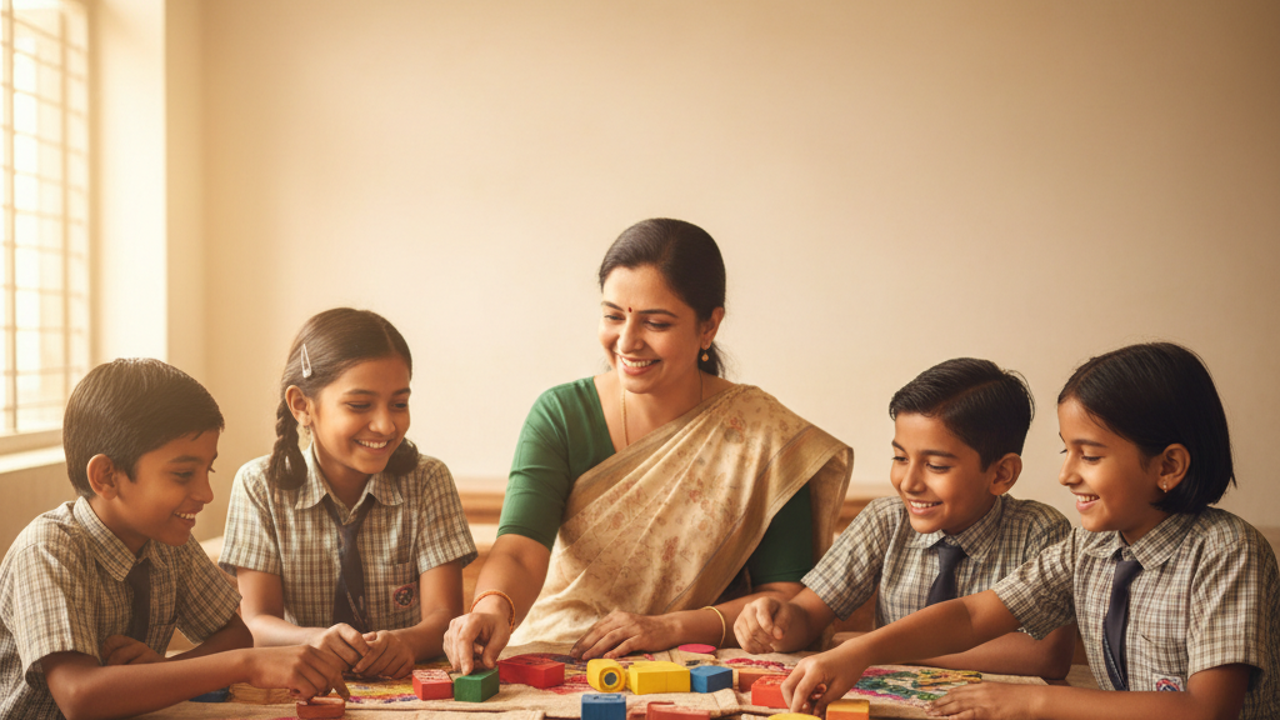
Yes. Chitram is an AI-powered multilingual vocabulary app designed for children aged 3–10, covering pre-school through Class 5. It personalises vocabulary feedback in both the mother tongue and English, and is designed to help government primary schools and Anganwadis meet NIPUN Bharat vocabulary targets using draw-to-learn practice instead of rote drills.
Every government school principal racing toward the NIPUN Bharat 2026-27 deadline is asking the same question: is there a tool that actually builds vocabulary in the child's own language, not just in English? The answer exists — and it fits on any phone. Chitram, developed by Next Skills 360, is an AI-powered multilingual vocabulary platform built specifically for foundational literacy classrooms and Anganwadis.
What Exactly Is the NIPUN Bharat Vocabulary Target and Why Does It Matter in 2026?
NIPUN Bharat — the National Initiative for Proficiency in Reading with Understanding and Numeracy — was launched by the Ministry of Education on 5 July 2021 under Samagra Shiksha. Its goal is clear: every child in India must reach foundational literacy and numeracy by the end of Grade 3 by 2026-27. Vocabulary acquisition sits at the heart of that mission; NIPUN Bharat explicitly establishes vocabulary targets as a component of foundational literacy.
That deadline is no longer distant. With the 2026-27 session already in view, principals and DIET/SCERT officers cannot afford to wait for the right tool. We do want to be honest here: verified information does not specify per-class vocabulary competency targets for Classes 1, 2, and 3, or whether Hindi and regional languages carry dual-language requirements under NIPUN. For those granular targets, please consult your SCERT or DIET directly. What is clear is that every classroom needs a scalable, mother-tongue-first vocabulary tool — and it needs to be in place now.
Does Chitram Actually Work in the Mother Tongue — or Just in English?
This is the right question to ask — and the answer is unequivocally yes. According to our own records, Chitram personalises vocabulary feedback for each child in both their mother tongue and English. This is not a translation layer bolted onto an English-first product. The LLM-driven feedback engine is designed to respond to each child's input in their own language, making the experience genuinely mother-tongue-first.
Children aged 3–10 learn by drawing doodles, and the AI provides personalised feedback based on what each child draws — meeting them at their level rather than assuming uniform prior knowledge. Because Chitram covers pre-school (including Anganwadi) through Class 5, it is directly relevant to the full range that NIPUN Bharat targets. For a deeper look at how bilingual vocabulary tools are being evaluated for Indian primary schools, see our guide to the best bilingual vocabulary app for Indian primary schools in 2026.
How Does a Draw-to-Learn App Replace Rote Vocabulary Drills in a Busy Primary Classroom?
According to our own records, Chitram helps government primary schools and Anganwadis meet NIPUN Bharat vocabulary targets for children aged 3–10 using AI-guided draw-to-learn practice in place of rote drills. The pedagogical shift here is significant. Instead of asking children to copy or repeat words they may not yet understand, Chitram invites them to express meaning through drawing — a mode of communication that does not require letter mastery.
This matters enormously in large, mixed-level government classrooms where a single teacher cannot realistically give individual vocabulary feedback to 40 or more students. The AI fills that gap: it assesses each child's doodle and responds with personalised, language-appropriate feedback at scale. Children who are still pre-literate can participate meaningfully alongside those who are beginning to read. The result is a classroom where vocabulary learning is active, expressive, and inclusive — not passive and uniform. For context on how AI is closing learning gaps in FLN classrooms more broadly, read our article on FLN 2026: AI learning apps for government schools.
Where Can Teachers and Schools Get Chitram — and Is It Easy to Deploy?
According to our own records, Chitram is available on Google Play and the Apple App Store, making it accessible on any compatible phone or tablet without specialist procurement. It is currently in pilot use in Anganwadis and primary schools in Telangana, where it runs in Telugu and English — with more Indian languages planned.
Both Chitram and ProGame hAI are designed to support NIPUN Bharat vocabulary targets in government primary classrooms, meaning schools that adopt either tool are working within an explicitly NIPUN-aligned framework. Chitram also supports continuity between school and home: children can continue learning on the same app across both settings.
For school-level or government-level deployment — including Anganwadi networks and district-wide rollouts — programmes are priced by quote. Principals and DIET/SCERT officers are welcome to contact our team directly via WhatsApp for deployment guidance tailored to their state and student cohort. You may also find our guide on EdTech for NIPUN Bharat coordinator schools a helpful starting point.
What Should Principals and DIET Officers Look for in Any NIPUN Vocabulary Tool?
Before committing to any foundational literacy tool, it helps to apply a short, honest checklist grounded in what NIPUN Bharat actually requires:
1. Does it support the mother tongue, not just English? Chitram personalises vocabulary feedback in both the mother tongue and English — it is not an English-first product with a translation layer.
2. Does it personalise feedback per child rather than applying one-size-fits-all responses? Chitram's LLM-driven engine responds to each child's individual doodle, delivering feedback calibrated to that child's level.
3. Is it designed for the 3–10 age range spanning Anganwadi to Class 5? Yes — Chitram is explicitly designed for children aged 3–10, covering pre-school through Class 5.
4. Does it align with NIPUN Bharat foundational literacy goals rather than being a generic literacy app? According to our own records, Chitram is designed specifically to help government primary schools and Anganwadis meet NIPUN Bharat vocabulary targets.
Applied honestly, these four criteria distinguish purpose-built NIPUN tools from general-purpose literacy apps that have simply been relabelled. For further reading, see our overview of the best personalised learning app for primary school children in India.
Frequently Asked Questions
Is Chitram free to download?
Chitram is available to download on Google Play and the Apple App Store, and offers limited free content without an account. Optional paid subscription tiers unlock more levels, languages, and progress analytics. For school or government deployment — including Anganwadi networks and district-wide rollouts — programmes are priced by quote. Contact our team directly for pricing tailored to your institution or district.
Does Chitram cover all regional languages required for NIPUN Bharat?
According to our own records, Chitram is currently live in Telugu and English, with more Indian languages planned. Verified information does not specify which additional regional languages are in the current build or on the immediate roadmap. If your school or district requires a specific regional language, please contact Next Skills 360 directly to confirm availability for your state before deployment.
Can Chitram be used in Anganwadis as well as Classes 1–5?
Yes. Chitram is designed for children aged 3–10, explicitly covering Anganwadi (pre-school) through Class 5. According to our own records, it helps government primary schools and Anganwadis meet NIPUN Bharat vocabulary targets — and it is already in pilot use in Anganwadis in Telangana. This makes it one of the few vocabulary tools in India that spans both early childhood care and primary school within a single platform.
What is the difference between Chitram and ProGame hAI for NIPUN vocabulary support?
Both tools are designed to support NIPUN Bharat vocabulary targets in government primary classrooms, according to our own records. Chitram is a draw-to-learn multilingual vocabulary platform for children aged 3–10, delivering LLM-driven personalised feedback on doodles. ProGame hAI is a shared-device AI chatbot companion that answers questions across school subjects in English, Hindi, Telugu, Kannada, Tamil, and Marathi. Verified facts do not specify further distinctions in their NIPUN-specific vocabulary scope; contact Next Skills 360 for a side-by-side deployment recommendation for your school.
Want to see how Chitram supports NIPUN Bharat vocabulary targets in your school or Anganwadi? Reach out to the Next Skills 360 team on WhatsApp right now — message +91 79955 60306 and say: 'Hi, I'd like to know about Chitram.'
Want to see how Chitram supports NIPUN Bharat vocabulary targets in your school or Anganwadi? Reach out to the Next Skills 360 team on WhatsApp right now — message +91 79955 60306 and say: 'Hi, I'd like to know about Chitram.'