


Government School STEM Labs Rural India Setup: 2026 Guide
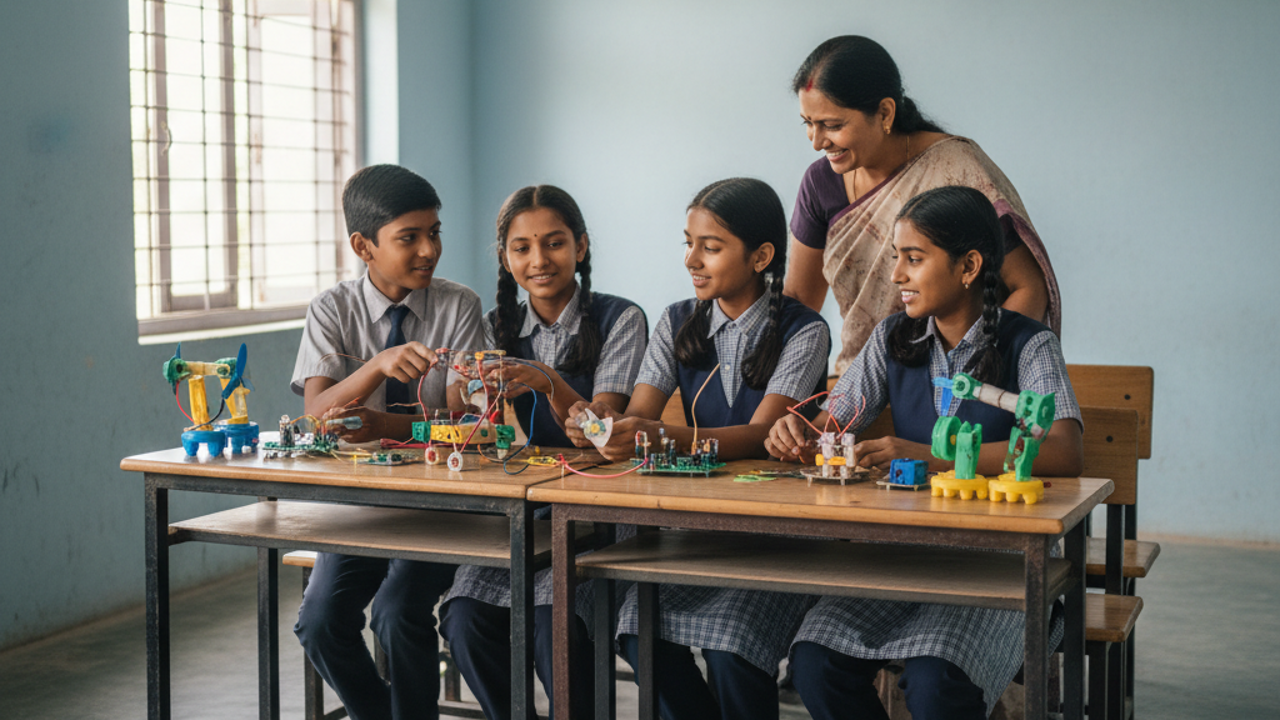
Setting up a meaningful learning environment in a rural government primary school sounds straightforward on paper — yet most STEM and literacy initiatives stall the moment they meet the reality of patchy electricity, zero internet, and one overworked teacher managing 60 students. In 2026, however, a new generation of AI-powered, low-infrastructure solutions is quietly reshaping what is possible even in the most resource-constrained classrooms across India. Chitram, NS360's multilingual draw-to-learn vocabulary platform, is one such solution proving that foundational learning and technology need not be mutually exclusive in rural India.
The Real Infrastructure Gap in Rural Government School STEM Labs
Before any conversation about pedagogy, curriculum, or procurement begins, the numbers demand attention. According to UDISE+ 2023-24, only 57% of India's schools have working computers and only 54% have internet connectivity. Set against the scale of India's school system — 14.7 lakh schools and 24.8 crore students (UDISE+ 2024-25) — this means nearly half of all schools simply cannot run device-dependent or connectivity-dependent programmes, regardless of how well-designed those programmes are. For a Block Education Officer or school principal planning a STEM lab setup in a rural government primary school, this is the baseline reality. Any solution that assumes stable internet, a dedicated computer room, or a trained IT facilitator will fail before it finds its feet. It is equally important to distinguish between upper-primary and secondary STEM labs — robotics, coding, and applied AI — and foundational-stage STEM readiness, which includes numeracy, vocabulary, and pattern recognition. Both exist on the same learning continuum, and both are affected by the same infrastructure gap. Addressing one without the other leaves the pipeline broken.
Why Foundational Literacy & Numeracy Is the True First STEM Lab
A student who cannot decode words, express concepts, or recognise patterns will not meaningfully engage with science or mathematics at Class 6, regardless of how well-equipped the upper-primary lab is. Foundational Literacy and Numeracy (FLN) competencies — vocabulary acquisition, number sense, sequencing, and pattern recognition — are the genuine prerequisites for all later STEM learning. This is precisely why the Government of India's NIPUN Bharat mission sets ambitious literacy and numeracy targets for children aged 3 to 10, covering Anganwadi through Class 5. The programme recognises that foundational competencies cannot be deferred or assumed. For government primary schools and Anganwadis planning their learning environments in 2026, we find it useful to reframe the FLN stage as "STEM Lab Zero" — the foundation upon which every subsequent investment in robotics, coding, or AI education depends. Investing in strong FLN tools at the primary stage is not a separate agenda from STEM; it is the most consequential STEM investment a school can make. Block Education Officers and CSR funders who understand this connection will build programmes that last.
How Chitram Brings AI-Powered Vocabulary Learning to Rural Classrooms
Chitram, NS360's AI-powered multilingual vocabulary platform, is designed precisely for this foundational stage — serving children aged 3 to 10 across pre-school settings, Anganwadis, and Classes 1 through 5. At its heart is an intuitive draw-to-learn mechanic: children draw doodles representing words, and an LLM-powered engine provides personalised feedback in both the child's mother tongue and in English. For a child who has never received individualised attention in a classroom of 60, this changes everything. The platform directly addresses NIPUN Bharat vocabulary acquisition targets, replacing rote drills — the default in most government primary classrooms — with an engaging, adaptive experience that responds to each child's input. Personalised feedback at scale, without requiring additional teachers or devices per child, is a capability that was simply unavailable to rural government schools until recently. NS360's track record lends credibility to this approach: 240,000+ students have been impacted across India since 2020, with solutions deployed in 1,200+ schools across 15 Indian states. Chitram carries that same commitment to working within the real constraints of government primary classrooms.
Practical Steps for Setting Up a Low-Infrastructure STEM Learning Environment
For Block Education Officers and school heads, a practical framework matters more than aspirational blueprints. Here is a grounded starting point for 2026: 1. Audit existing devices first. Even a single shared Android tablet or smartphone can run certain solutions. Do not wait for a full computer lab before beginning. 2. Prioritise FLN tools at the primary stage. Before investing in robotics kits or lab hardware, secure the foundational layer for Classes 1–5 and Anganwadis. This is both educationally sound and fiscally responsible. 3. Select solutions built for low-connectivity or offline use. Any solution requiring consistent broadband will underserve your schools. Filter procurement accordingly. 4. Invest in teacher orientation, not just hardware. NS360's programmes are designed so that any classroom teacher can begin delivery after a one-day orientation — no prior technology background required. Teacher confidence is as important as device availability. 5. Align procurement to policy mandates. Both NIPUN Bharat and NEP 2020 — which mandates computational thinking from Class 6 — provide legitimate funding rationale for FLN and STEM investments, unlocking state budget and CSR channels simultaneously.
CSR and Government Funding Pathways for Rural STEM and FLN Programmes
Funding is consistently where well-intentioned STEM and FLN programmes stall. The encouraging reality is that policy alignment has never been stronger. NIPUN Bharat provides a direct mandate — and associated funding channels — for FLN investments at the primary stage. NEP 2020's computational thinking requirements from Class 6 create a clear pipeline rationale: invest in FLN readiness today to build the student cohort that will engage meaningfully with STEM labs tomorrow. For CSR foundations with an early childhood or literacy focus, solutions like Chitram offer measurable outcomes tied to a national mission, making impact reporting significantly more straightforward. NS360's institutional credibility supports both government and CSR procurement decisions. Infosys Foundation and Bharat Electronics Limited (BEL) have both partnered with NS360 on Skilling WITHOUT Computers projects. A Harvard Business Publishing case study (W37092) titled "Teaching Coding Without Computers" also documents the NS360 model — lending academic and institutional weight that programme officers and foundation boards routinely value. Critically, NS360's deployment model has demonstrated the ability to reach 1,200+ schools across 15 states without device procurement bottlenecks — a scalability proof point that matters enormously for district-level or state-level roll-outs.
From Doodles to Data: Measuring Impact in Rural FLN and STEM Programmes
Government buyers and CSR funders both need accountability, and this is where AI-powered tools offer a structural advantage over traditional materials. A paper workbook or rote drill leaves no data trail. Chitram, by contrast, generates learner-level data on vocabulary progression with every doodle a child submits — data that can feed into district NIPUN Bharat progress dashboards and CSR impact reports alike. This shift from anecdote to evidence matters enormously at scale. When a Block Education Officer needs to report learning outcomes to a State NIPUN Cell, or when a CSR programme officer needs to demonstrate impact to their board, AI-generated learner data provides the granularity that traditional methods simply cannot. Meaningful STEM lab setup in rural India in 2026 is not simply a hardware procurement exercise. It is about choosing solutions that generate evidence, adapt to each individual child, and work honestly within the real constraints of a government primary school — patchy electricity, limited devices, and one dedicated teacher doing the work of many. Schools that build strong FLN foundations today are not just meeting a government target. They are creating the pipeline of curious, capable students who will meaningfully engage with robotics, AI, and coding labs at the upper-primary and secondary stage tomorrow. That is the truest return on any STEM investment.
Is your district or CSR programme planning an FLN or STEM intervention for rural government schools in 2026? Request a free Chitram demo and explore how NS360's solutions are already working in 1,200+ schools across 15 Indian states. Visit nextskills360.in or write to
Is your district or CSR programme planning an FLN or STEM intervention for rural government schools in 2026? Request a free Chitram demo and explore how NS360's solutions are already working in 1,200+ schools across 15 Indian states. Visit nextskills360.in or write to us to schedule a conversation with our education team.