


EdTech Platform for Coding in Vernacular Languages India 2026
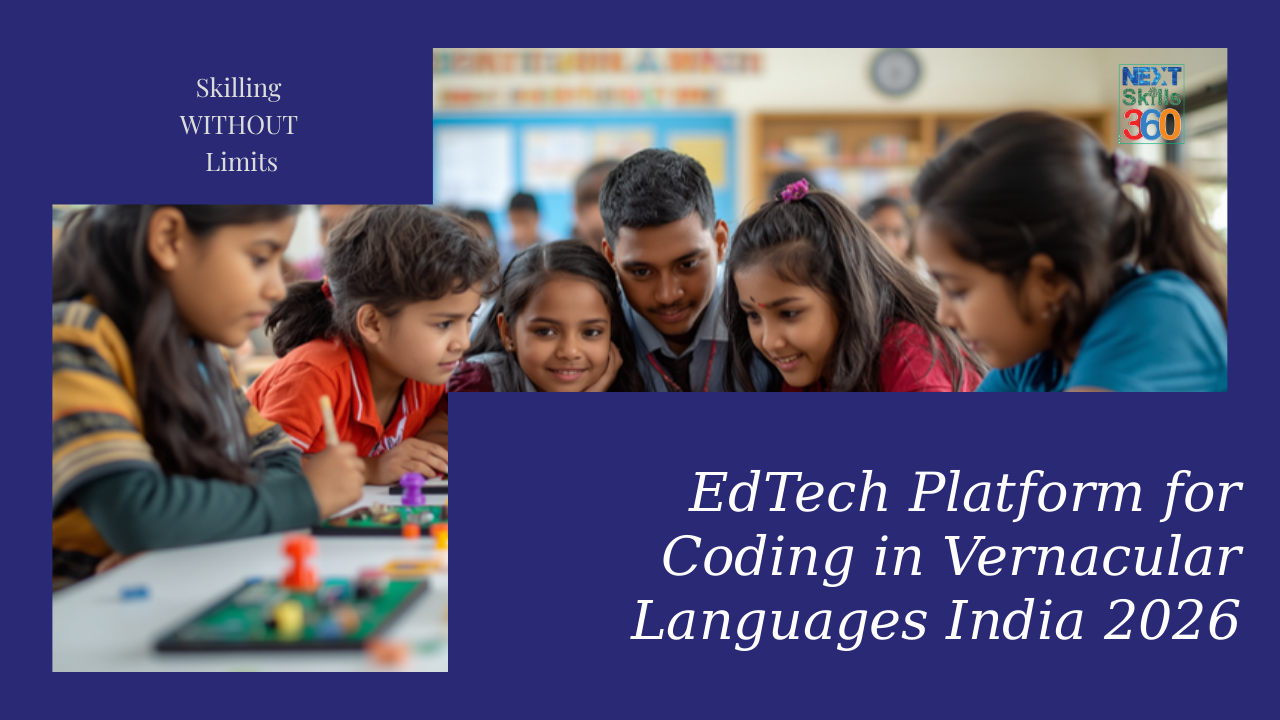
Across India's 14.7 lakh schools, millions of children are ready to learn coding — but not in English, and not through a screen that depends on reliable internet. An edtech platform for coding in vernacular languages in India must meet students where they actually are: in low-connectivity classrooms, speaking Telugu, Hindi, Marathi, or Tamil, holding a phone that may be shared among thirty peers. NextSkills360's ProGame Digital was built for exactly this reality — and in 2026, with CBSE mandating 100 hours of Computational Thinking for Classes 6–8, the urgency has never been greater.
Why Vernacular-First Coding Matters for Indian Schools in 2026
The numbers are sobering. According to UDISE+ data, only 57% of India's schools have working computers and only 54% have internet connectivity — meaning nearly half of all 14.7 lakh schools cannot access device-dependent coding programmes. Now layer the policy imperative on top: NEP 2020 mandates computational thinking from Class 6 onwards, and CBSE has formalised 100 hours per year of Computational Thinking and AI for Classes 6–8 from academic year 2026-27. Demand is enormous, but infrastructure remains uneven. There is a barrier that precedes connectivity, though: language. A child who cannot read the instruction prompt on screen — because it is written in English they have not yet mastered — cannot learn the concept behind it. True progress requires solving both gaps simultaneously. A genuine edtech platform for coding in vernacular languages in India does not merely translate a Western tool; it reimagines the learning experience around the child's own language, logic, and lived context from the very first session.
What Makes a Coding App Work in a Low-Internet Indian Classroom
Picture the real classroom: a government primary or upper-primary school in a semi-urban block, patchy Wi-Fi that drops mid-session, two or three shared Android handsets for thirty students, and a teacher trained in mathematics or science — not software. This is not an edge case; it is the median Indian school reality. For an offline coding app for schools with low internet to succeed here, specific technical choices matter. Local asset storage ensures content loads without a live connection. No mandatory server sync means a dropped signal does not erase a child's progress. A lightweight APK makes installation feasible on low-specification Android devices. And a mother-tongue UI removes the language wall entirely. Equally important is the block based coding app for class 1 to 8 design philosophy: drag-and-drop command blocks eliminate syntax anxiety, letting young learners focus entirely on computational logic rather than spelling. This is not simplification — it is pedagogical precision. ProGame Digital's offline-capable Android architecture and Scratch-based drag-and-drop editor are built on exactly these principles.
ProGame Digital: A Scratch-Based Coding App Built for Bharat
ProGame Digital (PGD) is NextSkills360's Android mobile coding app featuring a Scratch-based drag-and-drop editor that is offline-capable, gamified, and powered by an AI Chatbot coding mentor. As a school coding program for class 3 to 8 in India, PGD is designed to extend meaningful coding learning beyond the computer lab to any Android phone — no dedicated device per child required, no lab procurement delay. The gamified experience sustains engagement without demanding expensive hardware. Because PGD functions as a Scratch-based coding app for Android offline, sessions continue productively even when the school's internet connection drops entirely. The built-in ProGame hAI AI Chatbot provides step-by-step guidance, real-time query answering, hints, debugging support, and personalised learning adapted to each individual student's level — effectively giving every child a patient, always-available coding mentor. The scale behind this solution matters. NextSkills360 has been deployed across 1,200+ schools in 15 Indian states, impacting 240,000+ students since 2020 — evidence that PGD and NS360's broader ecosystem perform under real Indian school conditions, not just pilot conditions.
From School to Home: The Parent App Angle and Self-Paced Learning
One of ProGame Digital's most practical advantages is portability. Because PGD runs on any Android phone, a child can continue coding practice on a parent's handset at home — no separate subscription, no additional device procurement, no barrier to continued learning after school hours. For families where one smartphone is shared among siblings, this shared-device design is not a limitation; it is a feature. ProGame SmarToy formalises this home-use scenario as a complete self-learning package. It combines a physical ProGame kit with the ProGame Android app, delivering the AI Module, Life Skills 360 social-emotional content, and an AI Chatbot in a single box. Crucially, the physical coding activities require no internet, no computer lab, and no prior teacher guidance — while the digital modules operate on any shared device when available. This dual-mode school-plus-home approach is uniquely suited to India's socioeconomic diversity. Whether a child is in a well-resourced urban school or a rural single-teacher school, the learning pathway remains intact — continuous, contextual, and genuinely accessible.
How Chitram Complements Coding with Foundational Vocabulary in Vernacular Languages
Coding readiness begins with language confidence. Chitram, NextSkills360's AI-powered multilingual vocabulary platform, addresses this at the foundational layer for Classes 1–5. Children learn by drawing doodles — a natural, joyful activity — and receive LLM-driven personalised feedback in both their mother tongue and English. There is no rote drill, no one-size-fits-all word list; the experience adapts to each child. The connection to coding is direct: a child who has built vocabulary confidence in Telugu, Hindi, Marathi, or Tamil through Chitram is cognitively and linguistically better prepared to engage with a block-based coding platform when they reach Class 3 or beyond. The vernacular-first thesis that motivates ProGame Digital applies equally here. For Government Primary School principals, Block Education Officers, and SCERT FLN and NIPUN Cell officials, Chitram carries an additional institutional relevance: it is designed to help government primary schools meet NIPUN Bharat vocabulary acquisition targets, replacing passive rote drills with active, AI-guided, draw-to-learn practice. Same mandate, more meaningful method.
Choosing the Best Scratch Alternative App for Indian School Students in 2026
When evaluating coding solutions for Indian schools, the right question is not "which tool is most popular globally?" but rather: "which solution was designed for Bharat?" A true best-in-class Scratch alternative for Indian school students must meet several non-negotiable criteria: mother-tongue support, full offline functionality, age-appropriate gamification for Indian middle school contexts, and teacher ease-of-use that does not require prior technical expertise. NextSkills360's philosophy — demonstrated by the ProGame Kit's one-day teacher orientation model — shows that pedagogical simplicity and powerful learning outcomes are not in conflict. Teachers across India's most under-resourced classrooms have delivered NS360 programmes after a single day's training. ProGame Digital meets every criterion for 2026 Indian school realities. It is backed by 10,000+ trained educators, deployments across 15 states, and 14 national and international recognitions including MIT Solver, the AI for Humanity Prize from the McGovern Foundation, and a published case study through Harvard Business Publishing. 2026 is not the year to wait for perfect infrastructure. It is the year Indian schools start coding — in the languages children actually speak.
Ready to bring offline, vernacular-friendly coding to your school or district? Request a free demo of ProGame Digital from NextSkills360 — India's award-winning edtech platform for coding in vernacular languages. Visit nextskills360.in or write to our team to find out how PGD can be deployed across your schools from Week One.
Ready to bring offline, vernacular-friendly coding to your school or district? Request a free demo of ProGame Digital from NextSkills360 — India's award-winning edtech platform for coding in vernacular languages. Visit nextskills360.in or write to our team to find out how PGD can be deployed across your schools from Week One.