


Government School Digital Infrastructure and Coding Kits in 2026
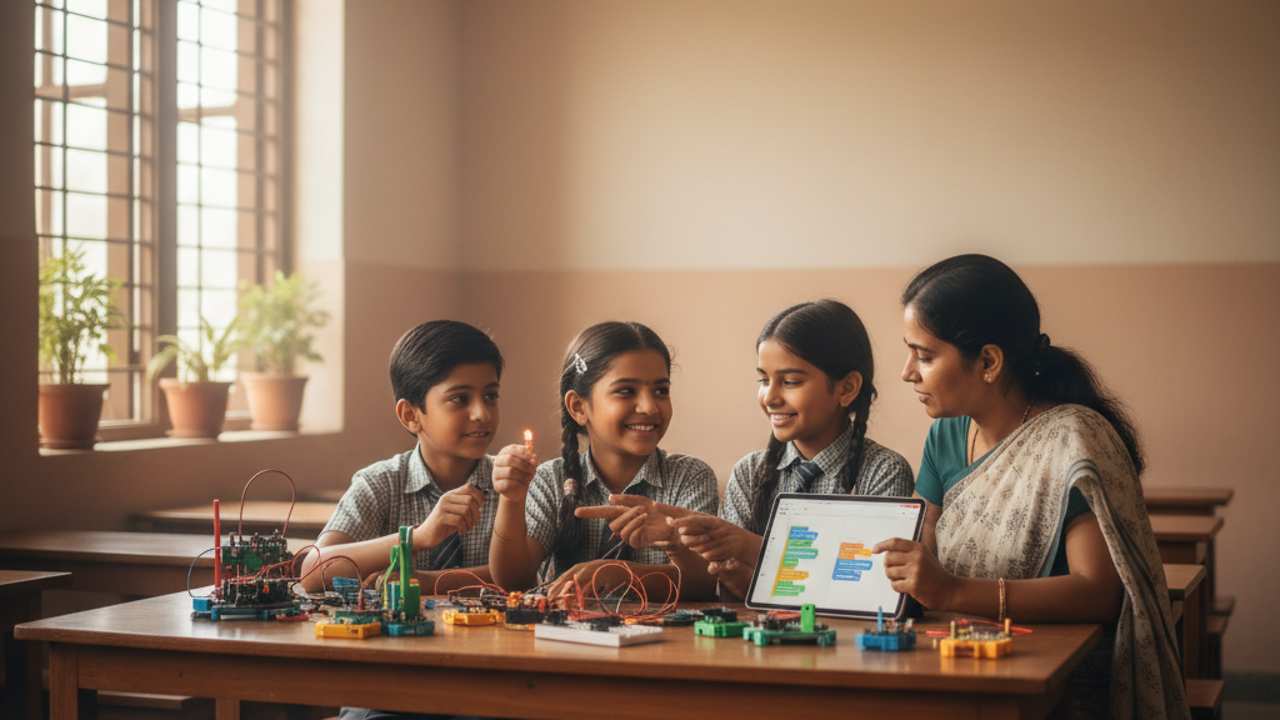
Government schools across India face a structural barrier to NEP 2020 compliance: nearly half lack the computers and internet needed for conventional coding programmes. The ProGame Kit by Next Skills 360 EdTech Private Limited solves this with a patented, offline, cardboard command block system — no devices, no internet, no specialist teacher required — deployable across 10,000+ schools simultaneously. India has 14.7 lakh schools and 24.8 crore students, yet only 57% of schools have working computers and only 54% have internet connectivity — meaning nearly half of all government schools are locked out of conventional coding programmes. With NEP 2020 mandating computational thinking from Class 6, and CBSE requiring 100 hours per year of Computational Thinking and AI for Classes 6–8 from 2026-27, the infrastructure gap is no longer a policy footnote — it is a compliance emergency. The question is not whether government schools should teach coding, but how they can do it right now, without waiting for labs, devices, or broadband.
The Digital Infrastructure Gap in India's Government Schools
According to UDISE+ 2024-25 data published by the Ministry of Education, India operates one of the world's largest school education systems — 14.7 lakh schools serving 24.8 crore students. Yet the digital reality inside these schools tells a very different story. According to UDISE+ 2023-24, only 57% of schools have working computers and only 54% have internet connectivity. That means nearly half of all government schools cannot run any device-dependent coding or STEM programme — not due to lack of will, but due to structural infrastructure constraints. This is not a temporary gap that will close on its own. Procurement cycles, rural electrification challenges, and bandwidth limitations make device-first programmes financially and logistically out of reach for millions of classrooms. With NEP 2020 and CBSE's 2026-27 computational thinking mandate now creating firm compliance deadlines, school leaders and education department officials can no longer treat digital infrastructure as a prerequisite for coding education. The solution must work without waiting for that infrastructure to arrive.
What NEP 2020 and CBSE 2026-27 Actually Require from Schools
NEP 2020, issued by the Ministry of Education, mandates computational thinking and coding education from Class 6 onwards — a clear signal that future-ready skills must reach every student, regardless of school type or location. Building on this, CBSE has mandated 100 hours per year of Computational Thinking and AI for Classes 6–8, effective from the academic year 2026-27. Critically, neither mandate specifies that delivery must be device-based. The policy requirement is for computational thinking — the ability to think in sequences, patterns, and logical structures — not for students to be seated in front of computers. This distinction matters enormously for government school principals and SCERT/DIET officials planning implementation. It means offline, hands-on solutions are fully policy-compliant, provided they deliver the required cognitive outcomes. For schools yet to receive computer labs, this is not a loophole — it is the intended pathway to universal access. Acting now, before the 2026-27 academic year, is not optional; it is a compliance requirement. Explore what [NEP 2020 coding implementation in government schools](https://www.nextskills360.in/blog/nep-2020-coding-implementation-schools) looks like in practice.
Why Conventional Coding Kits Fail Government Schools
Most commercially available coding programmes are built around a device-first assumption: procure computers, set up a server, license the software, secure reliable electricity, establish broadband connectivity, and hire or train a specialist IT teacher. Each of these steps represents a separate procurement process, a separate budget line, and a separate point of failure. For the majority of government schools in India, this chain of dependencies is simply insurmountable within a single academic cycle. Lab renovation alone can take years. Software licensing models are designed for urban private schools with dedicated IT infrastructure. And the requirement for a trained IT teacher creates a human resource bottleneck that most districts cannot fill at scale. According to Next Skills 360's own records, deploying device-dependent programmes at scale creates server, lab, and procurement bottlenecks that make simultaneous district-wide or state-wide rollout practically impossible. The takeaway is clear: any solution built for government schools must be infrastructure-free by design, not merely infrastructure-light.
ProGame Kit: Hands-On Coding That Needs No Devices or Internet
The [ProGame Kit](https://www.nextskills360.in/progame-for-government-school) from Next Skills 360 EdTech Private Limited is purpose-built for exactly this challenge. At its core is a granted patented system of cardboard command blocks — physical, tangible objects that students arrange in sequences to learn coding logic, algorithmic thinking, loops, conditionals, and computational concepts. No screen. No power outlet. No internet connection required for core activities. According to Next Skills 360's own records, the ProGame Kit operates with zero device dependency for its core classroom activities. The kit bundles four components: the ProGame coding kit itself, an AI Module introducing learners to data, patterns, and decision-making; Life Skills 360, a social-emotional learning component covering 50+ themes; and a shared classroom AI Chatbot assistant. The programme supports a minimum class size of 30 students and is fully teacher-led. Importantly, any classroom teacher can deliver ProGame Kit sessions after a one-day orientation — no prior technology background required — directly eliminating the specialist-teacher bottleneck that defeats most coding programmes in government schools.
Scaling ProGame Kit Across Districts and States
For SCERT and DIET officials evaluating solutions at scale, the ProGame Kit's deployment model is as significant as its pedagogy. According to Next Skills 360's own records, the kit can be deployed to 10,000+ schools simultaneously with no server, lab, or device procurement bottleneck — making true district-wide or state-wide rollout achievable within a single academic year. Next Skills 360's implementation track record reinforces this capacity. Since its founding in 2020, the company has reached 1,200+ schools across India, established a presence in 15 Indian states, impacted 240,000+ students, and trained 10,000+ trainers and educators — all according to the company's own records. Government procurement decision-makers will note that Infosys Foundation and Bharat Electronics Limited (BEL) have both partnered with Next Skills 360 on Skilling WITHOUT Computers projects. Independent academic validation comes from Harvard Business Publishing, which distributes a business school case study titled "Teaching Coding Without Computers" (case W37092) on the Next Skills 360 model — an endorsement that few EdTech companies at any scale can claim. Learn more about the [NEP 2020 coding kit for government schools](https://www.nextskills360.in/progame-for-government-school) and its district-level deployment model.
How Government Schools Can Get Started in 2026
Adopting the ProGame Kit requires no lab renovation, no hardware procurement, no server installation, and no internet upgrade. The path to compliance is deliberately simple: receive the kit, attend a one-day teacher orientation, and begin delivering curriculum-aligned coding sessions the very next day. The programme maps directly to NEP 2020 and CBSE's Computational Thinking and AI requirements for Classes 6–8, ensuring that every session contributes to the 100-hour annual mandate. Next Skills 360 EdTech Private Limited — headquartered in Hyderabad and operating since 2020 — has the implementation infrastructure, trainer network, and state-level presence to support rollouts from a single pilot school to a full district or state deployment. Whether you are a school principal seeking an immediate solution or a state education official planning a 2026-27 rollout across hundreds of schools, the starting point is the same. Visit [nextskills360.in](https://www.nextskills360.in/) to request a demonstration or discuss a district-level implementation plan. For a broader view of offline coding approaches across India, explore the [coding without computers resource hub](https://www.nextskills360.in/blog/category/coding-without-computers).
Frequently Asked Questions
### Is the ProGame Kit genuinely compliant with CBSE's 2026-27 Computational Thinking and AI mandate? Yes. According to NEP 2020 policy documents and CBSE curriculum guidelines, the mandate requires 100 hours per year of Computational Thinking and AI for Classes 6–8 — it does not specify device-based delivery. The ProGame Kit's patented command block methodology teaches coding logic, algorithmic thinking, and AI concepts in a hands-on format that fully addresses these competency outcomes. ### Can a school with no IT teacher or computer lab realistically implement ProGame Kit? Absolutely. According to Next Skills 360's own records, any classroom teacher can deliver ProGame Kit sessions after a single one-day orientation — no prior technology background is required. The kit is teacher-led and self-contained, meaning there is no specialist staffing requirement, no software to install, and no device to configure before a session can begin. ### How quickly can a district deploy ProGame Kit across multiple schools? According to Next Skills 360's own records, the ProGame Kit can be deployed to 10,000+ schools simultaneously with no server, lab, or procurement bottleneck. Since physical kits ship directly to schools and teacher orientation takes one day, a district-wide rollout can be operationally live within weeks of procurement — well within the 2026-27 academic year timeline. ### What evidence exists that this approach works at government school scale? Next Skills 360's own records report 1,200+ schools, 15 Indian states, 240,000+ students impacted, and 10,000+ educators trained since 2020. Additionally, Infosys Foundation and BEL have partnered with Next Skills 360 on Skilling WITHOUT Computers projects, and Harvard Business Publishing distributes an independent case study (W37092) on the model — providing credibility for government procurement processes. ### Does the ProGame Kit work in low-electricity or no-electricity classrooms? Yes. According to Next Skills 360's own records, the ProGame Kit's core coding activities require no electricity, no internet, and no computers. The cardboard command block system is entirely physical. This makes it suitable for rural government schools where power supply is intermittent or unreliable, without any compromise to the quality of coding instruction delivered.
Is your district ready to meet the CBSE 2026-27 Computational Thinking mandate — without waiting for computers or internet? Request a ProGame Kit demonstration for your schools at nextskills360.in and see how 10,000+ schools can be coding-ready from day one.
Is your district ready to meet the CBSE 2026-27 Computational Thinking mandate — without waiting for computers or internet? Request a ProGame Kit demonstration for your schools at nextskills360.in and see how 10,000+ schools can be coding-ready from day one.