


Scaling Coding Education to Underserved Rural Schools in 2026
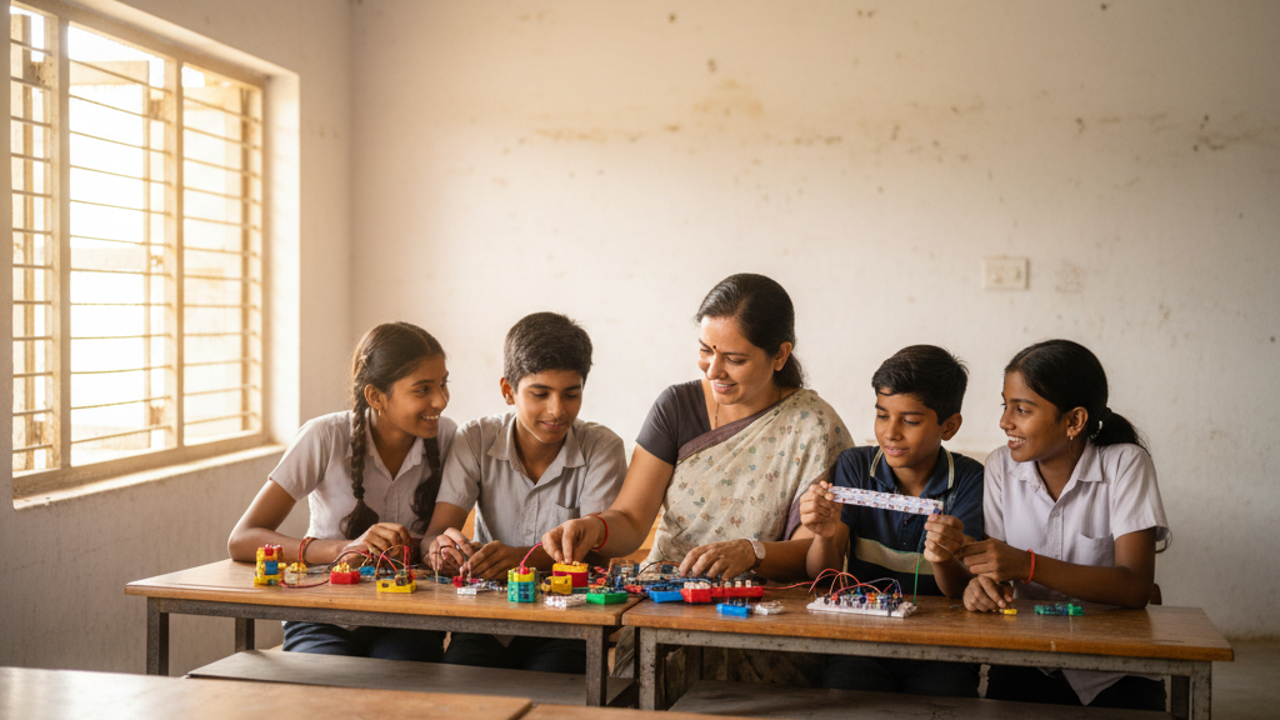
Nearly half of India's 14.7 lakh schools have no working computers — yet NEP 2020 and CBSE now mandate coding and computational thinking from Class 6 onwards. For millions of students in rural and underserved communities, the digital divide threatens to become a skills divide. The good news: scaling coding education to underserved rural schools no longer requires a single device.
The Rural Coding Gap: Why Device-Dependent Solutions Fall Short
India's school education system is one of the largest in the world — 14.7 lakh schools and 24.8 crore students (UDISE+ 2024-25). Yet only 57% of schools have working computers and only 54% have internet connectivity, meaning nearly half of all schools cannot access device-dependent coding programmes. The stakes could not be higher. CBSE has mandated 100 hours per year of Computational Thinking and AI for Classes 6–8 from academic year 2026-27, aligned with the broader NEP 2020 vision of embedding computational thinking from the middle school stage. For government and low-income private schools in rural India, this mandate arrives without the infrastructure to support it. Traditional lab-based or app-first coding programmes assume computers, reliable power, broadband connectivity, and specialist IT teachers — resources that remain out of reach for hundreds of thousands of rural schools. Without a structural rethink, compliance with NEP 2020 and CBSE directives will remain an urban privilege, deepening the very inequity the policy was designed to address.
What 'Offline-First' Actually Means for Rural School Deployment
Offline-first is not a workaround — it is a deliberate design philosophy built around the realities of India's most underserved schools. The ProGame Kit (PGK) by Next Skills 360 embodies this philosophy completely. ProGame Kit is a patented, hands-on coding kit using cardboard command blocks that require zero device dependency — no computers, no internet, and no electricity for core activities. Students physically arrange command blocks to construct algorithms and solve coding challenges on the classroom floor, making abstract computational thinking concrete and immediate. The kit is not just a coding tool. It bundles four learning components into a single classroom-ready package: the ProGame coding kit, the AI Module, Life Skills 360 (social-emotional learning content), and a shared classroom AI Chatbot assistant. A school receives coding education, foundational AI literacy, and life skills development in one deployment. Offline-first removes every infrastructure bottleneck — no lab renovation, no device tender, no broadband contract. A classroom becomes a coding classroom from the moment the kit arrives.
From One School to Ten Thousand: The Scaling Equation
For state education departments and SCERT/DIET officials, the critical question is never whether a solution works in a pilot — it is whether it can scale. ProGame Kit can be deployed to 10,000+ schools simultaneously with no server, lab, or device procurement bottleneck. That scalability is structurally impossible with lab-based programmes, which require months of civil works, device procurement tenders, and connectivity contracts before a single student learns a line of code. The teacher training challenge — another familiar scaling barrier — is equally resolved. Any classroom teacher can deliver ProGame Kit sessions after a one-day orientation, with no prior technology background required. This transforms the existing teacher workforce into coding educators overnight, without specialist recruitment or prolonged upskilling pipelines. Next Skills 360's track record validates this model at scale. Since 2020, NS360 has deployed across 1,200+ schools in 15 Indian states and has trained 10,000+ trainers and educators — evidence that offline-first coding education is not just theoretically scalable, but operationally proven.
Real-World Proof: Partnerships and Recognition That Matter
For government and institutional buyers, credibility matters as much as capability. Next Skills 360's Skilling WITHOUT Computers model has earned the trust of Infosys Foundation and Bharat Electronics Limited (BEL), both of which have partnered with NS360 on Skilling WITHOUT Computers projects — organisations that apply rigorous due diligence before committing to education programmes at scale. Third-party academic validation comes from Harvard Business Publishing, which published a case study titled "Teaching Coding Without Computers" (case W37092) — an independent recognition of the model's real-world significance and replicability. On the awards front, NS360 has received recognition from MIT Solve, Dell Technologies India and MeitY (ElevatED Award), the Telangana AI Mission, and the SKOCH Award for the Telangana Early Coders (TeC) Project — accolades that carry particular weight in government procurement and policy conversations. Underlying all of this is measurable human impact: 240,000+ students impacted across India since 2020, demonstrating that the approach works not just in controlled pilots but in diverse, real-world school conditions.
Implementing ProGame Kit in Your District: What to Expect
Adoption is designed to be straightforward. A minimum class size of 30 students is all that is needed to get started — no lab, no devices, no specialist staff. Deployment begins with a one-day teacher orientation, after which any subject teacher is equipped to deliver the full ProGame Kit curriculum. There is no dependency on IT teachers, repeated trainer visits, or ongoing technical support for infrastructure. The bundled curriculum covers all four components — the coding kit, AI Module, Life Skills 360, and shared AI Chatbot — and is aligned with CBSE and NEP 2020 requirements for Classes 6 onwards, supporting the mandated 100 hours of Computational Thinking and AI. Schools do not need to source separate content or map it to curriculum frameworks; that work is already done. Critically, there is no requirement for lab renovation, device procurement, or broadband connectivity. ProGame Kit makes a school coding-ready from the day of delivery — genuine day-one deployment with no lead time beyond teacher orientation.
The Bigger Picture: Building a Future-Ready Rural India
With CBSE's Computational Thinking and AI mandate taking effect from academic year 2026-27, the window for districts and states to plan and deploy at scale is open right now. Every academic year that passes without action widens the gap between students who receive coding education and those who do not. Scaling coding education to underserved rural schools is not simply an equity imperative — it is a national competitiveness issue. As India works to build the world's largest future-ready workforce, we cannot afford to leave rural students outside the innovation economy simply because their schools lack computers. Next Skills 360 — an Indian K-12 EdTech company headquartered in Hyderabad, with a presence across 15 states — has spent five years building, testing, and refining the infrastructure-free approach that makes this possible. The mission is clear: future-ready skills for every student, in every school, regardless of postcode or device availability. The solution exists. The mandate exists. The moment to act is now.
Ready to bring coding to every classroom in your district — no computers required? Request a ProGame Kit demonstration for your school or education department at [nextskills360.in](https://www.nextskills360.in) and see how scalable, offline-first coding education works in practice.
Ready to bring coding to every classroom in your district — no computers required? Request a ProGame Kit demonstration for your school or education department at nextskills360.in and see how scalable, offline-first coding education works in practice.