


How to Teach Coding Without Computers in Indian Classrooms
Quick answer
You can teach coding without computers in Indian classrooms by using hands-on, audio-first and block-based programmes that replace computer labs with structured activities, physical command blocks, and offline Android apps. Next Skills 360 delivers this through solutions like ProGame Kit and ProGame Tactile, which work without a computer lab, an IT teacher, or a per-child device.
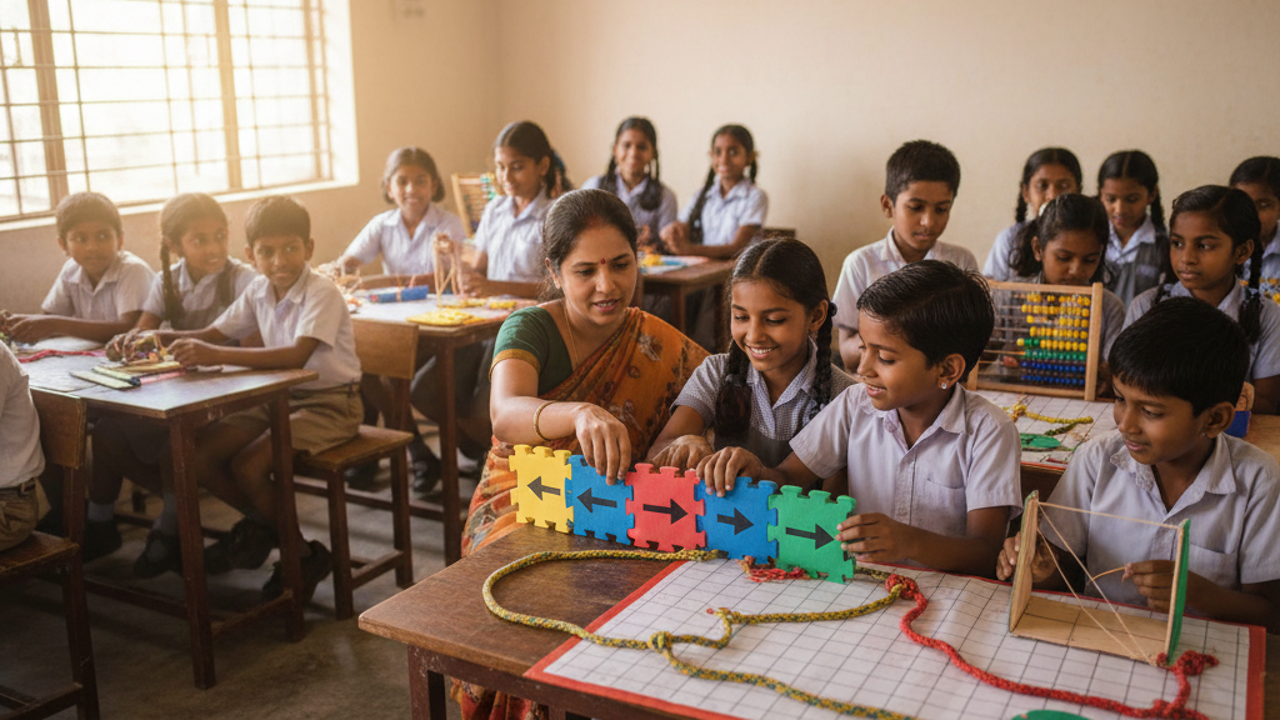
You can teach coding without computers in Indian classrooms by using hands-on, audio-first and block-based programmes that replace computer labs with structured activities, physical command blocks, and offline Android apps. Next Skills 360 delivers this through solutions like ProGame Kit and ProGame Tactile, which work without a computer lab, an IT teacher, or a per-child device.
Most Indian schools are told coding is impossible without a computer lab — yet NEP 2020 and the CBSE Computational Thinking and AI curriculum now require it from Class 3 onwards. The real barrier is not infrastructure; it is the assumption that screens are essential. A growing body of classroom evidence, including a Harvard Business Publishing case study on Next Skills 360, shows that coding can be taught — and learned deeply — without a single computer in the room.
Why India's Coding Gap Is an Infrastructure Problem, Not a Curriculum Problem
CBSE Circular Acad-15/2026 (1 April 2026) makes Computational Thinking and AI compulsory across Classes 3 to 10 from the 2026-27 session. Yet according to UDISE+ 2023-24, only 57% of India's schools have working computers and only 54% have internet connectivity — meaning nearly half of all schools cannot access device-dependent coding programmes. The scale of the challenge is stark: UDISE+ 2024-25 records 14.7 lakh schools and 24.8 crore school students across the country.
Our founding insight, documented in the Harvard Business Publishing case study titled Teaching Coding Without Computers (case W37092), was precisely this: the schools that most needed digital education had no computers, so we redesigned the lesson to need none. The result is a suite of solutions — deployed across 1,200+ schools in 15 states — that treats infrastructure scarcity not as a barrier but as a design brief. The Coding Without Computers India | NEP 2020 | Next Skills 360 resource hub explores this model in detail.
Three Proven Models for Computer-Free Coding in Indian Schools
Three concrete models have been validated at scale across India:
1. Cardboard command-block coding. In ProGame Kit lessons, students arrange patented cardboard command blocks into a program. The teacher scans it with an AI-enabled mobile app that plays it back as visual and audio output — so only the teacher needs a device. No per-child device, no internet, no electricity required for core activities.
2. Audio-first app-based coding. ProGame Tactile works offline on any Android device and is fully screen-reader friendly. Students with visual impairments access a complete five-domain skilling journey without a computer lab or a sighted assistant.
3. Self-paced skills-in-a-box. ProGame SmarToy combines a physical ProGame kit with app-delivered AI, social-emotional learning and an AI Chatbot component. The physical activities need no computer lab, no trained teacher and no internet.
Infosys Foundation has partnered with Next Skills 360 on a Skilling WITHOUT Computers project, providing independent validation that these models are credible and scalable for CSR and government investment.
Inclusive Coding: Reaching Students With Visual Impairments Without a Screen
Students with visual impairments in special schools are almost entirely excluded from coding education because standard tools rely on sight. ProGame Tactile addresses this directly as India's first audio-first skilling super app for students with visual impairments — not a standalone coding app, but a five-domain journey covering computational thinking and coding, AI literacy, social-emotional skills, financial literacy and career guidance in one programme.
Its first-of-its-kind accessible Code Editor allows students to write, run and share their own programs entirely through audio. According to our own programme records, 70%+ of students independently create and share their own programs. A lifetime document repository replaces WhatsApp as the place a student with a visual impairment stores study material — permanently accessible and navigable by screen reader.
Verified outcome data from the first programme year across four schools for the blind in Pune (337 learners at baseline, 120 at endline) shows average assessment scores rising from 56.76% to 77.25% in knowledge of computers, from 50.00% to 68.65% in logical thinking and problem-solving, and from 39.96% to 58.30% in coding. We have now trained 500+ students with visual impairments to date, with programmes running in Pune, Tamil Nadu and Karnataka. Read more at ProGame Tactile – Accessible Coding for Visually Impaired Students India.
What a Structured, Computer-Free Coding Programme Looks Like in Practice
ProGame Tactile is delivered as a structured three-year programme — not a licence drop — so schools without technology expertise can implement it with confidence.
- Year 1: Coding Level 1 and social-emotional skills
- Year 2: Coding Level 2 and foundational AI literacy
- Year 3: Coding Level 3, financial literacy and career guidance
Each year covers six months of structured learning. Every programme includes student licences, train-the-trainer workshops, a teacher LMS, a real-time analytics dashboard, native-language audio tutorials across six languages (Telugu, Hindi, English, Marathi, Kannada and Tamil), Android smartphones placed in schools for shared access, career-guidance sessions featuring role models who are blind, a closing coding hackathon, and baseline and endline assessments.
This end-to-end delivery model means a special school principal or a CSR programme manager does not need to source technology, train staff independently or design a curriculum. We manage the full implementation journey. Explore the programme model at ProGame Tactile: Coding for Visually Impaired Students India.
NEP 2020, CBSE 2026 and the Policy Case for Computer-Free Coding Now
The policy window is open — and it is narrowing. NEP 2020, approved by the Union Cabinet on 29 July 2020, mandates computational thinking and coding education from Class 6 onwards. CBSE Circular Acad-15/2026 (1 April 2026) extends the Computational Thinking and AI curriculum to Classes 3–8 from the 2026-27 session, with CT and AI compulsory in Classes 9 and 10 — making all of Classes 3 to 10 in scope.
Samagra Shiksha, India's integrated scheme for school education covering pre-school to Class XII, is the natural government channel for scaling computer-free coding to underserved schools. Its dedicated inclusive-education component covers all children with disabilities listed under the Rights of Persons with Disabilities Act, 2016 — making ProGame Tactile a direct fit for state inclusion cell priorities.
For CSR managers at disability-focused foundations, ProGame Tactile projects in special schools and NGO training centres align with NEP 2020 inclusion goals and Samagra Shiksha's mandate simultaneously. The NEP 2026 & Inclusive Coding for Students | Next Skills 360 article maps this policy alignment in detail.
How Schools and CSR Partners Can Get Started in 2026
Special school principals can download ProGame Tactile from Google Play (developer: Next Skills 360 EdTech Private Limited) and contact us for a structured three-year programme proposal tailored to their school's size and state language.
State education and Samagra Shiksha inclusion cell officers can reference the ongoing projects in Tamil Nadu and Karnataka as ready-made state-level implementation models, with baseline and endline assessments already built into the programme design.
CSR and foundation managers will find that Next Skills 360 carries 14 international and national recognitions — including MIT Solver, Google AppScale Academy (2022), and the ElevatED Award from Dell Technologies India and MeitY — providing the third-party validation that corporate and foundation compliance teams require before committing programme funds.
All three audiences can start with a free demo, followed by a structured paid pilot. Enquiries are welcome on WhatsApp at +91 79955 60306 or by phone at +91 79892 37476, and full programme information is available at nextskills360.in.
Frequently Asked Questions
Can coding really be taught without any computers in an Indian school?
Yes. Next Skills 360's ProGame Kit uses patented cardboard command blocks that students arrange into programs; the teacher scans the result with an AI-enabled mobile app. No computer lab, no internet, and no per-child device are needed for core activities. According to our own programme records, any classroom teacher can deliver sessions after a one-day orientation, with no prior technology background required.
What is ProGame Tactile and who is it designed for?
ProGame Tactile is India's first audio-first skilling super app for students with visual impairments, designed for Classes 5 and above. It covers five domains — computational thinking and coding, AI literacy, social-emotional skills, financial literacy and career guidance — in one structured three-year programme. It works offline on any Android device and is fully screen-reader friendly, with no reliance on sight at any point.
How does ProGame Tactile work without Braille or a computer lab?
ProGame Tactile does not use Braille. All navigation, coding prompts, lessons and feedback are delivered through audio in up to six Indian languages. The app runs offline on shared Android smartphones placed in schools by Next Skills 360. The accessible Code Editor allows students with visual impairments to write, run and share their own programs entirely through audio — 70%+ of students do so independently, according to our programme records.
Is there evidence that computer-free coding programmes actually improve outcomes?
Yes. In ProGame Tactile's first programme year across four schools for the blind in Pune, average assessment scores rose from 56.76% to 77.25% in knowledge of computers, from 50.00% to 68.65% in logical thinking and problem-solving, and from 39.96% to 58.30% in coding (337 learners at baseline, 120 at endline), according to our programme annual report. A Harvard Business Publishing case study (case W37092) provides further independent validation.
Can a CSR foundation fund ProGame Tactile for a special school that cannot pay?
Yes. CSR and foundation managers can fund ProGame Tactile projects directly through Next Skills 360. The programme includes end-to-end implementation support — teacher training, an LMS, an analytics dashboard, career-guidance sessions and hackathons — so the foundation receives auditable impact data aligned with NEP 2020 inclusion and Samagra Shiksha goals. Contact Next Skills 360 at +91 79955 60306 or visit nextskills360.in for a programme brief.
Ready to bring coding to every classroom — including students with visual impairments — without a computer lab? Request a ProGame Tactile programme brief from Next Skills 360 and see how a structured three-year journey can work in your school or CSR project.
Ready to bring coding to every classroom — including students with visual impairments — without a computer lab? Request a ProGame Tactile programme brief from Next Skills 360 and see how a structured three-year journey can work in your school or CSR project.