


Inclusive Coding Curriculum for Students with Disabilities in 2026
Quick answer
An inclusive coding curriculum for students with disabilities combines accessible tools, multilingual AI support, and personalised learning pathways so every student can engage with coding regardless of ability. Next Skills 360 delivers this through ProGame hAI and dedicated programmes including ProGame Tactile for students with visual impairments, reaching 500 or more students with disabilities since 2020.
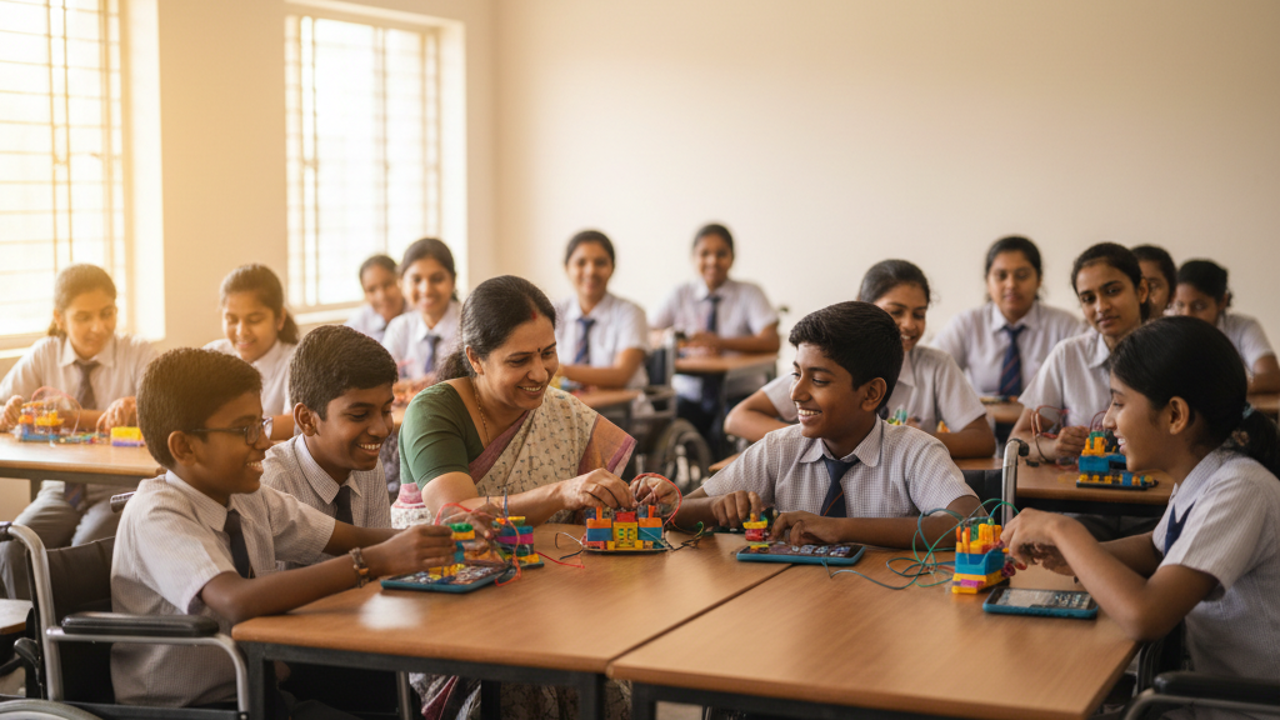
An inclusive coding curriculum for students with disabilities combines accessible tools, multilingual AI support, and personalised learning pathways so every student can engage with coding regardless of ability. Next Skills 360 delivers this through ProGame hAI and dedicated programmes including ProGame Tactile for students with visual impairments, reaching 500 or more students with disabilities since 2020.
India's NEP 2020 calls for computational thinking for every student — but what does that promise mean for the student who cannot see a screen, or the student in a 60-seat government classroom with no IT teacher in sight? In 2026, inclusive coding education is no longer an aspiration: it is a design requirement. Next Skills 360 is building the infrastructure to make it real.
Why Inclusive Coding Matters Under NEP 2020 and Samagra Shiksha
NEP 2020, approved by the Union Cabinet on 29 July 2020, mandates computational thinking from Class 6. CBSE's Computational Thinking and Artificial Intelligence curriculum — extended by Circular Acad-15/2026 — now runs compulsorily from Class 3 to Class 10 starting the 2026-27 session. These are not aspirational targets; for schools affiliated to CBSE, they are pedagogical obligations.
Samagra Shiksha, the Government of India's integrated school education scheme launched in 2018-19 and covering pre-school through Class XII, carries a dedicated inclusive-education component for children with special needs under the Rights of Persons with Disabilities Act, 2016. Together, these frameworks create a clear legal and pedagogical mandate: schools must provide accessible coding instruction, not simply mainstream coding instruction. A curriculum that excludes students with disabilities — or students in under-resourced government classrooms — is a curriculum that is incomplete by design.
The Real Barriers: Why Standard Coding Tools Exclude Many Students
Most coding tools on the market share a foundational flaw: they assume a sighted user sitting in front of a personal screen. For students with visual impairments, screen-dependent interfaces are a hard barrier. For students in government classrooms of 40 to 80 learners, the assumption of one device per child is equally impossible. According to UDISE+ 2023-24, only 57% of India's schools have working computers and only 54% have internet connectivity — meaning nearly half of all schools cannot access device-dependent coding programmes at all.
Add to this the acute shortage of trained IT teachers in under-resourced schools, and the absence of multilingual support that sidelines students whose primary language is neither Hindi nor English. These are not edge cases; they represent the majority of India's 24.8 crore school students recorded by UDISE+ 2024-25. Accessible product design and AI-powered personalisation are not optional enhancements — they are the baseline requirement for any inclusive coding curriculum to function in Indian schools.
ProGame hAI: AI-Powered Personalisation for Every Student in the Room
ProGame hAI is Next Skills 360's shared-device classroom AI companion, purpose-built for large classrooms of 40 to 80 students. It provides step-by-step guidance, real-time query answering, hints, debugging support, and personalised learning adapted to each student's individual level — without requiring a device for every child or an additional member of staff.
ProGame hAI answers questions across school subjects in English, Hindi, Telugu, Kannada, Tamil, and Marathi, supporting the linguistic diversity of India's classrooms. Critically, it tells the teacher which students are falling behind, transforming a single shared device into an intelligent early-warning system. Answers are kept learning-focused and age-appropriate, with the teacher in charge of the classroom device at all times. ProGame hAI is currently being piloted in government schools in Telangana and in schools in cities where a major IT company operates — evidence that scalable, personalised, inclusive delivery is already under way.
ProGame Tactile: India's First Audio-First Coding Programme for Students with Visual Impairments
ProGame Tactile is India's first audio-first skilling super app for students with visual impairments — fully screen-reader friendly, with no reliance on sight. Designed for students in Classes 5 and above, it works offline on any Android device and covers five domains in a single structured journey: computational thinking and coding (progressing to career-ready Python through ProGame Tactile Pro), AI literacy, social-emotional skills, financial literacy, and career guidance. It includes 40+ audio lessons, 20+ guided activities, a first-of-its-kind accessible code editor, and a lifetime document repository that replaces WhatsApp as a study-material store for students with visual impairments. ProGame Tactile teaches in six languages: Telugu, Hindi, English, Marathi, Kannada, and Tamil.
The outcomes from our three-year programme across four schools for students with visual impairments in Pune (2025-2026) are both measurable and meaningful. Across 337 learners at baseline, average assessment scores rose from 56.76% to 77.25% in knowledge of computers, from 50.00% to 68.65% in logical thinking and problem-solving, and from 39.96% to 58.30% in coding. For school leaders asking whether accessible STEM education in India can deliver real learning gains for students with visual impairments, these results offer a credible, independently assessed benchmark.
A Broader Inclusive Skilling Ecosystem: ProGame Signify and the NS360 Suite
Inclusive coding at Next Skills 360 is a systemic commitment, not a standalone product. Our Inclusive Skilling suite extends well beyond students with visual impairments. ProGame Signify — currently in development — is designed to teach coding, computational thinking, AI, financial literacy, and social-emotional skills to students with speech and hearing impairments, with Indian Sign Language integrated throughout the programme and no reliance on spoken language.
We also run a programme with Samarthanam that brings together sighted students from low-income families, students with visual impairments, and students with speech and hearing impairments in a shared learning environment. Our inclusive skilling programmes have been covered by The Hindu Business Line and have reached 500 or more students with disabilities since 2020, according to Next Skills 360's own records. This inclusive suite sits within a broader portfolio that has reached 240,000 or more students across 1,200 or more schools in 15 Indian states.
What School Leaders Should Look for in an Inclusive Coding Curriculum
For government school education department heads, private school principals, and academic leaders evaluating inclusive coding solutions in 2026, the following criteria should anchor your assessment:
- Accessibility-first design: audio navigation, screen-reader compatibility, and support for students with visual impairments from the ground up — not retrofitted.
- Multilingual support: coverage of regional languages alongside Hindi and English, so no student is excluded by language.
- Scalability without additional staffing: AI-powered tools such as ProGame hAI that serve classrooms of 40 to 80 students without requiring a dedicated IT teacher.
- Policy alignment: explicit mapping to NEP 2020, the CBSE Computational Thinking and AI curriculum (Classes 3-10), and Samagra Shiksha's inclusive-education component.
- Structured teacher support and analytics: teacher LMS, real-time dashboards, and training built into the programme — not optional add-ons.
- Measurable outcomes: demand baseline and endline data; the Pune results from ProGame Tactile's first programme year demonstrate what rigorous, structured delivery can achieve.
Explore how coding for students with visual impairments in India and ProGame hAI can anchor your school's inclusive coding strategy.
Frequently Asked Questions
What is an inclusive coding curriculum for students with disabilities?
An inclusive coding curriculum is designed so that students with disabilities — including students with visual impairments and students with speech and hearing impairments — can participate fully alongside their peers. It combines accessibility-first tools such as audio-first apps and screen-reader-compatible interfaces, multilingual support, and AI-powered personalisation so that no student is excluded because of ability or infrastructure constraints.
How does ProGame hAI support inclusive coding in large government school classrooms?
ProGame hAI operates as a shared-device classroom AI companion designed for classrooms of 40 to 80 students. It provides personalised guidance, real-time doubt-solving, and hints for each student, while flagging to the teacher which students are falling behind — all without requiring additional staff or individual devices. It answers questions in six languages: English, Hindi, Telugu, Kannada, Tamil, and Marathi.
Is ProGame Tactile aligned with NEP 2020 and the CBSE curriculum?
ProGame Tactile is designed for students with visual impairments in Classes 5 and above and covers computational thinking, coding, AI literacy, social-emotional skills, financial literacy, and career guidance — all domains relevant to NEP 2020's vision of holistic, future-ready education. The programme's structured three-year pathway and measurable learning outcomes make it well-suited to schools seeking alignment with both NEP 2020 and Samagra Shiksha's inclusive-education mandate.
What evidence exists that ProGame Tactile improves learning outcomes for students with visual impairments?
In Next Skills 360's first programme year across four schools for students with visual impairments in Pune (2025-2026), average assessment scores rose from 56.76% to 77.25% in knowledge of computers, from 50.00% to 68.65% in logical thinking and problem-solving, and from 39.96% to 58.30% in coding, across 337 learners at baseline.
How can a government school or education department begin working with Next Skills 360?
A school or education department begins with a free demonstration, followed by a paid pilot. Programmes are priced by quote for schools, government departments, and CSR partners. Next Skills 360 accepts enquiries at nextskills360.in, on WhatsApp at +91 79955 60306, or by phone at +91 79892 37476.
Ready to bring an inclusive coding curriculum to every student in your school? Request a demo of ProGame hAI and explore Next Skills 360's full Inclusive Skilling suite at nextskills360.in.
Ready to bring an inclusive coding curriculum to every student in your school? Request a demo of ProGame hAI and explore Next Skills 360's full Inclusive Skilling suite at nextskills360.in.