


Screen-Free Coding for Rural Indian Schools: 2026 Guide
Quick answer
Screen-free coding for rural Indian schools is possible today. Next Skills 360 delivers hands-on coding through patented cardboard command blocks that need no computer lab, and pairs it with the ProGame SEL Module — story-based social-emotional learning covering 50-plus themes — requiring minimal teacher training and no per-child device.
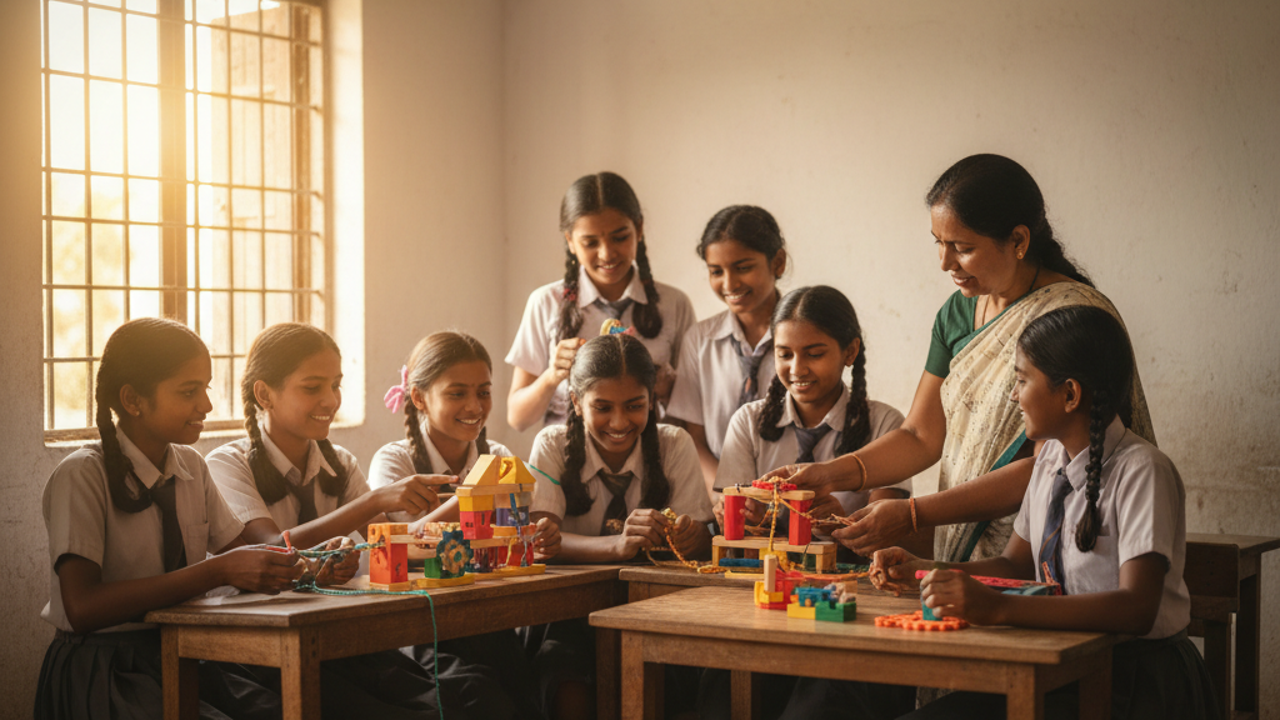
Screen-free coding for rural Indian schools is possible today. Next Skills 360 delivers hands-on coding through patented cardboard command blocks that need no computer lab, and pairs it with the ProGame SEL Module — story-based social-emotional learning covering 50-plus themes — requiring minimal teacher training and no per-child device.
Most rural Indian schools want to prepare students for a digital future — but lack the computer labs to start. Next Skills 360 was founded precisely on that finding: the schools that needed digital education most had no computers, so the lesson was redesigned to need none. Today, screen-free coding paired with structured social-emotional learning is reaching students across 15 Indian states.
Why Rural Schools Struggle to Deliver Coding Under NEP 2020
India operates one of the largest school education systems in the world, with 14.7 lakh schools and 24.8 crore students, according to UDISE+ 2024-25. Yet according to UDISE+ 2023-24, only 57% of India's schools have working computers and only 54% have internet connectivity. That means nearly half of all schools cannot access device-dependent coding programmes — precisely the schools that serve the most underserved communities.
The National Education Policy 2020 mandates computational thinking and coding from Class 6 onwards, and CBSE's Computational Thinking and AI curriculum now runs from Class 3 to Class 10. Yet most EdTech solutions in the market assume a device-per-child model that rural and semi-urban schools simply cannot afford. Without reliable labs, trained IT teachers, or stable connectivity, well-intentioned digital mandates stall at the school gate. The infrastructure gap is not a temporary obstacle — it requires a fundamentally different approach to coding without computers in India.
What Screen-Free Coding Actually Means in Practice
The ProGame Kit from Next Skills 360 reframes the problem entirely. Instead of waiting for a computer lab, students arrange patented cardboard command blocks into programs on any flat surface — practising sequencing, loops, and conditionals through collaborative, hands-on activity. Only the teacher needs a device: the teacher scans the student-built program using an AI-enabled mobile app that plays it back as visual and audio output.
The accurate framing here is no computer lab, no IT teacher, no per-child device — not fully app-free, because the teacher's phone enables playback. Any classroom teacher can deliver ProGame Kit sessions after a one-day orientation, with no prior technology background required, according to Next Skills 360's own records. The kit can be deployed to 10,000-plus schools simultaneously with no server, lab, or device procurement bottleneck. For a closer look at what this means on the ground, our thinking on offline-first coding kits for rural schools sets out why this approach marks a new benchmark for accessibility.
Why Social-Emotional Learning Belongs Alongside Coding
NEP 2020's vision extends well beyond computational skills — it calls for holistic development that nurtures empathy, resilience, and responsible citizenship. Coding skills alone do not fulfil that mandate. The ProGame SEL Module (formerly known as Life Skills 360) addresses this directly.
Using story-based and activity-driven books, the ProGame SEL Module develops empathy, resilience, self-awareness, and responsible decision-making across 50-plus themes — including bullying, peer pressure, substance abuse, and personal safety. It is designed for self-reflection and independent use, meaning students engage meaningfully even without continuous teacher facilitation. Critically for rural settings, the module fits into a school's existing timetable and requires minimal teacher training, lowering the barrier to sustained delivery. This combination of coding logic and structured emotional development creates a genuinely rounded learning experience — one that aligns with what NEP 2020 envisions for every Indian child. Explore the full SEL curriculum for schools in India to understand how it maps to school timetables.
How Next Skills 360 Makes This Work at Scale
The ProGame Kit and ProGame SEL Module are not pilot experiments — they are proven at significant scale. According to Next Skills 360's own records, we have reached 240,000-plus students across 1,200-plus schools in 15 Indian states since our founding in 2020. Most of those students are in government and low-income private schools, with the largest single implementation being a district-wide rollout to 34,000 students in Telangana.
Our credibility extends internationally: Next Skills 360 has received 14 national and international recognitions, including selection as an MIT Solver, the AI for Humanity Prize from the McGovern Foundation, and the ElevatED Award from Dell Technologies India and MeitY. A case study titled Teaching Coding Without Computers is published and distributed via Harvard Business Publishing. Teacher preparation follows a structured two-day train-the-trainer model, ensuring that programme quality scales without deep technical expertise at the school level.
What Schools and CSR Partners Should Look for in 2026
When evaluating screen-free coding and SEL programmes, school principals, education department officers, and CSR managers should apply a clear checklist:
- NEP 2020 and CBSE alignment — does the programme meet the Computational Thinking and AI curriculum mandate from Class 3 upwards?
- No per-child device requirement — can it run in classrooms with zero or minimal hardware?
- Minimal teacher training — can any subject teacher deliver it after a short orientation?
- Proven outcomes at scale — does the provider have verified deployment data across diverse school contexts?
- Inclusive design — does the programme extend to learners with disabilities?
The ProGame Kit combined with the ProGame SEL Module meets every criterion. For schools seeking self-paced, home-and-library-friendly options, our broader catalogue includes ProGame SmarToy, a skills-in-a-box solution delivering coding, AI, and SEL without requiring continuous access to computers. For students with visual impairments, ProGame Tactile extends the same inclusive philosophy through an audio-first skilling programme.
Getting Started: Next Steps for Rural School Leaders
The path to implementation is straightforward. Begin by assessing your current infrastructure gap: how many functional computers does your school have, and how many students need coding and life-skills education? The ProGame Kit is designed for Classes 5 and above in government and low-resource schools, making it practical to start with upper primary grades and expand progressively.
Next, evaluate teacher readiness: with a one-day orientation for the ProGame Kit and minimal training for the ProGame SEL Module, most schools can begin within weeks of programme confirmation. For schools that cannot self-fund, CSR partnership routes are well established — Next Skills 360 works with over 80 partner organisations, including Infosys Foundation and Bharat Electronics Limited, on Skilling WITHOUT Computers projects. A school starts with a free demo, followed by a paid pilot. For context on EdTech solutions for low-resource schools, our approach offers one of the most deployment-ready models available in India today.
Frequently Asked Questions
Is screen-free coding aligned with the NEP 2020 and CBSE curriculum?
Yes. NEP 2020 mandates computational thinking and coding from Class 6, and CBSE's Computational Thinking and AI curriculum runs from Class 3 to Class 10. The ProGame Kit teaches sequencing, loops, and conditionals — core computational thinking skills — and is designed to align with these requirements, making it a practical fit for schools operating under both frameworks.
How much teacher training does the ProGame Kit require?
According to Next Skills 360's own records, any classroom teacher can deliver ProGame Kit sessions after a one-day orientation, with no prior technology background needed. The ProGame SEL Module similarly requires minimal teacher training, making the combined programme deliverable by existing school staff without specialist IT support — a significant advantage for rural and semi-urban schools with limited staffing.
Can the ProGame SEL Module be used independently from the coding kit?
The ProGame SEL Module is designed for self-reflection and independent use, and it fits into a school's existing curriculum. While it is often deployed alongside the ProGame Kit as part of a holistic programme, its story-based and activity-driven format means it can function as a standalone social-emotional learning resource covering 50-plus themes including bullying, peer pressure, and resilience.
How does Next Skills 360 support schools that cannot self-fund a programme?
Next Skills 360 works with over 80 partner organisations on CSR-funded implementations. Verified partners include Infosys Foundation and Bharat Electronics Limited on Skilling WITHOUT Computers projects. Schools that cannot pay can receive a Next Skills 360 programme through CSR funding routes. Schools begin with a free demo followed by a paid pilot, and CSR managers can request a customised programme quote directly from Next Skills 360.
Is the ProGame Kit suitable for students with disabilities?
The core ProGame Kit is designed for sighted students in government and low-resource schools. For students with visual impairments, Next Skills 360 offers ProGame Tactile — India's first audio-first skilling programme covering coding, AI literacy, social-emotional skills, financial literacy, and career guidance, working offline on any Android device for students in Classes 5 and above, according to Next Skills 360's own records.
Ready to bring screen-free coding and structured social-emotional learning to your school? Contact Next Skills 360 to request a ProGame SEL Module demo or get a customised programme quote for your school or CSR initiative.
Ready to bring screen-free coding and structured social-emotional learning to your school? Contact Next Skills 360 to request a ProGame SEL Module demo or get a customised programme quote for your school or CSR initiative.