


Teacher Upskilling Programs for Robotics and Coding in 2026
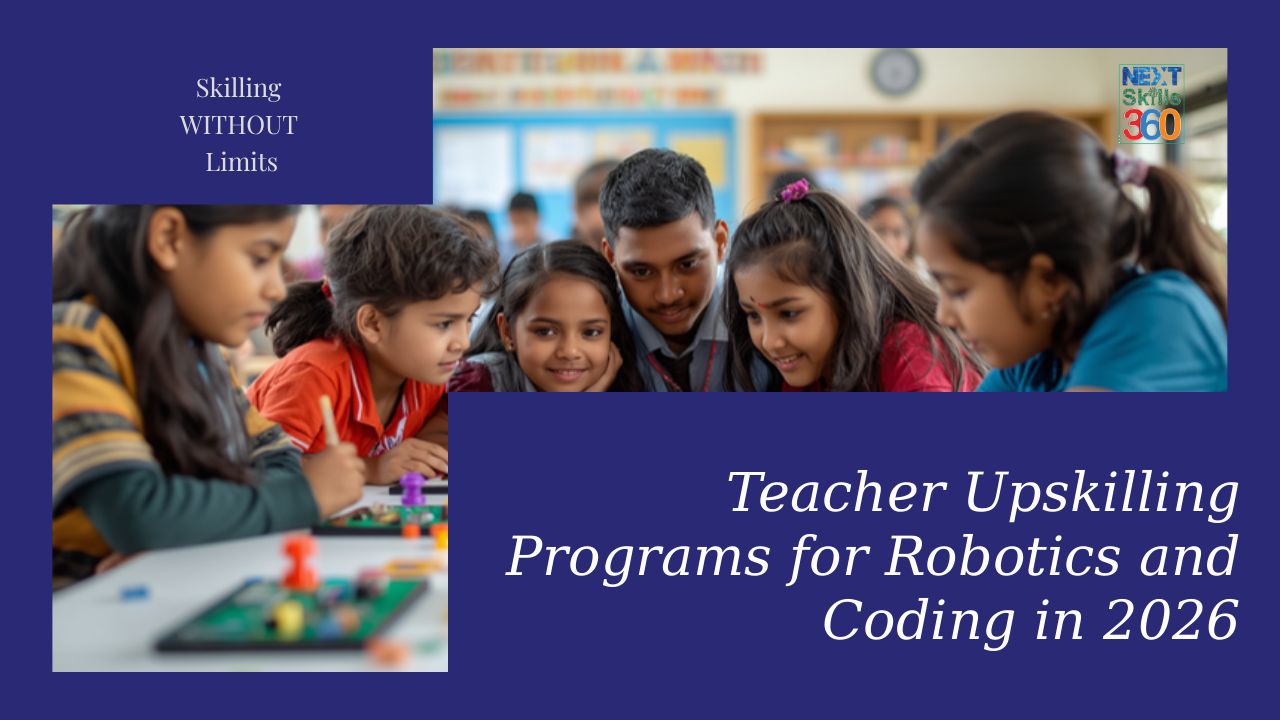
As CBSE mandates 100 hours per year of Computational Thinking and AI for Classes 6–8 from 2026-27, schools across India are racing to upskill their teachers — but most training programs were never designed with inclusion in mind. For the millions of students with visual impairments enrolled in special and mainstream schools, the gap between policy ambition and classroom reality remains wide. Teacher upskilling programs for robotics and coding must now evolve to equip educators who teach every learner, not just the mainstream majority.
Why Teacher Upskilling for Coding and Robotics Is Urgent in 2026
India's school education system is one of the largest in the world — 14.7 lakh schools serving 24.8 crore students (UDISE+ 2024-25). With CBSE's 2026-27 mandate now confirmed, Computational Thinking and AI education is no longer optional for Classes 6–8. Yet the urgency of this transition is colliding with a deeply uneven reality on the ground. Most existing teacher training programmes assume access to functioning computer labs, reliable internet, and sighted learners — conditions that simply do not hold across a significant share of Indian schools. Educators in special schools for the visually impaired, and IT department heads managing inclusive mainstream classrooms, have been largely left out of the upskilling conversation. Without inclusion-aware training, students with visual impairments risk being systematically excluded from the coding and AI education that their peers receive. In 2026, that is not just an equity failure — it is a policy failure. Addressing it begins with redesigning teacher upskilling from the ground up, with every learner in mind.
The Inclusion Gap in Most Robotics and Coding Training Programmes
Walk into any standard teacher training workshop for robotics or coding, and you will find curricula built entirely around sighted learners: visual block editors, screen-dependent activities, and interfaces that are inaccessible to learners who rely on screen readers or keyboard navigation. Special school teachers and inclusive IT department heads are being handed tools that simply do not work for their students. This gap is systemic, not incidental. Inclusive coding education for visually impaired students requires a fundamentally different pedagogical toolkit — one that most mainstream training providers have never developed. This is precisely where Next Skills 360 (NS360) has been building differently. Since 2020, NS360 has trained 10,000+ trainers and educators across India and has impacted 500+ students with disabilities through its dedicated inclusive skilling programmes — evidence that inclusion-aware educator training is not only possible, but scalable. Closing the inclusion gap in teacher upskilling starts by acknowledging that it exists, and then choosing solutions designed specifically to bridge it.
What Makes an Effective Inclusive Coding Upskilling Programme
Effective teacher upskilling for inclusive coding classrooms rests on four clear pillars. First, familiarity with assistive technology — educators need confidence navigating screen readers, keyboard-only interfaces, and audio-first learning environments. Second, hands-on experience with accessible block-based programming tools that work seamlessly with the assistive technology their students already use. Third, pedagogical strategies tailored to audio-first and tactile learners, including sequencing instruction without visual cues and providing audio-based feedback loops. Fourth — and critically — curriculum alignment from Class 5 upwards, ensuring that what teachers learn to deliver is directly relevant to their students' grade levels and learning goals. Here is something we find ourselves saying often: teachers do not need deep technical backgrounds to succeed. What they need is structured orientation, purpose-built tools, and the confidence that comes from practising on accessible platforms before entering the classroom. NS360's approach to educator upskilling is designed to lower every one of these barriers, making inclusion-ready coding instruction achievable for any motivated teacher.
ProGame Tactile Plus: The Tool That Makes Teacher Upskilling Stick
At the centre of NS360's accessible coding education offer is ProGame Tactile Plus — a browser-based, block-based programming environment built specifically for students with visual impairments. Designed for accessible navigation with assistive technology and suitable for Classes 5 and above, ProGame Tactile Plus gives teachers a purpose-built platform rather than a retrofitted mainstream tool. This distinction matters enormously. When educators are trained on a tool designed from the ground up for accessibility — rather than one patched to be "screen-reader compatible" after the fact — their confidence in the classroom increases dramatically. They know the platform behaves predictably with assistive technology. They understand its logic. They can troubleshoot with their students rather than stumbling alongside them. ProGame Tactile Plus's browser-based architecture removes procurement bottlenecks entirely: no lab installation, no device purchasing cycle, no IT administrator dependency. Combined with NS360's deployment across 1,200+ schools in 15 Indian states, this is inclusive coding upskilling that has already demonstrated scalability at the ground level.
How Schools and State Education Departments Can Implement These Programmes
For IT/CS Department Heads in inclusive mainstream schools and Samagra Shiksha Inclusion Cell officers, the implementation pathway is practical and sequenced. Begin with a straightforward needs assessment: how many students with visual impairments are currently enrolled, and which teachers are responsible for their technology education? Identify two or three champion teachers for initial orientation — educators who will build internal expertise and model inclusive coding instruction for colleagues. Next, procure accessible tools aligned to your learners' grade levels. ProGame Tactile Plus is purpose-built for this context and integrates readily into existing school timetables from Class 5 onwards. Schedule structured upskilling sessions that combine platform familiarisation with classroom pedagogy. NS360's credibility in this space is well established — recognised by MIT Solve, the ElevatED Award from Dell Technologies India and MeitY, and 14 national and international honours in total. Schools and state departments can connect directly through nextskills360.in, where NS360's Hyderabad-headquartered team is ready to support implementation at both school and state scale.
Building a Future-Ready, Inclusive Coding Culture in Your School
Teacher upskilling is not a one-time workshop — it is the foundation of an ongoing culture of inclusive, future-ready education. Schools that invest in inclusion-aware robotics and coding training today will not only meet CBSE's 2026-27 mandates more confidently; they will be better aligned with the broader vision of NEP 2020, which places equitable access to computational thinking at the heart of school education reform. Tools like ProGame Tactile Plus, paired with structured educator training and institutional commitment, allow special schools and inclusive mainstream schools to deliver meaningful, standards-aligned coding education to every student — regardless of visual ability. No student has to sit out the lesson while their peers code. No teacher has to improvise with tools built for a different classroom. Truly future-ready skilling means every child has a pathway. When schools get teacher upskilling right — when they choose inclusive coding education for visually impaired students as a deliberate priority rather than an afterthought — they create classrooms where the promise of coding education belongs to everyone.
Ready to build an inclusive coding programme your teachers can confidently deliver? Explore ProGame Tactile Plus and NS360's teacher upskilling resources for special and inclusive schools — visit nextskills360.in or reach out to the NS360 team today to schedule a demo for your school or state education department.
Ready to build an inclusive coding programme your teachers can confidently deliver? Explore ProGame Tactile Plus and NS360's teacher upskilling resources for special and inclusive schools — visit nextskills360.in or reach out to the NS360 team today to schedule a demo for your school or state education department.