


How Can a CSR Foundation Measure Outcomes of an AI Literacy Programme
Quick answer
Learn how a CSR foundation can measure outcomes of an AI literacy programme using activity hours, student reach, curriculum mapping, and ESG-reportable indicators from Next Skills 360.
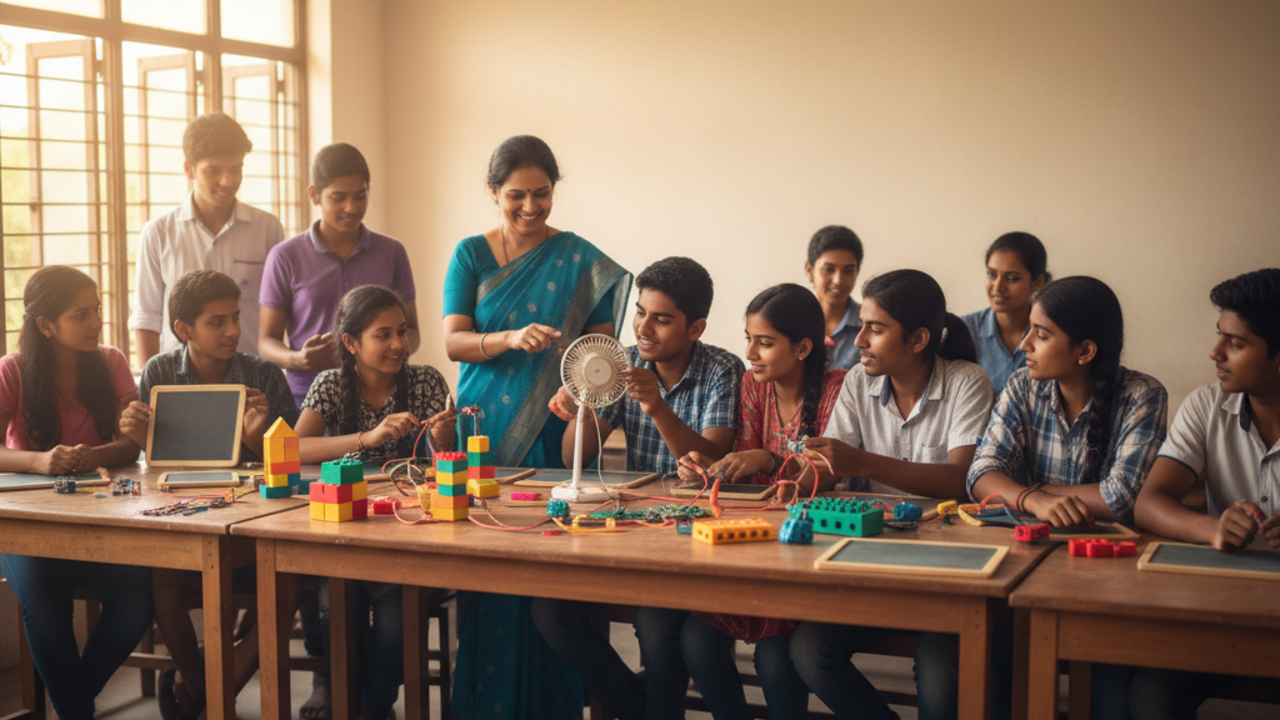
A CSR foundation can measure outcomes of an AI literacy programme by tracking six auditable indicators: student reach by grade and gender, structured learning hours per class, curriculum alignment to a recognised standard, teacher training milestones, geographic deployment, and baseline-to-endline assessment scores. Choosing a programme with built-in reporting infrastructure — such as Next Skills 360's ProGame AI Module — makes every indicator board-ready from day one.
Corporate foundations investing in school AI literacy face one consistent challenge: how do you prove it worked? Funders, board ESG committees, and government partners all require numbers — not intentions. This guide breaks down exactly which indicators matter, how to collect them, and how a structured programme like Next Skills 360's ProGame AI Module makes measurement straightforward from day one.
Why Outcome Measurement Is Non-Negotiable for AI Literacy CSR Projects
India's regulatory environment is tightening around CSR accountability. SEBI's Business Responsibility and Sustainability Report framework, Ministry of Corporate Affairs Schedule VII compliance, and internal board ESG committees all demand evidence that spending produced change — not merely activity. Yet many foundations still report outputs: kits distributed, students enrolled, schools visited. These numbers satisfy procurement records, not impact audits.
Outputs tell you what was delivered. Outcomes tell you what changed. For AI literacy, that distinction matters enormously. AI is an emerging domain in Indian school education; CBSE's Computational Thinking and AI curriculum now runs from Class 3 to Class 10. Funders cannot defend budget allocations to board committees without a framework that links spend to measurable competency gain.
Selecting a programme with built-in metrics — structured hours, assessments, and training records — is therefore a governance decision as much as a pedagogical one. The right programme makes your ESG report defensible before a single session begins.
The Six ESG-Reportable Indicators Every AI Literacy Programme Should Track
A practical indicator framework gives CSR managers language they can lift directly into BRSR filings and impact reports.
1. Student reach — total students completing the programme, disaggregated by grade, gender, and school type (government, aided, private).
2. Structured learning hours — activity hours delivered per class per year. Next Skills 360's ProGame AI Module delivers 30 to 50 hours per class per year, according to Next Skills 360's own records — a concrete, loggable benchmark.
3. Curriculum alignment — confirmation that content maps to CBSE Computational Thinking and AI standards, satisfying NEP 2020 compliance questions from school principals.
4. Teacher training — number of educators trained and duration. Next Skills 360 prepares teachers through a two-day training for ProGame AI Module, adding a workforce-development indicator.
5. Geographic spread — schools and states covered. Next Skills 360 has been deployed in 1,200-plus schools across 15 Indian states, according to Next Skills 360's own records.
6. Baseline and endline assessments — pre- and post-programme scores that demonstrate knowledge gain. Each indicator must be auditable and traceable to source records for third-party verification.
How ProGame AI Module Is Designed for Measurable CSR Deployment
The ProGame AI Module is an add-on kit that teaches AI fundamentals through games and analogies — covering data, patterns, decision-making, face recognition, image recognition, and object detection — making AI concepts accessible without device dependency, according to Next Skills 360's own records. This matters for CSR deployment: nearly half of India's schools lack working computers or reliable internet, according to UDISE+ 2023-24. A programme that requires no lab removes the single largest infrastructure barrier to scale.
The module is built for Classes 3 to 10 and mapped to the CBSE Computational Thinking and AI curriculum. It delivers 30 to 50 activity hours per class per year, each of which can be logged as a reportable output for ESG documentation. Only the teacher's phone is needed in the classroom; students learn through hands-on activities.
Teachers are prepared through a two-day training by Next Skills 360, adding an educator-upskilling indicator to your impact narrative. The programme works in both low-resource and well-equipped classrooms and extends into guided learning at home, broadening measurable reach beyond school hours. Explore more at the AI Module for Schools India | ProGame AI | Next Skills 360 resource hub.
Including Disability-Inclusive AI Literacy in Your CSR Impact Report
Disability inclusion transforms a standard education CSR project into a high-visibility ESG story — one that speaks directly to SEBI BRSR indicators on marginalised communities and the Rights of Persons with Disabilities Act, 2016.
We have impacted 500-plus students with disabilities since 2020 through our inclusive skilling programmes, according to Next Skills 360's own records. For CSR managers seeking an inclusive AI literacy layer, ProGame Tactile — our audio-first programme for students with visual impairments — covers AI literacy as part of its five-domain learning journey, which also includes computational thinking and coding, social-emotional skills, financial literacy, and career guidance.
Disability-inclusion indicators now increasingly appear in ESG disclosures: number of students with disabilities reached, accessible learning hours delivered, and assistive-technology integration are all reportable. Including even one inclusive skilling cohort alongside a mainstream AI literacy rollout substantially elevates the ESG profile of a CSR initiative and signals genuine commitment to equity — not tokenism.
ProGame AI Module remains the primary hero solution; inclusive skilling represents an additive layer that widens your impact story without complicating programme management.
Building Your Measurement Framework: A Step-by-Step Checklist for CSR Managers
Before signing a programme agreement, work through this checklist:
1. Define the target population — grade range, school type (government or private), urban or rural geography, and any disability-inclusion goals.
2. Confirm curriculum alignment — verify the solution maps to CBSE Computational Thinking and AI standards or the relevant state board framework.
3. Agree on activity-hour commitments in the MOU — for example, 30 to 50 hours per class per year for ProGame AI Module.
4. Establish a baseline assessment protocol — administer pre-programme assessments before the first session so endline gains are attributable to the intervention.
5. Set teacher training milestones — confirm teacher count and confirm the two-day training schedule with Next Skills 360.
6. Agree on data reporting cadence — monthly or quarterly school-level reports with student completion data.
7. Plan endline assessment and third-party verification if required for board-level ESG reporting.
8. Document geographic deployment for state-level and national reporting.
Next Skills 360 prices every programme for a CSR partner by quote, according to Next Skills 360's own records, allowing custom scope alignment to budget and reporting requirements. For schools in government systems, the ProGame Coding Kit for Government Schools page outlines deployment contexts relevant to CSR-funded public-school rollouts.
Recognitions That Give CSR Boards Confidence in Next Skills 360
Investment committees always ask the same question before approving an EdTech CSR partner: has this organisation been independently validated?
Next Skills 360 has received 14 national and international recognitions, according to award certificates and public announcements, including: MIT Solver, the AI for Humanity Prize from the McGovern Foundation, the Innovation for Women Prize from the Vodafone Americas Foundation, the ElevatED Award from Dell Technologies India and MeitY, the Best Indian Social Enterprise Award in Education from the AFI Forum, Top Three Finalists at the NASSCOM Foundation Awards, and the SKOCH Award for the Telangana Early Coders project, among others.
Infosys Foundation has partnered with Next Skills 360 on a Skilling WITHOUT Computers project, according to Infosys Foundation partnership documentation — institutional CSR trust from one of India's most scrutinised foundations. Next Skills 360 has also been recognised as a DPIIT-recognised startup under Startup India, according to Next Skills 360's own records.
Frequently Asked Questions
What ESG-reportable indicators should a CSR foundation capture for an AI literacy programme?
The six core indicators are: student reach disaggregated by grade and gender, structured learning hours per class per year, curriculum alignment to a recognised standard such as CBSE's Computational Thinking and AI framework, number of teachers trained, geographic spread by school and state, and baseline-to-endline assessment scores demonstrating knowledge gain. Each must be auditable and traceable to source records.
How many learning hours does ProGame AI Module deliver per class per year?
ProGame AI Module delivers 30 to 50 activity hours per class per year, according to Next Skills 360's own records. Each hour is a loggable, reportable output suitable for inclusion in ESG disclosures and Ministry of Corporate Affairs Schedule VII compliance documentation.
Does ProGame AI Module work in government schools without computer labs?
Yes. ProGame AI Module requires only the teacher's phone in the classroom; students learn through hands-on activities. This makes it deployable across government and low-resource schools — precisely the contexts where CSR funding has the highest impact.
How does including students with disabilities strengthen a CSR AI literacy impact report?
Disability-inclusion indicators — such as number of students with disabilities reached and accessible learning hours delivered — are increasingly required in SEBI BRSR filings. Next Skills 360 has impacted 500-plus students with disabilities through its inclusive skilling programmes, according to Next Skills 360's own records, and offers ProGame Tactile as an audio-first AI literacy pathway for students with visual impairments.
How does Next Skills 360 support CSR reporting documentation?
Next Skills 360 provides custom deployment proposals for CSR partners, including student reach projections, activity-hour commitments, and reporting templates designed for CSR impact documentation, according to Next Skills 360's own records. Programmes are priced by quote, allowing scope alignment to available budget and board-mandated reporting requirements.
Ready to build a measurable AI literacy programme your ESG report can stand behind? Contact Next Skills 360 to get a custom deployment proposal for ProGame AI Module — including student reach projections, activity-hour commitments, and reporting templates designed for CSR impact documentation.
Ready to build a measurable AI literacy programme your ESG report can stand behind? Contact Next Skills 360 to get a custom deployment proposal for ProGame AI Module — including student reach projections, activity-hour commitments, and reporting templates designed for CSR impact documentation.