


Inclusive Coding Curriculum for Government Schools India 2026
Quick answer
An inclusive coding curriculum for government schools in India must work without reliable computers or internet. Next Skills 360's ProGame AI Module is built for Classes 3 to 10, mapped to the CBSE Computational Thinking and AI curriculum, and delivers 30 to 50 activity hours per class per year in both low-resource and well-equipped classrooms.
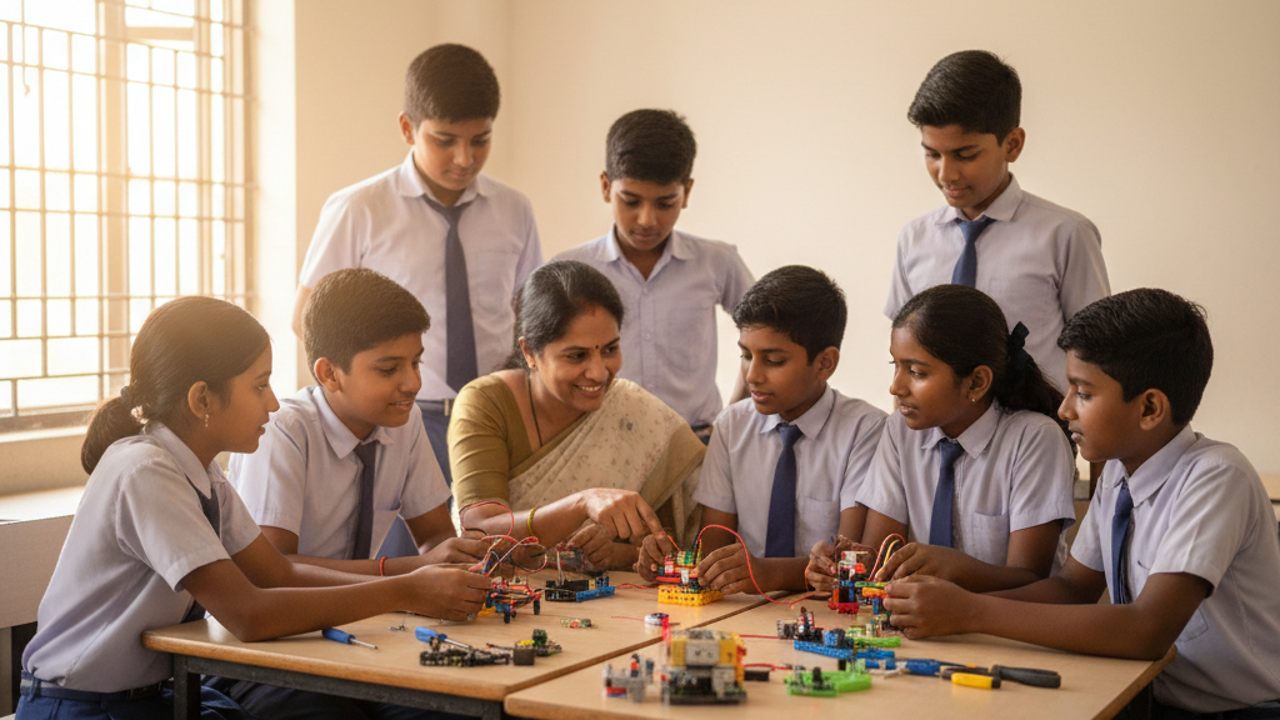
An inclusive coding curriculum for government schools in India must work without reliable computers or internet. Next Skills 360's ProGame AI Module is built for Classes 3 to 10, mapped to the CBSE Computational Thinking and AI curriculum, and delivers 30 to 50 activity hours per class per year in both low-resource and well-equipped classrooms.
Only 57% of India's schools have working computers and only 54% have internet connectivity, according to UDISE+ 2023-24 — yet NEP 2020 mandates computational thinking and AI learning for every child. Building a truly inclusive coding curriculum for government schools in India means designing for the classrooms that have the least, not the most. That is exactly the challenge Next Skills 360 set out to solve.
Why Government Schools Need a Device-Light AI Curriculum
According to UDISE+ 2023-24, only 57% of India's schools have working computers and only 54% have internet connectivity. That structural gap means any coding programme built around a computer lab or broadband connection excludes nearly half of all schools before a single lesson is taught. The problem is one of infrastructure inequality, not student capability.
NEP 2020 mandates computational thinking and coding education from Class 6 onwards, and according to CBSE's curriculum guidelines, the Computational Thinking and AI curriculum now runs from Class 3 to Class 10. Yet policy intent cannot translate into classroom reality if the solution requires infrastructure that most government schools simply do not have.
The answer is not to lower ambition — it is to redesign delivery. A device-light AI curriculum reaches every classroom precisely because it is built around activity, not equipment. That design principle is the foundation of NEP 2020-aligned AI learning that works in every school.
What 'Inclusive' Really Means in a Coding Curriculum
True inclusivity in a coding curriculum operates across two dimensions at once. The first is infrastructure inclusivity: the programme must work without a computer lab, a trained IT teacher, or a device for every student. The second is learner inclusivity: the programme must reach students with disabilities alongside mainstream learners, so that no child is left out by circumstance or ability.
Next Skills 360 addresses both. ProGame Tactile is India's first audio-first skilling super app for students with visual impairments — fully screen-reader friendly, with no reliance on sight, covering computational thinking and coding, AI literacy, social-emotional skills, financial literacy, and career guidance in a single structured journey. ProGame Signify, currently in development by Next Skills 360, is designed with Indian Sign Language integrated throughout to serve students with speech and hearing impairments through visual, gesture-based learning.
Using person-first language is not simply a style choice — it reflects the design philosophy: students with visual impairments, students with speech and hearing impairments, and students from under-resourced schools all deserve a curriculum built for them. For a fuller picture of inclusive coding education and what schools need in 2026, the approach begins with designing for those who have the least.
ProGame AI Module: AI Learning That Travels to Every Classroom
The ProGame AI Module is Next Skills 360's activity-based, self-guided add-on that introduces AI fundamentals through games and analogies — covering data, pattern recognition, decision-making, face recognition, image recognition, and object detection — making AI concepts accessible without device dependency. The ProGame AI Module is built for Classes 3 to 10 and mapped to the CBSE Computational Thinking and AI curriculum, providing 30 to 50 hours of activities per class per year.
What makes it practical is this: the ProGame AI Module needs only the teacher's phone in the classroom, while students learn through hands-on activities. It works equally well in low-resource and well-equipped classrooms, and it extends into guided learning at home. Teachers are prepared to deliver it through a two-day training by Next Skills 360 — no prior AI expertise required.
Next Skills 360 has already deployed the ProGame AI Module as an add-on to ProGame schools across its 15 states. For programme officers building an AI module for CBSE schools that actually works in 2026, this is the layer that makes AI learning portable, affordable, and immediately deployable.
How Government School Programmes Are Built for Scale
Scalability for a state or district rollout demands structural design choices, not just good content. Next Skills 360's ProGame Kit operates with zero device dependency — no computers, internet, or electricity required for core activities. Only the teacher needs a device: students arrange patented cardboard command blocks into a programme, and the teacher scans it with an AI-enabled mobile app. Next Skills 360 reports that ProGame Kit can be deployed to 10,000+ schools simultaneously with no server, lab, or device procurement bottleneck.
Any classroom teacher can deliver ProGame Kit sessions after a one-day orientation, with no prior tech background required. This directly supports Samagra Shiksha — the Government of India's integrated scheme for school education from pre-school to Class XII — as the natural implementation and funding channel.
Most of the 240,000+ students Next Skills 360 has reached since 2020 are in government and low-income private schools. The model's credibility extends beyond NS360's own records: a Harvard Business Publishing case study titled "Teaching Coding Without Computers" (case W37092) independently documents the approach.
Outcomes and Recognition That Back the Approach
Independent recognition strengthens the case for any procurement decision. Next Skills 360 has received 14 international and national recognitions, including MIT Solver, the AI for Humanity Prize from the McGovern Foundation, the ElevatED Award from Dell Technologies India and MeitY, the SKOCH Award for the Telangana Early Coders project, and a Top Three Finalist position at the NASSCOM Foundation Awards.
On inclusion impact, Next Skills 360's inclusive skilling programmes have benefited 500+ students with disabilities since 2020. Learning outcome data from ProGame Tactile's first programme year — July 2025 to June 2026, across four schools for the blind in Pune — shows average assessment scores rising from 56.76% to 77.25% in knowledge of computers, and from 39.96% to 58.30% in coding. These gains, documented in Next Skills 360's ProGame Tactile programme annual report, demonstrate that activity-based, inclusive design produces measurable results — even in the most under-resourced settings.
For context on how inclusive design creates these outcomes, see Next Skills 360's perspective on NEP 2026 and inclusive coding for students.
Choosing the Right Solution for Your School or District
The right starting point depends on your school's infrastructure and learner profile. Here is a brief decision guide:
- No computer lab, no devices: Deploy ProGame Kit + ProGame AI Module. Next Skills 360's ProGame Kit requires no computers, internet, or electricity for core activities, and the AI Module adds structured AI learning with only a teacher's phone.
- Learners who are students with visual impairments: ProGame Tactile is India's first audio-first skilling super app for students with visual impairments, covering coding, AI, social-emotional skills, financial literacy, and career guidance across Classes 5 and above.
- School has a computer lab: Skills Buddy is a skilling platform used on computers, with coding, AI, and social-emotional skills modules for students in Class 4 and above, mapped to NEP 2020 and the CBSE Computational Thinking and AI curriculum.
- Goal is a full robotics and AI lab: xSTREAM Labs is a complete robotics and AI package — hardware, software, a Classes 6–12 curriculum, and teacher training — so a school's lab is active from week one.
Across all these pathways, the ProGame AI Module is the foundational AI layer that works at every infrastructure level — making it the natural first step for any government school or district building an inclusive coding curriculum for every student.
Frequently Asked Questions
What is an inclusive coding curriculum for government schools in India?
An inclusive coding curriculum for government schools in India is one that works without computer labs, internet connectivity, or per-child devices — and that is designed to reach all learners, including students with disabilities. Next Skills 360's ProGame AI Module, for example, requires only the teacher's phone, is mapped to the CBSE Computational Thinking and AI curriculum, and is built for Classes 3 to 10.
How does the ProGame AI Module deliver AI learning without computers?
Next Skills 360's ProGame AI Module introduces AI through activity-based, self-guided experiences — covering data, patterns, decision-making, face recognition, image recognition, and object detection — using games and analogies rather than software. Students learn through hands-on activities; only the teacher's phone is needed in the classroom. Teachers are prepared through a two-day training with no prior AI expertise required.
Is the ProGame AI Module aligned with NEP 2020 and CBSE requirements?
Yes. Next Skills 360's ProGame AI Module is built for Classes 3 to 10 and mapped to the CBSE Computational Thinking and AI curriculum. According to CBSE's curriculum guidelines, Computational Thinking and AI is now a curricular area from Class 3 to Class 10, and NEP 2020 mandates computational thinking from Class 6 onwards. The ProGame AI Module delivers 30 to 50 activity hours per class per year.
Can ProGame AI Module be scaled across an entire district or state?
Next Skills 360 reports that the ProGame Kit — the platform on which the AI Module is built — can be deployed to 10,000+ schools simultaneously with no server, lab, or device procurement bottleneck. Next Skills 360 has already reached 240,000+ students across 1,200+ schools in 15 states since 2020, with most learners in government and low-income private schools.
How does Next Skills 360 support students with disabilities in government schools?
Next Skills 360's inclusive skilling programmes have benefited 500+ students with disabilities since 2020. ProGame Tactile is India's first audio-first skilling super app for students with visual impairments, working offline on any Android device with no reliance on sight. Next Skills 360 also runs a programme with Samarthanam that serves sighted students from low-income families, students with visual impairments, and students with speech and hearing impairments together in one cohort.
Ready to bring an inclusive AI and coding curriculum to your government school or district? Download the ProGame AI Module brochure or request a free pilot demo at nextskills360.in — and let every student, in every classroom, start learning AI this year.
Ready to bring an inclusive AI and coding curriculum to your government school or district? Download the ProGame AI Module brochure or request a free pilot demo at nextskills360.in — and let every student, in every classroom, start learning AI this year.