


Inclusive STEM Education for Special Needs Students in India
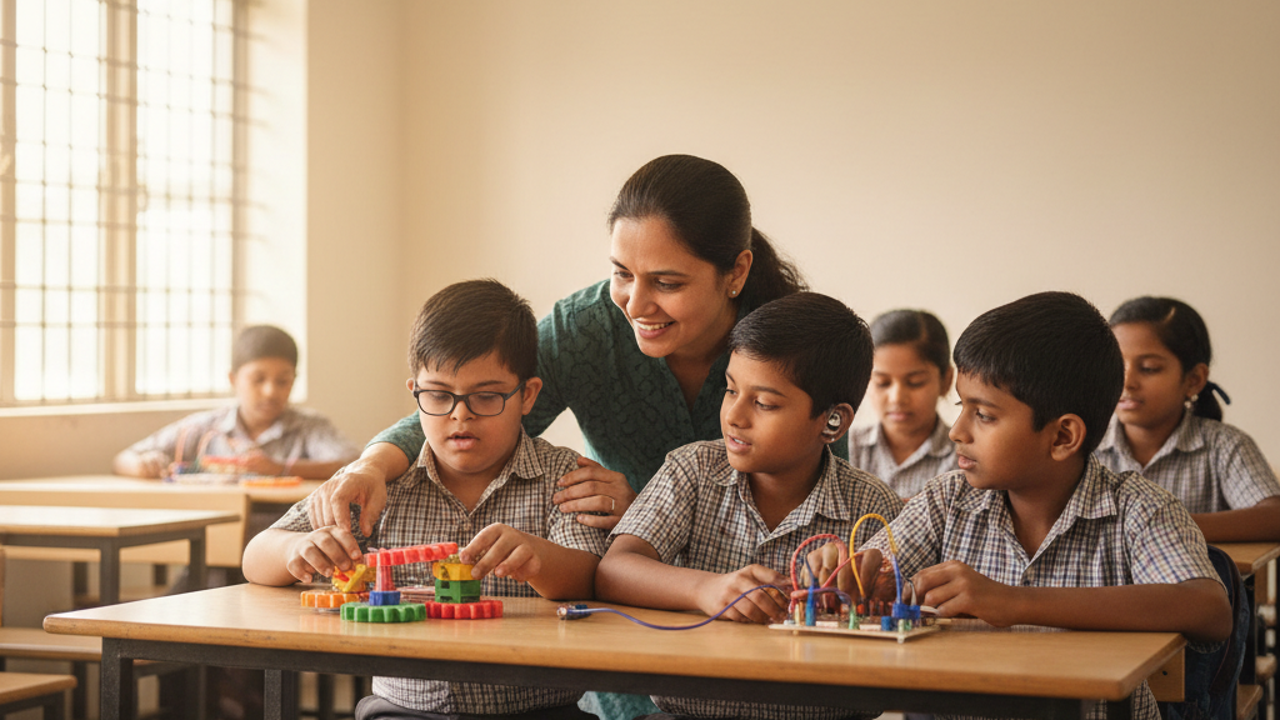
For millions of students with visual impairments across India, STEM education has long meant navigating a world designed entirely around sight — inaccessible interfaces, screen-locked content, and digital tools that simply were not built for them. Inclusive STEM education for special needs students is no longer a distant ideal; it is a measurable programme reality. ProGame Tactile, India's first audio-first skilling super app for students with visual impairments, is changing what is possible inside special schools and inclusion classrooms today.
Why Inclusive STEM Education for Special Needs Students Remains a Systemic Gap in India
India operates one of the largest school education systems in the world, with 14.7 lakh schools and 24.8 crore students (UDISE+ 2024-25). Yet for students with visual impairments, the rapid digitisation of learning has often deepened exclusion rather than reduced it. Most EdTech products are built around visual interfaces — drag-and-drop editors, colour-coded blocks, screen-dependent navigation — making STEM subjects structurally inaccessible by design. This gap is now a policy urgency. NEP 2020 mandates computational thinking and coding from Class 6 onwards, and CBSE has mandated 100 hours per year of Computational Thinking and AI for Classes 6–8 from academic year 2026-27. That mandate must extend to every learner. Students with visual impairments in special schools and inclusion classrooms cannot be treated as an afterthought when national policy explicitly frames coding and AI literacy as foundational skills for all. The infrastructure to include them must be built deliberately — and it must be built now.
What Audio-First Learning Actually Means — and Why It Matters
There is an important distinction between an app that is compatible with a screen reader and one that is built audio-first from the ground up. Most accessibility features in mainstream EdTech are retrofitted — menus that partially read aloud, instructions buried in visual layouts, feedback that requires a sighted prompt to interpret. ProGame Tactile is different in design philosophy: every element of navigation, every coding prompt, and every piece of feedback is delivered through audio, with zero reliance on sight at any point. The app includes 40+ audio lessons, 20+ guided activities, and technology podcasts, with native-language audio tutorials ensuring language is never an additional barrier. Crucially, it works offline on any Android device, so unreliable internet connectivity — still a reality in many special schools across India — does not exclude students further. For buyers evaluating an audio-first learning app for visually impaired students, ProGame Tactile sets the benchmark: not adapted for accessibility, but built for it from the first line of design.
Five Domains, One Journey: How ProGame Tactile Goes Beyond Coding
ProGame Tactile is described accurately as a skilling super app, not a single-subject coding tool — and that distinction matters enormously for special schools seeking a holistic programme rather than a collection of disconnected applications. The app delivers five domains within a single structured journey: computational thinking and coding (progressing through to career-ready Python via Tactile Pro), AI literacy, social-emotional skills, financial literacy, and career guidance. This breadth means a school can address employability, wellbeing, and digital literacy simultaneously, without stitching together multiple vendors or platforms. At the heart of the coding experience is a first-of-its-kind accessible Code Editor — allowing students with visual impairments to write, run, and share their own programmes entirely through audio. The results speak for themselves: over 70% of ProGame Tactile students independently create and share their own programmes. For a skilling programme for students with visual impairments, that level of independent creation is a meaningful measure of genuine inclusion.
The Lifetime Document Repository: Replacing WhatsApp for Students with Visual Impairments
One of ProGame Tactile's most distinctive — and most underappreciated — features is its Lifetime Document Repository, and understanding it requires acknowledging a problem that is hiding in plain sight. Today, the primary way study material reaches students with visual impairments in many schools is through WhatsApp. Files are sent into group threads, buried under scrolling conversation, completely unnavigable by screen reader, and permanently lost when a student changes their phone. It is a workflow that was never designed for accessibility, yet it has become the default. ProGame Tactile's Lifetime Document Repository allows teachers to upload material for any subject — or students to upload their own — with every file permanently stored and fully navigable by screen reader. There are no threads to scroll, no lost attachments, no dependence on a specific device. This makes the app genuinely useful across every subject, not only within the skilling curriculum. For school principals and Samagra Shiksha Inclusion Cell officers evaluating daily utility, this single feature transforms ProGame Tactile from a curriculum programme into essential school infrastructure.
A Structured 3-Year Programme, Not a Licence Drop
For procurement-minded buyers — whether a school principal, a state department officer, or a CSR programme manager — the delivery model matters as much as the product itself. ProGame Tactile is not a licence that arrives and sits unused. It is a structured 3-year programme with defined learning outcomes at every stage. Year 1 delivers Coding Level 1 alongside social-emotional skills. Year 2 builds to Coding Level 2 paired with foundational AI literacy. Year 3 advances to Coding Level 3, financial literacy, and career guidance — with six months of structured learning delivered each year. Every programme includes student licences, train-the-trainer workshops, a teacher LMS, a real-time analytics dashboard, Android smartphones placed in schools for shared access, career-guidance sessions featuring role models who are blind, a closing coding hackathon, and baseline and endline assessments with weekly teacher engagement. NS360 has impacted 500+ students with disabilities since 2020 and trained 10,000+ educators and trainers across India — a programme track record that procurement teams can rely on.
How Schools, State Departments, and CSR Partners Can Get Started in 2026
For special schools, ProGame Tactile is designed for deployment without complex infrastructure. The teacher LMS, train-the-trainer workshops, and native-language audio tutorials mean that educators without a technology background can deliver structured sessions from the first month. Android smartphones are placed directly in schools as part of the programme, removing the device procurement barrier entirely. For State Education Departments and Samagra Shiksha Inclusion Cells, ProGame Tactile's real-time analytics dashboard provides programme-level visibility across schools, directly supporting NEP 2020 inclusion mandates and CBSE's 2026-27 computational thinking requirements. The structured 3-year model and standardised assessments make state-level reporting straightforward. For CSR and disability-focused foundations, NS360 brings a credibility record that is independently verified: 14 national and international recognitions, including selection as an MIT Solver, the AI for Humanity Prize from the McGovern Foundation, and the ElevatED Award from Dell Technologies India and MeitY. A case study on Next Skills 360 — "Teaching Coding Without Computers" — is published and distributed through Harvard Business Publishing. This is a partner with demonstrated impact, recognised globally and proven on the ground.
If your school, department, or foundation is committed to making STEM education genuinely accessible for students with visual impairments, we would welcome a conversation. Visit nextskills360.in or reach out to the NS360 team to schedule a ProGame Tactile demo and explore a pilot for the 2026-27 academic year.
If your school, department, or foundation is committed to making STEM education genuinely accessible for students with visual impairments, we would welcome a conversation. Visit nextskills360.in or reach out to the NS360 team to schedule a ProGame Tactile demo and explore a pilot for the 2026-27 academic year.